 |
PDBsum entry 1zds

|
|
|
|
|
|

|

|

|

|
|

|
|

|
|

|
|

|
|

|
|

|
|

|
|
|
 |

|

|
|
|
|
|
|
|
|
|
|
|
|
|
|
|
|
|
|
|
|
|
|
|
|
|
|
|
|
|
|
|
|
|
|
|
|
Oxidoreductase
|
PDB id
|
|
|
|
1zds
|
|
|
|
|
|
|
|
|
|
|
|
|
|
|

|

|

|
|
|
|
|
|
|
|
 |
Contents |
 |
|
|
|
|
|
|
|
|
|
|
|
|
|
|
* Residue conservation analysis
|
|
|
|
|
|
PDB id:
|
|
|
|
| Name: |
|
Oxidoreductase
|
|
|
Title:
|
|
Crystal structure of met150gly afnir with acetamide bound
|
|
Structure:
|
|
Copper-containing nitrite reductase. Chain: a, b, c. Synonym: cu-nir. Engineered: yes. Mutation: yes
|
|
Source:
|
|
Alcaligenes faecalis. Organism_taxid: 511. Gene: nirk, nir
|
|
Biol. unit:
|
|
Trimer (from
)
|
|
Resolution:
|
|
|
1.55Å
|
R-factor:
|
0.183
|
R-free:
|
0.214
|
|
|
Authors:
|
|
H.J.Wijma,I.S.Macpherson,M.Alexandre,R.E.M.Diederix,G.W.Canters, M.E.P.Murphy,M.P.Verbeet
|
Key ref:

|
|
H.J.Wijma
et al.
(2006).
A rearranging ligand enables allosteric control of catalytic activity in copper-containing nitrite reductase.
J Mol Biol,
358,
1081-1093.
PubMed id:
DOI:

|
|
|
Date:
|
|
|
14-Apr-05
|
Release date:
|
28-Mar-06
|
|
|
|
|
|
|
PROCHECK
|

|
|
|
|
|
Headers
|
|
|
|
References
|
|
|
|
|
|

|
|
P38501
(NIR_ALCFA) -
Copper-containing nitrite reductase from Alcaligenes faecalis
|
|
|
|
Seq:
Struc:
|
|
|
|
376 a.a.
335 a.a.*
|
|

|

|

|
|
|
|
|
|
|
|
|
|
|
Key: |
 |
PfamA domain |
|
|
 |
Secondary structure |
|
 |
CATH domain |
|
|
*
PDB and UniProt seqs differ
at 1 residue position (black
cross)
|
|
|
|
|
|
|
|
|
|
|
|
|
Enzyme class:
|
|
E.C.1.7.2.1
- nitrite reductase (NO-forming).
|
|
|
|
|
|
|
Reaction:
|
|
nitric oxide + Fe(III)-[cytochrome c] + H2O = Fe(II)-[cytochrome c] + nitrite + 2 H+
|
|
|
|
|
|
 nitric oxide
|
+
|
Fe(III)-[cytochrome c]
|
+
|
H2O
|
=
|
Fe(II)-[cytochrome c]
|
+
|
 nitrite
|
+
|
2
×
H(+)
|
|
|
|
|
|
|
|
|
|
Cofactor:
|
|
Cu cation or Fe cation; FAD
|
|
|
|
|
|
Cu cation
|
or
|
Fe cation
|
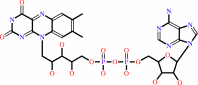 FAD
FAD
|
|
|
|
|
|
|
Molecule diagrams generated from .mol files obtained from the
KEGG ftp site
|
|
|
|
|
|
|
|
|
|
|
|
|
|
 |
|
|
|
|
|
|
| |
|
|
| |
|
DOI no:
|
J Mol Biol
358:1081-1093
(2006)
|
|
PubMed id:
|
|
|
|
|
|
| |
|
A rearranging ligand enables allosteric control of catalytic activity in copper-containing nitrite reductase.
|
|
H.J.Wijma,
I.Macpherson,
M.Alexandre,
R.E.Diederix,
G.W.Canters,
M.E.Murphy,
M.P.Verbeet.
|
|
|
|
|
| |
ABSTRACT
|
|
|
|
| |
|
|
In Cu-containing nitrite reductase from Alcaligenes faecalis S-6 the axial
methionine ligand of the type-1 site was replaced (M150G) to make the copper ion
accessible to external ligands that might affect the enzyme's catalytic
activity. The type-1 site optical spectrum of M150G (A(460)/A(600)=0.71) differs
significantly from that of the native nitrite reductase (A(460)/A(600)=1.3). The
midpoint potential of the type-1 site of nitrite reductase M150G
(E(M)=312(+/-5)mV versus hydrogen) is higher than that of the native enzyme
(E(M)=213(+/-5)mV). M150G has a lower catalytic activity (k(cat)=133(+/-6)s(-1))
than the wild-type nitrite reductase (k(cat)=416(+/-10)s(-1)). The binding of
external ligands to M150G restores spectral properties, midpoint potential
(E(M)<225mV), and catalytic activity (k(cat)=374(+/-28)s(-1)). Also the M150H
(A(460)/A(600)=7.7, E(M)=104(+/-5)mV, k(cat)=0.099(+/-0.006)s(-1)) and M150T
(A(460)/A(600)=0.085, E(M)=340(+/-5)mV, k(cat)=126(+/-2)s(-1)) variants were
characterized. Crystal structures show that the ligands act as allosteric
effectors by displacing Met62, which moves to bind to the Cu in the position
emptied by the M150G mutation. The reconstituted type-1 site has an otherwise
unaltered geometry. The observation that removal of an endogenous ligand can
introduce allosteric control in a redox enzyme suggests potential for structural
and functional flexibility of copper-containing redox sites.
|
|
|
|
|
|
| |
Selected figure(s)
|
|
|
|
| |
|
|

|
|

|
|
Figure 4.
|
|
Figure 7.
Figure 7. Crystal structures of the type-1 copper sites.
Identical views are given for (a), (b) and (c). Foreground:
Ala61–Phe64, His95. Background: Cys136, Trp144, His145, and
Gly150 (mutant) or Met150 (wt). The type-1 copper is a salmon
colored sphere. The σ[A] weighted 2F[o]−F[c] electron density
maps are contoured at 1σ. (a) The structure of M150G-DMS. (b)
The structure of M150G-acetamide. (c) Stereo stick
representation of wt NiR superimposed with M150G-DMS and
M150G-acetamide. The carbon atoms are colored white, slate, and
green for wt NiR, M150G-DMS, and M150G-acetamide, respectively.
|
|
|
|
|
|
| |
The above figures are
reprinted
by permission from Elsevier:
J Mol Biol
(2006,
358,
1081-1093)
copyright 2006.
|
|
| |
Figures were
selected
by the author.
|
|
|
|
|
|
|
|
|
|
|
|
|
|
|
|
 |
 |
 |
|
Literature references that cite this PDB file's key reference
|
|
|
| |
PubMed id
|
|
Reference
|
|
|
|
|
|
I.S.MacPherson,
F.I.Rosell,
M.Scofield,
A.G.Mauk,
and
M.E.Murphy
(2010).
Directed evolution of copper nitrite reductase to a chromogenic reductant.
|
| |
Protein Eng Des Sel,
23,
137-145.
|
|
|
PDB codes:
|
|
|
|
|
|
|
The most recent references are shown first.
Citation data come partly from CiteXplore and partly
from an automated harvesting procedure. Note that this is likely to be
only a partial list as not all journals are covered by
either method. However, we are continually building up the citation data
so more and more references will be included with time.
Where a reference describes a PDB structure, the PDB
codes are
shown on the right.
|
|


 Links
Links


