
|
|
|
|
|
 |
Contents |
 |
|
|
|
|
|
|
|
|
|
|
|
|
|
|
* Residue conservation analysis
|
|
|
|
|
|
|
|
|
|
Enzyme class:
|
|
Chain B:
E.C.2.7.11.18
- [myosin light-chain] kinase.
|
|
|
|
|
|
|
Reaction:
|
|
|
1.
|
L-seryl-[myosin light chain] + ATP = O-phospho-L-seryl-[myosin light chain] + ADP + H+
|
|
2.
|
L-threonyl-[myosin light chain] + ATP = O-phospho-L-threonyl-[myosin light chain] + ADP + H+
|
|
|
|
|
|
|
L-seryl-[myosin light chain]
|
+
|
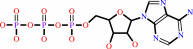 ATP
ATP
|
=
|
O-phospho-L-seryl-[myosin light chain]
|
+
|
 ADP
ADP
|
+
|
H(+)
|
|
|
|
|
|
|
L-threonyl-[myosin light chain]
|
+
|
ATP
|
=
|
O-phospho-L-threonyl-[myosin light chain]
|
+
|
ADP
|
+
|
H(+)
|
|
|
|
|
|
|
|
|
|
Cofactor:
|
|
Ca(2+)
|
|
|
|
|
|
|
|
|
Molecule diagrams generated from .mol files obtained from the
KEGG ftp site
|
|
|
|
|
|
|
|
|
|
|
|
|
|
 |
|
|
|
|
|
|
| |
|
|
| |
|
DOI no:
|
Biochemistry
38:3936-3947
(1999)
|
|
PubMed id:
|
|
|
|
|
|
| |
|
Analysis of the functional coupling between calmodulin's calcium binding and peptide recognition properties.
|
|
S.Mirzoeva,
S.Weigand,
T.J.Lukas,
L.Shuvalova,
W.F.Anderson,
D.M.Watterson.
|
|
|
|
|
| |
ABSTRACT
|
|
|
|
| |
|
|
The enhancement of calmodulin's (CaM) calcium binding activity by an enzyme or a
recognition site peptide and its diminution by key point mutations at the
protein recognition interface (e.g., E84K-CaM), which is more than 20 A away
from the nearest calcium ligation structure, can be described by an expanded
version of the Adair-Klotz equation for multiligand binding. The expanded
equation can accurately describe the calcium binding events and their variable
linkage to protein recognition events can be extended to other CaM-regulated
enzymes and can potentially be applied to a diverse array of ligand binding
systems with allosteric regulation of ligand binding, whether by other ligands
or protein interaction. The 1.9 A resolution X-ray crystallographic structure of
the complex between E84K-CaM and RS20 peptide, the CaM recognition site peptide
from vertebrate smooth muscle and nonmuscle forms of myosin light chain kinase,
provides insight into the structural basis of the functional communication
between CaM's calcium ligation structures and protein recognition surfaces. The
structure reveals that the complex adapts to the effect of the functional
mutation by discrete adjustments in the helix that contains E84. This helix is
on the amino-terminal side of the helix-loop-helix structural motif that is the
first to be occupied in CaM's calcium binding mechanism. The results reported
here are consistent with a sequential and cooperative model of CaM's calcium
binding activity in which the two globular and flexible central helix domains
are functionally linked, and provide insight into how CaM's calcium binding
activity and peptide recognition properties are functionally coupled.
|
|
|
|
|
|
|
|
|
|
|
|
|
|
|
|
|
|
 |
 |
 |
|
Literature references that cite this PDB file's key reference
|
|
|
| |
PubMed id
|
|
Reference
|
|
|
|
|
|
F.Rodríguez-Castañeda,
M.Maestre-Martínez,
N.Coudevylle,
K.Dimova,
H.Junge,
N.Lipstein,
D.Lee,
S.Becker,
N.Brose,
O.Jahn,
T.Carlomagno,
and
C.Griesinger
(2010).
Modular architecture of Munc13/calmodulin complexes: dual regulation by Ca2+ and possible function in short-term synaptic plasticity.
|
| |
EMBO J,
29,
680-691.
|
|
|
PDB code:
|
|
|
|
|
|
|
|
N.Juranic,
E.Atanasova,
A.G.Filoteo,
S.Macura,
F.G.Prendergast,
J.T.Penniston,
and
E.E.Strehler
(2010).
Calmodulin wraps around its binding domain in the plasma membrane Ca2+ pump anchored by a novel 18-1 motif.
|
| |
J Biol Chem,
285,
4015-4024.
|
|
|
PDB code:
|
|
|
|
|
|
|
|
M.I.Stefan,
S.J.Edelstein,
and
N.Le Novère
(2008).
An allosteric model of calmodulin explains differential activation of PP2B and CaMKII.
|
| |
Proc Natl Acad Sci U S A,
105,
10768-10773.
|
|
|
|
|
|
|
R.A.Newman,
W.S.Van Scyoc,
B.R.Sorensen,
O.R.Jaren,
and
M.A.Shea
(2008).
Interdomain cooperativity of calmodulin bound to melittin preferentially increases calcium affinity of sites I and II.
|
| |
Proteins,
71,
1792-1812.
|
|
|
|
|
|
|
A.Helten,
W.Säftel,
and
K.W.Koch
(2007).
Expression level and activity profile of membrane bound guanylate cyclase type 2 in rod outer segments.
|
| |
J Neurochem,
103,
1439-1446.
|
|
|
|
|
|
|
J.H.Streiff,
T.W.Allen,
E.Atanasova,
N.Juranic,
S.Macura,
A.R.Penheiter,
and
K.A.Jones
(2006).
Prediction of volatile anesthetic binding sites in proteins.
|
| |
Biophys J,
91,
3405-3414.
|
|
|
|
|
|
|
K.Chen,
J.Ruan,
and
L.A.Kurgan
(2006).
Prediction of three dimensional structure of calmodulin.
|
| |
Protein J,
25,
57-70.
|
|
|
|
|
|
|
T.I.Igumenova,
A.L.Lee,
and
A.J.Wand
(2005).
Backbone and side chain dynamics of mutant calmodulin-peptide complexes.
|
| |
Biochemistry,
44,
12627-12639.
|
|
|
|
|
|
|
T.J.Lukas
(2004).
A signal transduction pathway model prototype I: From agonist to cellular endpoint.
|
| |
Biophys J,
87,
1406-1416.
|
|
|
|
|
|
|
M.Nousiainen,
P.J.Derrick,
D.Lafitte,
and
P.Vainiotalo
(2003).
Relative affinity constants by electrospray ionization and Fourier transform ion cyclotron resonance mass spectrometry: calmodulin binding to peptide analogs of myosin light chain kinase.
|
| |
Biophys J,
85,
491-500.
|
|
|
|
|
|
|
S.W.Vetter,
and
E.Leclerc
(2003).
Novel aspects of calmodulin target recognition and activation.
|
| |
Eur J Biochem,
270,
404-414.
|
|
|
|
|
|
|
A.V.Velentza,
A.M.Schumacher,
and
D.M.Watterson
(2002).
Structure, activity, regulation, and inhibitor discovery for a protein kinase associated with apoptosis and neuronal death.
|
| |
Pharmacol Ther,
93,
217-224.
|
|
|
|
|
|
|
H.H.Gan,
R.A.Perlow,
S.Roy,
J.Ko,
M.Wu,
J.Huang,
S.Yan,
A.Nicoletta,
J.Vafai,
D.Sun,
L.Wang,
J.E.Noah,
S.Pasquali,
and
T.Schlick
(2002).
Analysis of protein sequence/structure similarity relationships.
|
| |
Biophys J,
83,
2781-2791.
|
|
|
|
|
|
|
G.Larsson,
J.Schleucher,
J.Onions,
S.Hermann,
T.Grundström,
and
S.S.Wijmenga
(2001).
A novel target recognition revealed by calmodulin in complex with the basic helix--loop--helix transcription factor SEF2-1/E2-2.
|
| |
Protein Sci,
10,
169-186.
|
|
|
|
|
|
|
M.V.Medvedeva,
D.R.Djemuchadze,
D.M.Watterson,
S.B.Marston,
and
N.B.Gusev
(2001).
Replacement of Lys-75 of calmodulin affects its interaction with smooth muscle caldesmon.
|
| |
Biochim Biophys Acta,
1544,
143-150.
|
|
|
|
|
|
|
O.R.Jaren,
S.Harmon,
A.F.Chen,
and
M.A.Shea
(2000).
Paramecium calmodulin mutants defective in ion channel regulation can bind calcium and undergo calcium-induced conformational switching.
|
| |
Biochemistry,
39,
6881-6890.
|
|
|
|
|
|
|
T.J.Hill,
D.Lafitte,
J.I.Wallace,
H.J.Cooper,
P.O.Tsvetkov,
and
P.J.Derrick
(2000).
Calmodulin-peptide interactions: apocalmodulin binding to the myosin light chain kinase target-site.
|
| |
Biochemistry,
39,
7284-7290.
|
|
|
|
|
|
The most recent references are shown first.
Citation data come partly from CiteXplore and partly
from an automated harvesting procedure. Note that this is likely to be
only a partial list as not all journals are covered by
either method. However, we are continually building up the citation data
so more and more references will be included with time.
Where a reference describes a PDB structure, the PDB
code is
shown on the right.
|
 |


 Links
Links


