 |
PDBsum entry 1v66

|
|
|
|
|
 |
Contents |
 |
|
|
|
|
|
|
|
|
* Residue conservation analysis
|
|
|
|
|
|
PDB id:
|
|
|
|
| Name: |
|
Ligase
|
|
|
Title:
|
|
Solution structure of human p53 binding domain of pias-1
|
|
Structure:
|
|
Protein inhibitor of activated stat protein 1. Chain: a. Fragment: residues 1-65. Synonym: protein inhibitor of activated stat-1, pias-1, gu binding protein, gbp, RNA helicase ii binding protein, dead/h box-binding protein 1. Engineered: yes
|
|
Source:
|
|
Homo sapiens. Human. Organism_taxid: 9606. Expressed in: escherichia coli bl21(de3). Expression_system_taxid: 469008.
|
|
NMR struc:
|
|
20 models
|
|
|
Authors:
|
|
S.Okubo,F.Hara,Y.Tsuchida,S.Shimotakahara,S.Suzuki,H.Hatanaka, S.Yokoyama,H.Tanaka,H.Yasuda,H.Shindo,Riken Structural Genomics/proteomics Initiative (Rsgi)
|
Key ref:

|
|
S.Okubo
et al.
(2004).
NMR structure of the N-terminal domain of SUMO ligase PIAS1 and its interaction with tumor suppressor p53 and A/T-rich DNA oligomers.
J Biol Chem,
279,
31455-31461.
PubMed id:
DOI:

|
|
|
Date:
|
|
|
27-Nov-03
|
Release date:
|
07-Dec-04
|
|
|
|
|
|
|
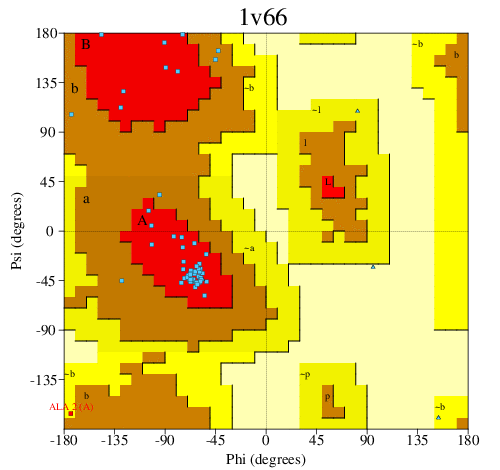
PROCHECK
|
|
|
|
|
|
Headers
|
|
|
|
References
|
|
|
|
|
|

|
|
O75925
(PIAS1_HUMAN) -
E3 SUMO-protein ligase PIAS1 from Homo sapiens
|
|
|
|
Seq:
Struc:
|
|
|
|
651 a.a.
65 a.a.
|
|

|

|
|
|
|
|
|
|
|
|
|
|
|
Key: |
 |
PfamA domain |
|
|
 |
Secondary structure |
|
 |
CATH domain |
|
|
|
|
|
|
|
|
|
|
|
|
|
|
|
|
|
 |
|
|
|
|
|
|
| |
|
DOI no:
|
J Biol Chem
279:31455-31461
(2004)
|
|
PubMed id:
|
|
|
|
|
|
| |
|
NMR structure of the N-terminal domain of SUMO ligase PIAS1 and its interaction with tumor suppressor p53 and A/T-rich DNA oligomers.
|
|
S.Okubo,
F.Hara,
Y.Tsuchida,
S.Shimotakahara,
S.Suzuki,
H.Hatanaka,
S.Yokoyama,
H.Tanaka,
H.Yasuda,
H.Shindo.
|
|
|
|
|
| |
ABSTRACT
|
|
|
|
| |
|
|
A member of the PIAS (protein inhibitor of activated STAT) family of proteins,
PIAS1, have been reported to serve as an E3-type SUMO ligase for tumor
suppressor p53 and its own. It also was proposed that the N-terminal domain of
PIAS1 interacts with DNA as well as p53. Extensive biochemical studies have been
devoted recently to understand sumoylations and its biological implications,
whereas the structural aspects of the PIAS family and the mechanism of its
interactions with various factors are less well known to date. In this study,
the three-dimensional structure of the N-terminal domain (residues 1-65) of SUMO
ligase PIAS1 was determined by NMR spectroscopy. The structure revealed a unique
four-helix bundle with a topology of an up-down-extended loop-down-up, a part of
which the helix-extended loop-helix represented the SAP (SAF-A/B, Acinus, and
PIAS) motif. Thus, this N-terminal domain may be referred to as a four-helix SAP
domain. The glutathione S-transferase pull-down assay demonstrated that this
domain possesses a binding ability to tumor suppressor p53, a target protein for
sumoylation by PIAS1, whereas gel mobility assays showed that it has a strong
affinity toward A/T-rich DNA. An NMR analysis of the four-helix SAP domain
complexed with the 16-bp-long DNA demonstrated that one end of the four-helix
bundle is the binding site and may fit into the minor groove of DNA. The
three-dimensional structure and its binding duality are discussed in conjunction
with the biological functions of PIAS1 as a SUMO ligase.
|
|
|
|
|
|
| |
Selected figure(s)
|
|
|
|
| |
|
|

|
|

|
|
Figure 6.
FIG. 6. The highly perturbed residues of PIA-(1-65) upon
its binding to DNA16 are colored in red (   > 0.3 ppm) and pink
(0.3 ppm > > 0.1 ppm) in the side
view (a) and the top view (b). Side chains of basic residues
also are depicted in the model. C, C terminus; N, N terminus. > 0.3 ppm) and pink
(0.3 ppm > > 0.1 ppm) in the side
view (a) and the top view (b). Side chains of basic residues
also are depicted in the model. C, C terminus; N, N terminus.
|
|
Figure 7.
FIG. 7. Stereoviews of the superimposed ribbon diagrams for
the four-helix SAP domain, PIA-(1-65), with protease inhibitor
Iceberg (Protein Data Bank code 1DGN [PDB]
) (a), the C-terminal domain of bacteriophage T4 endonuclease
VII (Protein Data Bank code 1EN7 [PDB]
) (b), and the C-terminal domain of Ku70 (Protein Data Bank code
1JJR [PDB]
) (c). The N-terminal domain of PIAS1 is in blue, and the other
domains are in red.
|
|
|
|
|
|
| |
The above figures are
reprinted
by permission from the ASBMB:
J Biol Chem
(2004,
279,
31455-31461)
copyright 2004.
|
|
| |
Figures were
selected
by an automated process.
|
|
|
|
|
|
|
|
|
|
|
|
|
|
|
|
 |
 |
 |
|
Literature references that cite this PDB file's key reference
|
|
|
| |
PubMed id
|
|
Reference
|
|
|
|
|
|
C.Alfonso-Parra,
and
K.A.Maggert
(2010).
Drosophila SAF-B links the nuclear matrix, chromosomes, and transcriptional activity.
|
| |
PLoS One,
5,
e10248.
|
|
|
|
|
|
|
J.A.Tan,
J.Song,
Y.Chen,
and
L.K.Durrin
(2010).
Phosphorylation-dependent interaction of SATB1 and PIAS1 directs SUMO-regulated caspase cleavage of SATB1.
|
| |
Mol Cell Biol,
30,
2823-2836.
|
|
|
|
|
|
|
K.Kim,
S.Bae,
J.Hong,
J.Choi,
S.Ryoo,
H.Jhun,
S.Lee,
E.Her,
K.Hong,
and
S.Kim
(2010).
Generation of monoclonal antibodies against recombinant AtSIZ1.
|
| |
Hybridoma (Larchmt),
29,
333-340.
|
|
|
|
|
|
|
M.M.Rytinki,
S.Kaikkonen,
P.Pehkonen,
T.Jääskeläinen,
and
J.J.Palvimo
(2009).
PIAS proteins: pleiotropic interactors associated with SUMO.
|
| |
Cell Mol Life Sci,
66,
3029-3041.
|
|
|
|
|
|
|
R.Suzuki,
H.Shindo,
A.Tase,
Y.Kikuchi,
M.Shimizu,
and
T.Yamazaki
(2009).
Solution structures and DNA binding properties of the N-terminal SAP domains of SUMO E3 ligases from Saccharomyces cerevisiae and Oryza sativa.
|
| |
Proteins,
75,
336-347.
|
|
|
PDB codes:
|
|
|
|
|
|
|
|
A.Vazquez,
E.E.Bond,
A.J.Levine,
and
G.L.Bond
(2008).
The genetics of the p53 pathway, apoptosis and cancer therapy.
|
| |
Nat Rev Drug Discov,
7,
979-987.
|
|
|
|
|
|
|
J.L.Parker,
A.Bucceri,
A.A.Davies,
K.Heidrich,
H.Windecker,
and
H.D.Ulrich
(2008).
SUMO modification of PCNA is controlled by DNA.
|
| |
EMBO J,
27,
2422-2431.
|
|
|
|
|
|
|
L.O.Tykocinski,
A.Sinemus,
and
B.Kyewski
(2008).
The thymus medulla slowly yields its secrets.
|
| |
Ann N Y Acad Sci,
1143,
105-122.
|
|
|
|
|
|
|
M.Devany,
F.Kappes,
K.M.Chen,
D.M.Markovitz,
and
H.Matsuo
(2008).
Solution NMR structure of the N-terminal domain of the human DEK protein.
|
| |
Protein Sci,
17,
205-215.
|
|
|
PDB code:
|
|
|
|
|
|
|
|
P.Peterson,
T.Org,
and
A.Rebane
(2008).
Transcriptional regulation by AIRE: molecular mechanisms of central tolerance.
|
| |
Nat Rev Immunol,
8,
948-957.
|
|
|
|
|
|
|
Y.J.Lin,
T.Umehara,
M.Inoue,
K.Saito,
T.Kigawa,
M.K.Jang,
K.Ozato,
S.Yokoyama,
B.Padmanabhan,
and
P.Güntert
(2008).
Solution structure of the extraterminal domain of the bromodomain-containing protein BRD4.
|
| |
Protein Sci,
17,
2174-2179.
|
|
|
|
|
|
|
Y.Tsuji,
K.Watanabe,
K.Araki,
M.Shinohara,
Y.Yamagata,
T.Tsurimoto,
F.Hanaoka,
K.Yamamura,
M.Yamaizumi,
and
S.Tateishi
(2008).
Recognition of forked and single-stranded DNA structures by human RAD18 complexed with RAD6B protein triggers its recruitment to stalled replication forks.
|
| |
Genes Cells,
13,
343-354.
|
|
|
|
|
|
|
Z.Tang,
C.M.Hecker,
A.Scheschonka,
and
H.Betz
(2008).
Protein interactions in the sumoylation cascade: lessons from X-ray structures.
|
| |
FEBS J,
275,
3003-3015.
|
|
|
|
|
|
|
J.Lee,
J.Beliakoff,
and
Z.Sun
(2007).
The novel PIAS-like protein hZimp10 is a transcriptional co-activator of the p53 tumor suppressor.
|
| |
Nucleic Acids Res,
35,
4523-4534.
|
|
|
|
|
|
|
J.X.Du,
C.C.Yun,
A.Bialkowska,
and
V.W.Yang
(2007).
Protein inhibitor of activated STAT1 interacts with and up-regulates activities of the pro-proliferative transcription factor Krüppel-like factor 5.
|
| |
J Biol Chem,
282,
4782-4793.
|
|
|
|
|
|
|
V.Notenboom,
R.G.Hibbert,
S.E.van Rossum-Fikkert,
J.V.Olsen,
M.Mann,
and
T.K.Sixma
(2007).
Functional characterization of Rad18 domains for Rad6, ubiquitin, DNA binding and PCNA modification.
|
| |
Nucleic Acids Res,
35,
5819-5830.
|
|
|
|
|
|
|
X.L.Chen,
H.R.Silver,
L.Xiong,
I.Belichenko,
C.Adegite,
and
E.S.Johnson
(2007).
Topoisomerase I-dependent viability loss in saccharomyces cerevisiae mutants defective in both SUMO conjugation and DNA repair.
|
| |
Genetics,
177,
17-30.
|
|
|
|
|
|
|
J.R.Prigge,
and
E.E.Schmidt
(2006).
Interaction of protein inhibitor of activated STAT (PIAS) proteins with the TATA-binding protein, TBP.
|
| |
J Biol Chem,
281,
12260-12269.
|
|
|
|
|
|
|
T.M.Wise-Draper,
H.V.Allen,
E.E.Jones,
K.B.Habash,
H.Matsuo,
and
S.I.Wells
(2006).
Apoptosis inhibition by the human DEK oncoprotein involves interference with p53 functions.
|
| |
Mol Cell Biol,
26,
7506-7519.
|
|
|
|
|
|
|
F.Böhm,
F.Kappes,
I.Scholten,
N.Richter,
H.Matsuo,
R.Knippers,
and
T.Waldmann
(2005).
The SAF-box domain of chromatin protein DEK.
|
| |
Nucleic Acids Res,
33,
1101-1110.
|
|
|
|
|
|
|
K.Shuai,
and
B.Liu
(2005).
Regulation of gene-activation pathways by PIAS proteins in the immune system.
|
| |
Nat Rev Immunol,
5,
593-605.
|
|
|
|
|
|
|
Y.Azuma,
A.Arnaoutov,
T.Anan,
and
M.Dasso
(2005).
PIASy mediates SUMO-2 conjugation of Topoisomerase-II on mitotic chromosomes.
|
| |
EMBO J,
24,
2172-2182.
|
|
|
|
|
|
|
E.Munarriz,
D.Barcaroli,
A.Stephanou,
P.A.Townsend,
C.Maisse,
A.Terrinoni,
M.H.Neale,
S.J.Martin,
D.S.Latchman,
R.A.Knight,
G.Melino,
and
V.De Laurenzi
(2004).
PIAS-1 is a checkpoint regulator which affects exit from G1 and G2 by sumoylation of p73.
|
| |
Mol Cell Biol,
24,
10593-10610.
|
|
|
|
|
|
The most recent references are shown first.
Citation data come partly from CiteXplore and partly
from an automated harvesting procedure. Note that this is likely to be
only a partial list as not all journals are covered by
either method. However, we are continually building up the citation data
so more and more references will be included with time.
Where a reference describes a PDB structure, the PDB
codes are
shown on the right.
|
|


 Links
Links


