
|
|
|
|
|
 |
Contents |
 |
|
|
|
|
|
|
|
|
|
|
|
 289 a.a.
|
|
|
|
|
|
|
|
|
|
|
 252 a.a.
|
|
|
|
|
|
|
|
|
|
|
 238 a.a.
|
|
|
|
|
|
|
|
|
|
|
 60 a.a.
|
|
|
|
|
|
|
|
|
|
|
 125 a.a.
|
|
|
|
|
|
|
* Residue conservation analysis
|
|
|
|
|
|
PDB id:
|
|
|
|
| Name: |
|
Virus/receptor
|
|
|
Title:
|
|
Complex of echovirus type 12 with domains 3 and 4 of its receptor decay accelerating factor (cd55) by cryo electron microscopy at 16 a
|
|
Structure:
|
|
Echovirus 11 coat protein vp1. Chain: a. Echovirus 11 coat protein vp2. Chain: b. Echovirus 11 coat protein vp3. Chain: c. Echovirus 11 coat protein vp4. Chain: d. Other_details: structure of echovirus type 11 fitted into cryo-em
|
|
Source:
|
|
Human echovirus 11. Organism_taxid: 12078. Strain: gregory. Homo sapiens. Human. Organism_taxid: 9606. Expressed in: escherichia coli. Expression_system_taxid: 562
|
|
Authors:
|
|
D.Bhella,I.G.Goodfellow,P.Roversi,D.Pettigrew,Y.Chaudry,D.J.Evans, S.M.Lea
|
Key ref:

|
|
D.Bhella
et al.
(2004).
The structure of echovirus type 12 bound to a two-domain fragment of its cellular attachment protein decay-accelerating factor (CD 55).
J Biol Chem,
279,
8325-8332.
PubMed id:
DOI:

|
|
|
Date:
|
|
|
08-Oct-03
|
Release date:
|
07-Jan-04
|
|
|
|
|
|
|
PROCHECK
|

|
|
|
|
|
Headers
|
|
|
|
References
|
|
|
|
|
|

|
|
Q8JKE8
(Q8JKE8_9ENTO) -
Genome polyprotein from Echovirus E11
|
|
|
|
Seq:
Struc:
|
|
|
|
2195 a.a.
289 a.a.
|
|

|

|
|
|
|
|
|
|
|
|
|
|
|
|

|
|
Q8JKE8
(Q8JKE8_9ENTO) -
Genome polyprotein from Echovirus E11
|
|
|
|
Seq:
Struc:
|
|
|
|
2195 a.a.
252 a.a.*
|
|
|

|
|
|
|
|
|
|
|
|
|
|
|
|

|
|
Q8JKE8
(Q8JKE8_9ENTO) -
Genome polyprotein from Echovirus E11
|
|
|
|
Seq:
Struc:
|
|
|
|
2195 a.a.
238 a.a.*
|
|
|

|
|
|
|
|
|
|
|
|
|
|
|
|
|
|
|
|
|
Enzyme class 1:
|
|
Chains A, B, C, D:
E.C.2.7.7.48
- RNA-directed Rna polymerase.
|
|
|
|
|
|
|
Reaction:
|
|
RNA(n) + a ribonucleoside 5'-triphosphate = RNA(n+1) + diphosphate
|
|
|
|
|
|
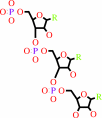 RNA(n)
|
+
|
ribonucleoside 5'-triphosphate
|
=
|
RNA(n+1)
|
+
|
 diphosphate
|
|
|
|
|
|
|
|
|
|
Enzyme class 2:
|
|
Chains A, B, C, D:
E.C.3.4.22.28
- picornain 3C.
|
|
|
|
|
|
|
Reaction:
|
|
Selective cleavage of Gln-|-Gly bond in the poliovirus polyprotein. In other picornavirus reactions Glu may be substituted for Gln, and Ser or Thr for Gly.
|
|
|
|
|
|
Enzyme class 3:
|
|
Chains A, B, C, D:
E.C.3.4.22.29
- picornain 2A.
|
|
|
|
|
|
|
Reaction:
|
|
Selective cleavage of Tyr-|-Gly bond in the picornavirus polyprotein. In other picornavirus reactions Glu may be substituted for Gln, and Ser or Thr for Gly.
|
|
|
|
|
|
Enzyme class 4:
|
|
Chains A, B, C, D:
E.C.3.6.1.15
- nucleoside-triphosphate phosphatase.
|
|
|
|
|
|
|
Reaction:
|
|
a ribonucleoside 5'-triphosphate + H2O = a ribonucleoside 5'-diphosphate + phosphate + H+
|
|
|
|
|
|
ribonucleoside 5'-triphosphate
|
+
|
H2O
|
=
|
ribonucleoside 5'-diphosphate
|
+
|
 phosphate
|
+
|
H(+)
|
|
|
|
|
|
|
|
|
|
|
|
|
Note, where more than one E.C. class is given (as above), each may
correspond to a different protein domain or, in the case of polyprotein
precursors, to a different mature protein.
|
|
|
|
Molecule diagrams generated from .mol files obtained from the
KEGG ftp site
|
|
|
|
|
|
|
|
|
|
|
|
|
|
 |
|
|
|
|
|
|
| |
|
|
| |
|
DOI no:
|
J Biol Chem
279:8325-8332
(2004)
|
|
PubMed id:
|
|
|
|
|
|
| |
|
The structure of echovirus type 12 bound to a two-domain fragment of its cellular attachment protein decay-accelerating factor (CD 55).
|
|
D.Bhella,
I.G.Goodfellow,
P.Roversi,
D.Pettigrew,
Y.Chaudhry,
D.J.Evans,
S.M.Lea.
|
|
|
|
|
| |
ABSTRACT
|
|
|
|
| |
|
|
Echovirus type 12 (EV12), an Enterovirus of the Picornaviridae family, uses the
complement regulator decay-accelerating factor (DAF, CD55) as a cellular
receptor. We have calculated a three-dimensional reconstruction of EV12 bound to
a fragment of DAF consisting of short consensus repeat domains 3 and 4 from
cryo-negative stain electron microscopy data (EMD code 1057). This shows that,
as for an earlier reconstruction of the related echovirus type 7 bound to DAF,
attachment is not within the viral canyon but occurs close to the 2-fold
symmetry axes. Despite this general similarity our reconstruction reveals a
receptor interaction that is quite different from that observed for EV7. Fitting
of the crystallographic co-ordinates for DAF(34) and EV11 into the
reconstruction shows a close agreement between the crystal structure of the
receptor fragment and the density for the virus-bound receptor, allowing
unambiguous positioning of the receptor with respect to the virion (PDB code
1UPN). Our finding that the mode of virus-receptor interaction in EV12 is
distinct from that seen for EV7 raises interesting questions regarding the
evolution and biological significance of the DAF binding phenotype in these
viruses.
|
|
|
|
|
|
| |
Selected figure(s)
|
|
|
|
| |
|
|

|
|

|
|
Figure 2.
FIG. 2. Stereo pairs of surface rendered three-dimensional
reconstructions of unlabeled EV12 virions (A) and
DAF[34]-labeled virions (B). Isosurfaces of these
reconstructions are merged and rendered in their respective
color schemes to highlight the differences in density attributed
to the two SCR domain fragment of DAF (C). A low resolution
representation of EV7 bound to DAF[1234], derived from PDB code
1M11 [PDB]
(30), highlights the differently oriented densities in these two
complexes (D). In this model the densities of two copies of
DAF[1234] are superimposed, laying across the virion 2-fold
symmetry axes, giving rise to a hybrid density representing the
two possible positions for the molecule. A radial depth-cue
color scheme is used to indicate distance from the center of the
virion (see the key).
|
|
Figure 5.
FIG. 5. A comparison of the low resolution
three-dimensional reconstruction of EV12-DAF[34] (A) and a
space-filling representation of the EV12-DAF[34] complex (B),
generated using the crystallographic co-ordinates for EV11 and
DAF[34]. Radial depth-cueing emphasizes the distance between
atoms or regions of density and the center of the virion such
that dark colors are close to the center and light colors are
farther away. EV12 (and EV11) is colored in shades of blue,
whereas DAF[34] is colored in green. A space-filling
representation of the EV7-DAF[1234] complex (30) (C) highlights
the different orientation of DAF bound to these two viruses. The
model deposited under PDB code 1M11 [PDB]
contains  -carbon atoms only;
this view is therefore rendered with the atomic radii for each
atom set to 3.5Å. EV7 is colored in shades of purple, and
the receptor is in red. A close-up view of DAF[34] shown as in
panel B but rotated 180^o about a vertical axis exposes the
residues buried in the virus-receptor complex (D). Residues are
colored according to their contribution to the total contact
area ( -carbon atoms only;
this view is therefore rendered with the atomic radii for each
atom set to 3.5Å. EV7 is colored in shades of purple, and
the receptor is in red. A close-up view of DAF[34] shown as in
panel B but rotated 180^o about a vertical axis exposes the
residues buried in the virus-receptor complex (D). Residues are
colored according to their contribution to the total contact
area (  840 Å2); yellow (1
< 5%), orange (5 < 9%), and red (9%+). A close-up view of EV11
without the receptor in place exposes buried residues on the
surface of the capsid that are colored according to the same
scheme (E); the biological protomer is indicated. 840 Å2); yellow (1
< 5%), orange (5 < 9%), and red (9%+). A close-up view of EV11
without the receptor in place exposes buried residues on the
surface of the capsid that are colored according to the same
scheme (E); the biological protomer is indicated.
|
|
|
|
|
|
| |
The above figures are
reprinted
by permission from the ASBMB:
J Biol Chem
(2004,
279,
8325-8332)
copyright 2004.
|
|
| |
Figures were
selected
by the author.
|
|
|
|
|
|
|
|
|
|
|
|
|
|
|
|
 |
 |
 |
|
Literature references that cite this PDB file's key reference
|
|
|
| |
PubMed id
|
|
Reference
|
|
|
|
|
|
J.Seitsonen,
P.Susi,
O.Heikkilä,
R.S.Sinkovits,
P.Laurinmäki,
T.Hyypiä,
and
S.J.Butcher
(2010).
Interaction of alphaVbeta3 and alphaVbeta6 integrins with human parechovirus 1.
|
| |
J Virol,
84,
8509-8519.
|
|
|
|
|
|
|
P.McErlean,
L.A.Shackelton,
E.Andrews,
D.R.Webster,
S.B.Lambert,
M.D.Nissen,
T.P.Sloots,
and
I.M.Mackay
(2008).
Distinguishing molecular features and clinical characteristics of a putative new rhinovirus species, human rhinovirus C (HRV C).
|
| |
PLoS ONE,
3,
e1847.
|
|
|
|
|
|
|
S.Hafenstein,
V.D.Bowman,
P.R.Chipman,
C.M.Bator Kelly,
F.Lin,
M.E.Medof,
and
M.G.Rossmann
(2007).
Interaction of decay-accelerating factor with coxsackievirus B3.
|
| |
J Virol,
81,
12927-12935.
|
|
|
PDB codes:
|
|
|
|
|
|
|
|
E.Pokidysheva,
Y.Zhang,
A.J.Battisti,
C.M.Bator-Kelly,
P.R.Chipman,
C.Xiao,
G.G.Gregorio,
W.A.Hendrickson,
R.J.Kuhn,
and
M.G.Rossmann
(2006).
Cryo-EM reconstruction of dengue virus in complex with the carbohydrate recognition domain of DC-SIGN.
|
| |
Cell,
124,
485-493.
|
|
|
PDB code:
|
|
|
|
|
|
|
|
A.M.Milstone,
J.Petrella,
M.D.Sanchez,
M.Mahmud,
J.C.Whitbeck,
and
J.M.Bergelson
(2005).
Interaction with coxsackievirus and adenovirus receptor, but not with decay-accelerating factor (DAF), induces A-particle formation in a DAF-binding coxsackievirus B3 isolate.
|
| |
J Virol,
79,
655-660.
|
|
|
|
|
|
|
I.G.Goodfellow,
D.J.Evans,
A.M.Blom,
D.Kerrigan,
J.S.Miners,
B.P.Morgan,
and
O.B.Spiller
(2005).
Inhibition of coxsackie B virus infection by soluble forms of its receptors: binding affinities, altered particle formation, and competition with cellular receptors.
|
| |
J Virol,
79,
12016-12024.
|
|
|
|
|
|
|
E.S.Johansson,
L.Xing,
R.H.Cheng,
and
D.R.Shafren
(2004).
Enhanced cellular receptor usage by a bioselected variant of coxsackievirus a21.
|
| |
J Virol,
78,
12603-12612.
|
|
|
|
|
|
The most recent references are shown first.
Citation data come partly from CiteXplore and partly
from an automated harvesting procedure. Note that this is likely to be
only a partial list as not all journals are covered by
either method. However, we are continually building up the citation data
so more and more references will be included with time.
Where a reference describes a PDB structure, the PDB
codes are
shown on the right.
|

| |


 Links
Links


