 |
PDBsum entry 1sm2

|
|
|
|
|
 |
Contents |
 |
|
|
|
|
|
|
|
|
|
|
|
|
* Residue conservation analysis
|
|
|
|
|
|
PDB id:
|
|
|
|
| Name: |
|
Transferase
|
|
|
Title:
|
|
Crystal structure of the phosphorylated interleukin-2 tyrosine kinase catalytic domain
|
|
Structure:
|
|
Tyrosine-protein kinase itk/tsk. Chain: a, b. Fragment: catalytic kinase domain. Synonym: t-cell-specific kinase, tyrosine-protein kinase lyk, kinase emt. Engineered: yes
|
|
Source:
|
|
Homo sapiens. Human. Organism_taxid: 9606. Gene: itk, lyk, emt. Expressed in: escherichia coli. Expression_system_taxid: 562
|
|
Resolution:
|
|
|
2.30Å
|
R-factor:
|
0.223
|
R-free:
|
0.292
|
|
|
Authors:
|
|
K.Brown,J.M.Long,S.C.M.Vial,N.Dedi,N.J.Dunster,S.B.Renwick, A.J.Tanner,J.D.Frantz,M.A.Fleming,G.M.T.Cheetham
|
Key ref:

|
|
K.Brown
et al.
(2004).
Crystal structures of interleukin-2 tyrosine kinase and their implications for the design of selective inhibitors.
J Biol Chem,
279,
18727-18732.
PubMed id:
DOI:

|
|
|
Date:
|
|
|
08-Mar-04
|
Release date:
|
16-Jul-04
|
|
|
|
|
|
|
PROCHECK
|

|
|
|
|
|
Headers
|
|
|
|
References
|
|
|
|
|
|

|
|
Q08881
(ITK_HUMAN) -
Tyrosine-protein kinase ITK/TSK from Homo sapiens
|
|
|
|
Seq:
Struc:
|
|
|
|
620 a.a.
245 a.a.
|
|

|

|
|
|
|
|
|
|
|
|
|
|
|
Key: |
 |
PfamA domain |
|
|
 |
Secondary structure |
|
 |
CATH domain |
|
|
|
|
|
|
|
|
|
|
|
|
|
Enzyme class:
|
|
E.C.2.7.10.2
- non-specific protein-tyrosine kinase.
|
|
|
|
|
|
|
Reaction:
|
|
L-tyrosyl-[protein] + ATP = O-phospho-L-tyrosyl-[protein] + ADP + H+
|
|
|
|
|
|
L-tyrosyl-[protein]
|
+
|
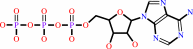 ATP
ATP
|
=
|
O-phospho-L-tyrosyl-[protein]
|
+
|
 ADP
ADP
|
+
|
H(+)
|
|
|
|
|
|
|
|
|
|
|
|
|
Molecule diagrams generated from .mol files obtained from the
KEGG ftp site
|
|
|
|
|
|
|
|
|
|
|
|
|
|
 |
|
|
|
|
|
|
| |
|
|
| |
|
DOI no:
|
J Biol Chem
279:18727-18732
(2004)
|
|
PubMed id:
|
|
|
|
|
|
| |
|
Crystal structures of interleukin-2 tyrosine kinase and their implications for the design of selective inhibitors.
|
|
K.Brown,
J.M.Long,
S.C.Vial,
N.Dedi,
N.J.Dunster,
S.B.Renwick,
A.J.Tanner,
J.D.Frantz,
M.A.Fleming,
G.M.Cheetham.
|
|
|
|
|
| |
ABSTRACT
|
|
|
|
| |
|
|
Interleukin-2 tyrosine kinase, Itk, is an important member of the Tec family of
non-receptor tyrosine kinases that play a central role in signaling through
antigen receptors such as the T-cell receptor, B-cell receptor, and Fcepsilon.
Selective inhibition of Itk may be an important way of modulating many diseases
involving heightened or inappropriate activation of the immune system. In
addition to an unliganded nonphophorylated Itk catalytic kinase domain, we
determined the crystal structures of the phosphorylated and nonphosphorylated
kinase domain bound to staurosporine, a potent broad-spectrum kinase inhibitor.
These structures are useful for the design of novel, highly potent and selective
Itk inhibitors and provide insight into the influence of inhibitor binding and
phosphorylation on the conformation of Itk.
|
|
|
|
|
|
| |
Selected figure(s)
|
|
|
|
| |
|
|

|
|

|
|
Figure 2.
FIG. 2. Interactions between phosphorylated Itk (pTyr512)
and staurosporine in the ATP-binding site. F[o] - F[c]
experimental electron density for the inhibitor is shown in
cyan, contoured at 1.5  and 2.3 Å
resolution. and 2.3 Å
resolution.
|
|
Figure 3.
FIG. 3. Conformational differences in the ATP-binding site
of Btk (cyan ribbons and cyan side chains) and Itk (green
ribbons and green side chains). Unphosphorylated and
phosphorylated Itk adopts a closed catalytic conformation of the
 C-helix and
glycine-rich loop. In contrast, the glycine-rich loop of
unphosphorylated Btk blocks the ATP-binding site, which is not
consistent with inhibitor binding. The Itk gatekeeper residue,
Phe^435, and catalytically important residues are shown in
detail. Itk residue numbering is used unless specified. C-helix and
glycine-rich loop. In contrast, the glycine-rich loop of
unphosphorylated Btk blocks the ATP-binding site, which is not
consistent with inhibitor binding. The Itk gatekeeper residue,
Phe^435, and catalytically important residues are shown in
detail. Itk residue numbering is used unless specified.
|
|
|
|
|
|
| |
The above figures are
reprinted
by permission from the ASBMB:
J Biol Chem
(2004,
279,
18727-18732)
copyright 2004.
|
|
| |
Figures were
selected
by an automated process.
|
|
|
|
|
|
|
|
|
|
|
|
|
|
|
|
 |
 |
 |
|
Literature references that cite this PDB file's key reference
|
|
|
| |
PubMed id
|
|
Reference
|
|
|
|
|
|
A.von Bonin,
A.Rausch,
A.Mengel,
M.Hitchcock,
M.Krüger,
O.von Ahsen,
C.Merz,
L.Röse,
C.Stock,
S.F.Martin,
G.Leder,
W.D.Döcke,
K.Asadullah,
and
U.Zügel
(2011).
Inhibition of the IL-2-inducible tyrosine kinase (Itk) activity: a new concept for the therapy of inflammatory skin diseases.
|
| |
Exp Dermatol,
20,
41-47.
|
|
|
|
|
|
|
A.G.Villaseñor,
A.Wong,
A.Shao,
A.Garg,
A.Kuglstatter,
and
S.F.Harris
(2010).
Acoustic matrix microseeding: improving protein crystal growth with minimal chemical bias.
|
| |
Acta Crystallogr D Biol Crystallogr,
66,
568-576.
|
|
|
|
|
|
|
D.J.Marcotte,
Y.T.Liu,
R.M.Arduini,
C.A.Hession,
K.Miatkowski,
C.P.Wildes,
P.F.Cullen,
V.Hong,
B.T.Hopkins,
E.Mertsching,
T.J.Jenkins,
M.J.Romanowski,
D.P.Baker,
and
L.F.Silvian
(2010).
Structures of human Bruton's tyrosine kinase in active and inactive conformations suggest a mechanism of activation for TEC family kinases.
|
| |
Protein Sci,
19,
429-439.
|
|
|
PDB codes:
|
|
|
|
|
|
|
|
L.Min,
W.Wu,
R.E.Joseph,
D.B.Fulton,
L.Berg,
and
A.H.Andreotti
(2010).
Disrupting the intermolecular self-association of Itk enhances T cell signaling.
|
| |
J Immunol,
184,
4228-4235.
|
|
|
|
|
|
|
C.Sacristán,
S.A.Schattgen,
L.J.Berg,
S.C.Bunnell,
A.L.Roy,
and
Y.Rosenstein
(2009).
Characterization of a novel interaction between transcription factor TFII-I and the inducible tyrosine kinase in T cells.
|
| |
Eur J Immunol,
39,
2584-2595.
|
|
|
|
|
|
|
N.Sahu,
and
A.August
(2009).
ITK inhibitors in inflammation and immune-mediated disorders.
|
| |
Curr Top Med Chem,
9,
690-703.
|
|
|
|
|
|
|
R.E.Joseph,
and
A.H.Andreotti
(2009).
Conformational snapshots of Tec kinases during signaling.
|
| |
Immunol Rev,
228,
74-92.
|
|
|
|
|
|
|
O.Hantschel,
U.Rix,
U.Schmidt,
T.Bürckstümmer,
M.Kneidinger,
G.Schütze,
J.Colinge,
K.L.Bennett,
W.Ellmeier,
P.Valent,
and
G.Superti-Furga
(2007).
The Btk tyrosine kinase is a major target of the Bcr-Abl inhibitor dasatinib.
|
| |
Proc Natl Acad Sci U S A,
104,
13283-13288.
|
|
|
|
|
|
|
R.E.Joseph,
D.B.Fulton,
and
A.H.Andreotti
(2007).
Mechanism and functional significance of Itk autophosphorylation.
|
| |
J Mol Biol,
373,
1281-1292.
|
|
|
|
|
|
|
L.J.Berg,
L.D.Finkelstein,
J.A.Lucas,
and
P.L.Schwartzberg
(2005).
Tec family kinases in T lymphocyte development and function.
|
| |
Annu Rev Immunol,
23,
549-600.
|
|
|
|
|
|
The most recent references are shown first.
Citation data come partly from CiteXplore and partly
from an automated harvesting procedure. Note that this is likely to be
only a partial list as not all journals are covered by
either method. However, we are continually building up the citation data
so more and more references will be included with time.
Where a reference describes a PDB structure, the PDB
codes are
shown on the right.
|
|


 Links
Links


