 |
PDBsum entry 1qcf

|
|
|
|
|
|

|

|

|

|
|

|
|

|
|

|
|

|
|

|
|
|
 |

|

|
|
|
|
|
|
|
|
|
|
|
|
|
|
|
|
|
|
|
|
|
|
|
|
|
|
|
|
|
|
|
|
|
|
Tyrosine kinase
|
PDB id
|
|
|
|
1qcf
|
|
|
|
|
|
|
|
|
|
|
|
|
|
|

|

|

|
|
|
|
|
|
|
|
 |
Contents |
 |
|
|
|
|
|
|
|
|
|
|
|
|
* Residue conservation analysis
|
|
|
|
|
|
PDB id:
|
|
|
|
| Name: |
|
Tyrosine kinase
|
|
|
Title:
|
|
Crystal structure of hck in complex with a src family-selective tyrosine kinase inhibitor
|
|
Structure:
|
|
Tyrosine-protein kinase hck. Chain: a. Fragment: sh3-sh2-kinase-high affinity tail. Synonym: hematopoietic cell kinase,hemopoietic cell kinase,p59- hck/p60-hck,p59hck,p61hck. Engineered: yes. Mutation: yes
|
|
Source:
|
|
Homo sapiens. Human. Organism_taxid: 9606. Gene: hck.
|
|
Resolution:
|
|
|
2.00Å
|
R-factor:
|
0.215
|
R-free:
|
0.257
|
|
|
Authors:
|
|
T.Schindler,F.Sicheri,A.Pico,A.Gazit,A.Levitzki,J.Kuriyan
|
Key ref:

|
|
T.Schindler
et al.
(1999).
Crystal structure of Hck in complex with a Src family-selective tyrosine kinase inhibitor.
Mol Cell,
3,
639-648.
PubMed id:
DOI:

|
|
|
Date:
|
|
|
04-May-99
|
Release date:
|
08-Jun-99
|
|
|
|
|
|
|
PROCHECK
|

|
|
|
|
|
Headers
|
|
|
|
References
|
|
|
|
|
|

|
|
P08631
(HCK_HUMAN) -
Tyrosine-protein kinase HCK from Homo sapiens
|
|
|
|
Seq:
Struc:
|
|
|
|
526 a.a.
450 a.a.*
|
|

|

|
|
|
|
|
|
|
|
|
|
|
|
Key: |
 |
PfamA domain |
|
|
 |
Secondary structure |
|
 |
CATH domain |
|
|
*
PDB and UniProt seqs differ
at 7 residue positions (black
crosses)
|
|
|
|
|
|
|
|
|
|
|
|
|
Enzyme class:
|
|
E.C.2.7.10.2
- non-specific protein-tyrosine kinase.
|
|
|
|
|
|
|
Reaction:
|
|
L-tyrosyl-[protein] + ATP = O-phospho-L-tyrosyl-[protein] + ADP + H+
|
|
|
|
|
|
L-tyrosyl-[protein]
|
+
|
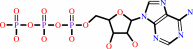 ATP
ATP
|
=
|
O-phospho-L-tyrosyl-[protein]
|
+
|
 ADP
ADP
|
+
|
H(+)
|
|
|
|
|
|
|
|
|
|
|
|
|
Molecule diagrams generated from .mol files obtained from the
KEGG ftp site
|
|
|
|
|
|
|
|
|
|
|
|
|
|
 |
|
|
|
|
|
|
| |
|
|
| |
|
DOI no:
|
Mol Cell
3:639-648
(1999)
|
|
PubMed id:
|
|
|
|
|
|
| |
|
Crystal structure of Hck in complex with a Src family-selective tyrosine kinase inhibitor.
|
|
T.Schindler,
F.Sicheri,
A.Pico,
A.Gazit,
A.Levitzki,
J.Kuriyan.
|
|
|
|
|
| |
ABSTRACT
|
|
|
|
| |
|
|
The crystal structure of the autoinhibited form of Hck has been determined at
2.0 A resolution, in complex with a specific pyrazolo pyrimidine-type inhibitor,
PP1. The activation segment, a key regulatory component of the catalytic domain,
is unphosphorylated and is visualized in its entirety. Tyr-416, the site of
activating autophosphorylation in the Src family kinases, is positioned such
that access to the catalytic machinery is blocked. PP1 is bound at the
ATP-binding site of the kinase, and a methylphenyl group on PP1 is inserted into
an adjacent hydrophobic pocket. The enlargement of this pocket in autoinhibited
Src kinases suggests a route toward the development of inhibitors that are
specific for the inactive forms of these proteins.
|
|
|
|
|
|
| |
Selected figure(s)
|
|
|
|
| |
|
|

|
|

|
|
Figure 4.
Figure 4. Interdependence of the Conformations of Helix αC
and the Activation SegmentThe catalytic domain of inactive Hck
is shown superimposed on that of active Lck ([45]) (A) and of
inactive Cdk2 (B) ( [6]). The structural alignments are based on
the C-terminal lobe in (A) and on the β strands in the
N-terminal lobe of the kinase domains in (B). Helix αC (α1 in
Cdk2) and the activation segment are colored in blue, red, and
green for Hck, Lck, and Cdk2, respectively. The figure was
generated using RIBBONS ( [5]).
|
|
Figure 7.
Figure 7. PP1 Leaves Unfilled a Cavity in Inactive Hck(A)
Structure of the PP1-binding region in inactive Hck. PP1 binding
creates a cavity (yellow surface) in the back of the ATP-binding
site, where two well-ordered water molecules (W1 and W2) are
found.(B) The same cavity (yellow) viewed from the top of the
N-terminal lobe of the catalytic domain. The collapse of this
cavity in active Lck is indicated by showing helix αC as found
in the structure of Lck (PDB code 3lck; [45]), drawn in orange.
|
|
|
|
|
|
| |
The above figures are
reprinted
by permission from Cell Press:
Mol Cell
(1999,
3,
639-648)
copyright 1999.
|
|
| |
Figures were
selected
by an automated process.
|
|
|
|
|
|
|
|
|
|
|
|
|
|
|
|
 |
 |
 |
|
Literature references that cite this PDB file's key reference
|
|
|
| |
PubMed id
|
|
Reference
|
|
|
|
|
|
J.A.Di Paolo,
T.Huang,
M.Balazs,
J.Barbosa,
K.H.Barck,
B.J.Bravo,
R.A.Carano,
J.Darrow,
D.R.Davies,
L.E.DeForge,
L.Diehl,
R.Ferrando,
S.L.Gallion,
A.M.Giannetti,
P.Gribling,
V.Hurez,
S.G.Hymowitz,
R.Jones,
J.E.Kropf,
W.P.Lee,
P.M.Maciejewski,
S.A.Mitchell,
H.Rong,
B.L.Staker,
J.A.Whitney,
S.Yeh,
W.B.Young,
C.Yu,
J.Zhang,
K.Reif,
and
K.S.Currie
(2011).
Specific Btk inhibition suppresses B cell- and myeloid cell-mediated arthritis.
|
| |
Nat Chem Biol,
7,
41-50.
|
|
|
|
|
|
|
L.P.O'Reilly,
S.C.Watkins,
and
T.E.Smithgall
(2011).
An unexpected role for the clock protein timeless in developmental apoptosis.
|
| |
PLoS One,
6,
e17157.
|
|
|
|
|
|
|
N.Jura,
X.Zhang,
N.F.Endres,
M.A.Seeliger,
T.Schindler,
and
J.Kuriyan
(2011).
Catalytic control in the EGF receptor and its connection to general kinase regulatory mechanisms.
|
| |
Mol Cell,
42,
9.
|
|
|
|
|
|
|
S.B.Gabelli,
D.Mandelker,
O.Schmidt-Kittler,
B.Vogelstein,
and
L.M.Amzel
(2010).
Somatic mutations in PI3Kalpha: structural basis for enzyme activation and drug design.
|
| |
Biochim Biophys Acta,
1804,
533-540.
|
|
|
|
|
|
|
S.I.O'Donoghue,
D.S.Goodsell,
A.S.Frangakis,
F.Jossinet,
R.A.Laskowski,
M.Nilges,
H.R.Saibil,
A.Schafferhans,
R.C.Wade,
E.Westhof,
and
A.J.Olson
(2010).
Visualization of macromolecular structures.
|
| |
Nat Methods,
7,
S42-S55.
|
|
|
|
|
|
|
S.Yang,
L.Blachowicz,
L.Makowski,
and
B.Roux
(2010).
Multidomain assembled states of Hck tyrosine kinase in solution.
|
| |
Proc Natl Acad Sci U S A,
107,
15757-15762.
|
|
|
|
|
|
|
B.B.Au-Yeung,
S.Deindl,
L.Y.Hsu,
E.H.Palacios,
S.E.Levin,
J.Kuriyan,
and
A.Weiss
(2009).
The structure, regulation, and function of ZAP-70.
|
| |
Immunol Rev,
228,
41-57.
|
|
|
|
|
|
|
B.D.Néel,
J.Lopez,
A.Chabadel,
and
G.Gillet
(2009).
Lithium suppresses motility and invasivity of v-src-transformed cells by glutathione-dependent activation of phosphotyrosine phosphatases.
|
| |
Oncogene,
28,
3246-3260.
|
|
|
|
|
|
|
C.Brignatz,
M.P.Paronetto,
S.Opi,
M.Cappellari,
S.Audebert,
V.Feuillet,
G.Bismuth,
S.Roche,
S.T.Arold,
C.Sette,
and
Y.Collette
(2009).
Alternative splicing modulates autoinhibition and SH3 accessibility in the Src kinase Fyn.
|
| |
Mol Cell Biol,
29,
6438-6448.
|
|
|
|
|
|
|
H.Huang,
E.Ozkirimli,
and
C.B.Post
(2009).
A Comparison of Three Perturbation Molecular Dynamics Methods for Modeling Conformational Transitions.
|
| |
J Chem Theory Comput,
5,
1301-1314.
|
|
|
|
|
|
|
J.Zhao,
Y.Zhang,
S.S.Ithychanda,
Y.Tu,
K.Chen,
J.Qin,
and
C.Wu
(2009).
Migfilin interacts with Src and contributes to cell-matrix adhesion-mediated survival signaling.
|
| |
J Biol Chem,
284,
34308-34320.
|
|
|
|
|
|
|
L.Emert-Sedlak,
T.Kodama,
E.C.Lerner,
W.Dai,
C.Foster,
B.W.Day,
J.S.Lazo,
and
T.E.Smithgall
(2009).
Chemical library screens targeting an HIV-1 accessory factor/host cell kinase complex identify novel antiretroviral compounds.
|
| |
ACS Chem Biol,
4,
939-947.
|
|
|
|
|
|
|
M.A.Meyn,
and
T.E.Smithgall
(2009).
Chemical genetics identifies c-Src as an activator of primitive ectoderm formation in murine embryonic stem cells.
|
| |
Sci Signal,
2,
ra64.
|
|
|
|
|
|
|
M.A.Seeliger,
P.Ranjitkar,
C.Kasap,
Y.Shan,
D.E.Shaw,
N.P.Shah,
J.Kuriyan,
and
D.J.Maly
(2009).
Equally potent inhibition of c-Src and Abl by compounds that recognize inactive kinase conformations.
|
| |
Cancer Res,
69,
2384-2392.
|
|
|
PDB codes:
|
|
|
|
|
|
|
|
N.K.Banavali,
and
B.Roux
(2009).
Flexibility and charge asymmetry in the activation loop of Src tyrosine kinases.
|
| |
Proteins,
74,
378-389.
|
|
|
|
|
|
|
N.K.Williams,
I.S.Lucet,
S.P.Klinken,
E.Ingley,
and
J.Rossjohn
(2009).
Crystal Structures of the Lyn Protein Tyrosine Kinase Domain in Its Apo- and Inhibitor-bound State.
|
| |
J Biol Chem,
284,
284-291.
|
|
|
PDB codes:
|
|
|
|
|
|
|
|
N.M.Levinson,
P.R.Visperas,
and
J.Kuriyan
(2009).
The tyrosine kinase Csk dimerizes through Its SH3 domain.
|
| |
PLoS One,
4,
e7683.
|
|
|
|
|
|
|
R.Barouch-Bentov,
J.Che,
C.C.Lee,
Y.Yang,
A.Herman,
Y.Jia,
A.Velentza,
J.Watson,
L.Sternberg,
S.Kim,
N.Ziaee,
A.Miller,
C.Jackson,
M.Fujimoto,
M.Young,
S.Batalov,
Y.Liu,
M.Warmuth,
T.Wiltshire,
M.P.Cooke,
and
K.Sauer
(2009).
A conserved salt bridge in the G loop of multiple protein kinases is important for catalysis and for in vivo Lyn function.
|
| |
Mol Cell,
33,
43-52.
|
|
|
|
|
|
|
R.Bose,
and
X.Zhang
(2009).
The ErbB kinase domain: structural perspectives into kinase activation and inhibition.
|
| |
Exp Cell Res,
315,
649-658.
|
|
|
|
|
|
|
R.E.Iacob,
T.Pene-Dumitrescu,
J.Zhang,
N.S.Gray,
T.E.Smithgall,
and
J.R.Engen
(2009).
Conformational disturbance in Abl kinase upon mutation and deregulation.
|
| |
Proc Natl Acad Sci U S A,
106,
1386-1391.
|
|
|
|
|
|
|
S.Barchéchath,
C.Williams,
K.Saade,
S.Lauwagie,
and
B.Jean-Claude
(2009).
Rational design of multitargeted tyrosine kinase inhibitors: a novel approach.
|
| |
Chem Biol Drug Des,
73,
380-387.
|
|
|
|
|
|
|
S.Deindl,
T.A.Kadlecek,
X.Cao,
J.Kuriyan,
and
A.Weiss
(2009).
Stability of an autoinhibitory interface in the structure of the tyrosine kinase ZAP-70 impacts T cell receptor response.
|
| |
Proc Natl Acad Sci U S A,
106,
20699-20704.
|
|
|
|
|
|
|
S.Yang,
N.K.Banavali,
and
B.Roux
(2009).
Mapping the conformational transition in Src activation by cumulating the information from multiple molecular dynamics trajectories.
|
| |
Proc Natl Acad Sci U S A,
106,
3776-3781.
|
|
|
|
|
|
|
T.S.Lee,
W.Ma,
X.Zhang,
H.Kantarjian,
and
M.Albitar
(2009).
Structural effects of clinically observed mutations in JAK2 exons 13-15: comparison with V617F and exon 12 mutations.
|
| |
BMC Struct Biol,
9,
58.
|
|
|
|
|
|
|
Y.Zhang,
Y.Tu,
J.Zhao,
K.Chen,
and
C.Wu
(2009).
Reversion-induced LIM interaction with Src reveals a novel Src inactivation cycle.
|
| |
J Cell Biol,
184,
785-792.
|
|
|
|
|
|
|
A.C.Dar,
M.S.Lopez,
and
K.M.Shokat
(2008).
Small molecule recognition of c-Src via the Imatinib-binding conformation.
|
| |
Chem Biol,
15,
1015-1022.
|
|
|
PDB codes:
|
|
|
|
|
|
|
|
B.Apsel,
J.A.Blair,
B.Gonzalez,
T.M.Nazif,
M.E.Feldman,
B.Aizenstein,
R.Hoffman,
R.L.Williams,
K.M.Shokat,
and
Z.A.Knight
(2008).
Targeted polypharmacology: discovery of dual inhibitors of tyrosine and phosphoinositide kinases.
|
| |
Nat Chem Biol,
4,
691-699.
|
|
|
PDB codes:
|
|
|
|
|
|
|
|
D.E.Johnson
(2008).
Src family kinases and the MEK/ERK pathway in the regulation of myeloid differentiation and myeloid leukemogenesis.
|
| |
Adv Enzyme Regul,
48,
98.
|
|
|
|
|
|
|
D.R.Caffrey,
E.A.Lunney,
and
D.J.Moshinsky
(2008).
Prediction of specificity-determining residues for small-molecule kinase inhibitors.
|
| |
BMC Bioinformatics,
9,
491.
|
|
|
|
|
|
|
E.Ozkirimli,
S.S.Yadav,
W.T.Miller,
and
C.B.Post
(2008).
An electrostatic network and long-range regulation of Src kinases.
|
| |
Protein Sci,
17,
1871-1880.
|
|
|
|
|
|
|
J.Won,
and
G.H.Lee
(2008).
T-cell-targeted signaling inhibitors.
|
| |
Int Rev Immunol,
27,
19-41.
|
|
|
|
|
|
|
J.Wu,
C.S.Bohanan,
J.C.Neumann,
and
J.B.Lingrel
(2008).
KLF2 transcription factor modulates blood vessel maturation through smooth muscle cell migration.
|
| |
J Biol Chem,
283,
3942-3950.
|
|
|
|
|
|
|
L.Perrone,
G.Peluso,
and
M.A.Melone
(2008).
RAGE recycles at the plasma membrane in S100B secretory vesicles and promotes Schwann cells morphological changes.
|
| |
J Cell Physiol,
217,
60-71.
|
|
|
|
|
|
|
M.H.Tomasson,
Z.Xiang,
R.Walgren,
Y.Zhao,
Y.Kasai,
T.Miner,
R.E.Ries,
O.Lubman,
D.H.Fremont,
M.D.McLellan,
J.E.Payton,
P.Westervelt,
J.F.DiPersio,
D.C.Link,
M.J.Walter,
T.A.Graubert,
M.Watson,
J.Baty,
S.Heath,
W.D.Shannon,
R.Nagarajan,
C.D.Bloomfield,
E.R.Mardis,
R.K.Wilson,
and
T.J.Ley
(2008).
Somatic mutations and germline sequence variants in the expressed tyrosine kinase genes of patients with de novo acute myeloid leukemia.
|
| |
Blood,
111,
4797-4808.
|
|
|
|
|
|
|
S.Chen,
T.P.Dumitrescu,
T.E.Smithgall,
and
J.R.Engen
(2008).
Abl N-terminal cap stabilization of SH3 domain dynamics.
|
| |
Biochemistry,
47,
5795-5803.
|
|
|
|
|
|
|
S.Yang,
and
B.Roux
(2008).
Src kinase conformational activation: thermodynamics, pathways, and mechanisms.
|
| |
PLoS Comput Biol,
4,
e1000047.
|
|
|
|
|
|
|
T.Pene-Dumitrescu,
L.F.Peterson,
N.J.Donato,
and
T.E.Smithgall
(2008).
An inhibitor-resistant mutant of Hck protects CML cells against the antiproliferative and apoptotic effects of the broad-spectrum Src family kinase inhibitor A-419259.
|
| |
Oncogene,
27,
7055-7069.
|
|
|
|
|
|
|
Y.Mori,
T.Hirokawa,
K.Aoki,
H.Satomi,
S.Takeda,
M.Aburada,
and
K.Miyamoto
(2008).
Structure activity relationships of quinoxalin-2-one derivatives as platelet-derived growth factor-beta receptor (PDGFbeta R) inhibitors, derived from molecular modeling.
|
| |
Chem Pharm Bull (Tokyo),
56,
682-687.
|
|
|
|
|
|
|
A.Kumar,
Y.Wang,
X.Lin,
G.Sun,
and
K.Parang
(2007).
Synthesis and Evaluation of 3-Phenylpyrazolo[3,4-d]pyrimidine-Peptide Conjugates as Src Kinase Inhibitors.
|
| |
ChemMedChem,
2,
1346-1360.
|
|
|
|
|
|
|
G.M.Verkhivker
(2007).
In silico profiling of tyrosine kinases binding specificity and drug resistance using Monte Carlo simulations with the ensembles of protein kinase crystal structures.
|
| |
Biopolymers,
85,
333-348.
|
|
|
|
|
|
|
G.M.Verkhivker
(2007).
Computational proteomics of biomolecular interactions in the sequence and structure space of the tyrosine kinome: deciphering the molecular basis of the kinase inhibitors selectivity.
|
| |
Proteins,
66,
912-929.
|
|
|
|
|
|
|
H.Zhang,
A.Berezov,
Q.Wang,
G.Zhang,
J.Drebin,
R.Murali,
and
M.I.Greene
(2007).
ErbB receptors: from oncogenes to targeted cancer therapies.
|
| |
J Clin Invest,
117,
2051-2058.
|
|
|
|
|
|
|
I.Plaza-Menacho,
L.Mologni,
E.Sala,
C.Gambacorti-Passerini,
A.I.Magee,
T.P.Links,
R.M.Hofstra,
D.Barford,
and
C.M.Isacke
(2007).
Sorafenib functions to potently suppress RET tyrosine kinase activity by direct enzymatic inhibition and promoting RET lysosomal degradation independent of proteasomal targeting.
|
| |
J Biol Chem,
282,
29230-29240.
|
|
|
|
|
|
|
J.D.Faraldo-Gómez,
and
B.Roux
(2007).
On the importance of a funneled energy landscape for the assembly and regulation of multidomain Src tyrosine kinases.
|
| |
Proc Natl Acad Sci U S A,
104,
13643-13648.
|
|
|
|
|
|
|
J.L.Mitchell,
R.P.Trible,
L.A.Emert-Sedlak,
D.D.Weis,
E.C.Lerner,
J.J.Applen,
B.M.Sefton,
T.E.Smithgall,
and
J.R.Engen
(2007).
Functional characterization and conformational analysis of the Herpesvirus saimiri Tip-C484 protein.
|
| |
J Mol Biol,
366,
1282-1293.
|
|
|
|
|
|
|
K.G.Zheng,
X.Q.Meng,
Y.Yang,
Y.S.Yu,
D.C.Liu,
and
Y.L.Li
(2007).
Requirements of Src family kinase during meiotic maturation in mouse oocyte.
|
| |
Mol Reprod Dev,
74,
125-130.
|
|
|
|
|
|
|
M.A.Seeliger,
B.Nagar,
F.Frank,
X.Cao,
M.N.Henderson,
and
J.Kuriyan
(2007).
c-Src binds to the cancer drug imatinib with an inactive Abl/c-Kit conformation and a distributed thermodynamic penalty.
|
| |
Structure,
15,
299-311.
|
|
|
PDB code:
|
|
|
|
|
|
|
|
N.K.Banavali,
and
B.Roux
(2007).
Anatomy of a structural pathway for activation of the catalytic domain of Src kinase Hck.
|
| |
Proteins,
67,
1096-1112.
|
|
|
|
|
|
|
R.P.Trible,
L.Emert-Sedlak,
T.E.Wales,
V.Ayyavoo,
J.R.Engen,
and
T.E.Smithgall
(2007).
Allosteric loss-of-function mutations in HIV-1 Nef from a long-term non-progressor.
|
| |
J Mol Biol,
374,
121-129.
|
|
|
|
|
|
|
S.Chen,
S.Brier,
T.E.Smithgall,
and
J.R.Engen
(2007).
The Abl SH2-kinase linker naturally adopts a conformation competent for SH3 domain binding.
|
| |
Protein Sci,
16,
572-581.
|
|
|
|
|
|
|
S.Deindl,
T.A.Kadlecek,
T.Brdicka,
X.Cao,
A.Weiss,
and
J.Kuriyan
(2007).
Structural basis for the inhibition of tyrosine kinase activity of ZAP-70.
|
| |
Cell,
129,
735-746.
|
|
|
PDB code:
|
|
|
|
|
|
|
|
T.Furukawa,
and
J.Kurokawa
(2007).
Regulation of cardiac ion channels via non-genomic action of sex steroid hormones: implication for the gender difference in cardiac arrhythmias.
|
| |
Pharmacol Ther,
115,
106-115.
|
|
|
|
|
|
|
Y.Gus,
R.Karni,
and
A.Levitzki
(2007).
Subunit S5a of the 26S proteasome is regulated by antiapoptotic signals.
|
| |
FEBS J,
274,
2815-2831.
|
|
|
|
|
|
|
A.Levitzki,
and
E.Mishani
(2006).
Tyrphostins and other tyrosine kinase inhibitors.
|
| |
Annu Rev Biochem,
75,
93.
|
|
|
|
|
|
|
A.Marx,
C.Nugoor,
J.Müller,
S.Panneerselvam,
T.Timm,
M.Bilang,
E.Mylonas,
D.I.Svergun,
E.M.Mandelkow,
and
E.Mandelkow
(2006).
Structural variations in the catalytic and ubiquitin-associated domains of microtubule-associated protein/microtubule affinity regulating kinase (MARK) 1 and MARK2.
|
| |
J Biol Chem,
281,
27586-27599.
|
|
|
PDB code:
|
|
|
|
|
|
|
|
D.Dalgarno,
T.Stehle,
S.Narula,
P.Schelling,
M.R.van Schravendijk,
S.Adams,
L.Andrade,
J.Keats,
M.Ram,
L.Jin,
T.Grossman,
I.MacNeil,
C.Metcalf,
W.Shakespeare,
Y.Wang,
T.Keenan,
R.Sundaramoorthi,
R.Bohacek,
M.Weigele,
and
T.Sawyer
(2006).
Structural basis of Src tyrosine kinase inhibition with a new class of potent and selective trisubstituted purine-based compounds.
|
| |
Chem Biol Drug Des,
67,
46-57.
|
|
|
PDB codes:
|
|
|
|
|
|
|
|
E.Ozkirimli,
and
C.B.Post
(2006).
Src kinase activation: A switched electrostatic network.
|
| |
Protein Sci,
15,
1051-1062.
|
|
|
|
|
|
|
G.Daoud,
E.Rassart,
A.Masse,
and
J.Lafond
(2006).
Src family kinases play multiple roles in differentiation of trophoblasts from human term placenta.
|
| |
J Physiol,
571,
537-553.
|
|
|
|
|
|
|
H.X.Zhou
(2006).
Quantitative relation between intermolecular and intramolecular binding of pro-rich peptides to SH3 domains.
|
| |
Biophys J,
91,
3170-3181.
|
|
|
|
|
|
|
J.M.Hochrein,
E.C.Lerner,
A.P.Schiavone,
T.E.Smithgall,
and
J.R.Engen
(2006).
An examination of dynamics crosstalk between SH2 and SH3 domains by hydrogen/deuterium exchange and mass spectrometry.
|
| |
Protein Sci,
15,
65-73.
|
|
|
|
|
|
|
M.A.Meyn,
M.B.Wilson,
F.A.Abdi,
N.Fahey,
A.P.Schiavone,
J.Wu,
J.M.Hochrein,
J.R.Engen,
and
T.E.Smithgall
(2006).
Src family kinases phosphorylate the Bcr-Abl SH3-SH2 region and modulate Bcr-Abl transforming activity.
|
| |
J Biol Chem,
281,
30907-30916.
|
|
|
|
|
|
|
M.Maeda,
Y.Shintani,
M.J.Wheelock,
and
K.R.Johnson
(2006).
Src activation is not necessary for transforming growth factor (TGF)-beta-mediated epithelial to mesenchymal transitions (EMT) in mammary epithelial cells. PP1 directly inhibits TGF-beta receptors I and II.
|
| |
J Biol Chem,
281,
59-68.
|
|
|
|
|
|
|
N.M.Levinson,
O.Kuchment,
K.Shen,
M.A.Young,
M.Koldobskiy,
M.Karplus,
P.A.Cole,
and
J.Kuriyan
(2006).
A Src-like inactive conformation in the abl tyrosine kinase domain.
|
| |
PLoS Biol,
4,
e144.
|
|
|
PDB codes:
|
|
|
|
|
|
|
|
P.Pellicena,
and
J.Kuriyan
(2006).
Protein-protein interactions in the allosteric regulation of protein kinases.
|
| |
Curr Opin Struct Biol,
16,
702-709.
|
|
|
|
|
|
|
R.P.Trible,
L.Emert-Sedlak,
and
T.E.Smithgall
(2006).
HIV-1 Nef selectively activates Src family kinases Hck, Lyn, and c-Src through direct SH3 domain interaction.
|
| |
J Biol Chem,
281,
27029-27038.
|
|
|
|
|
|
|
S.E.Winograd-Katz,
and
A.Levitzki
(2006).
Cisplatin induces PKB/Akt activation and p38(MAPK) phosphorylation of the EGF receptor.
|
| |
Oncogene,
25,
7381-7390.
|
|
|
|
|
|
|
X.Zhang,
J.Gureasko,
K.Shen,
P.A.Cole,
and
J.Kuriyan
(2006).
An allosteric mechanism for activation of the kinase domain of epidermal growth factor receptor.
|
| |
Cell,
125,
1137-1149.
|
|
|
PDB codes:
|
|
|
|
|
|
|
|
Z.A.Knight,
B.Gonzalez,
M.E.Feldman,
E.R.Zunder,
D.D.Goldenberg,
O.Williams,
R.Loewith,
D.Stokoe,
A.Balla,
B.Toth,
T.Balla,
W.A.Weiss,
R.L.Williams,
and
K.M.Shokat
(2006).
A pharmacological map of the PI3-K family defines a role for p110alpha in insulin signaling.
|
| |
Cell,
125,
733-747.
|
|
|
PDB codes:
|
|
|
|
|
|
|
|
A.Gill,
A.Cleasby,
and
H.Jhoti
(2005).
The discovery of novel protein kinase inhibitors by using fragment-based high-throughput x-ray crystallography.
|
| |
Chembiochem,
6,
506-512.
|
|
|
|
|
|
|
E.C.Lerner,
R.P.Trible,
A.P.Schiavone,
J.M.Hochrein,
J.R.Engen,
and
T.E.Smithgall
(2005).
Activation of the Src family kinase Hck without SH3-linker release.
|
| |
J Biol Chem,
280,
40832-40837.
|
|
|
|
|
|
|
G.H.Iyer,
M.J.Moore,
and
S.S.Taylor
(2005).
Consequences of lysine 72 mutation on the phosphorylation and activation state of cAMP-dependent kinase.
|
| |
J Biol Chem,
280,
8800-8807.
|
|
|
|
|
|
|
M.S.Cohen,
C.Zhang,
K.M.Shokat,
and
J.Taunton
(2005).
Structural bioinformatics-based design of selective, irreversible kinase inhibitors.
|
| |
Science,
308,
1318-1321.
|
|
|
|
|
|
|
M.Tanaka,
R.Bateman,
D.Rauh,
E.Vaisberg,
S.Ramachandani,
C.Zhang,
K.C.Hansen,
A.L.Burlingame,
J.K.Trautman,
K.M.Shokat,
and
C.L.Adams
(2005).
An unbiased cell morphology-based screen for new, biologically active small molecules.
|
| |
PLoS Biol,
3,
e128.
|
|
|
PDB code:
|
|
|
|
|
|
|
|
N.Hosoya,
Y.Qiao,
A.Hangaishi,
L.Wang,
Y.Nannya,
M.Sanada,
M.Kurokawa,
S.Chiba,
H.Hirai,
and
S.Ogawa
(2005).
Identification of a SRC-like tyrosine kinase gene, FRK, fused with ETV6 in a patient with acute myelogenous leukemia carrying a t(6;12)(q21;p13) translocation.
|
| |
Genes Chromosomes Cancer,
42,
269-279.
|
|
|
|
|
|
|
N.K.Banavali,
and
B.Roux
(2005).
The N-terminal end of the catalytic domain of SRC kinase Hck is a conformational switch implicated in long-range allosteric regulation.
|
| |
Structure,
13,
1715-1723.
|
|
|
|
|
|
|
R.Karni,
Y.Gus,
Y.Dor,
O.Meyuhas,
and
A.Levitzki
(2005).
Active Src elevates the expression of beta-catenin by enhancement of cap-dependent translation.
|
| |
Mol Cell Biol,
25,
5031-5039.
|
|
|
|
|
|
|
S.W.Cowan-Jacob,
G.Fendrich,
P.W.Manley,
W.Jahnke,
D.Fabbro,
J.Liebetanz,
and
T.Meyer
(2005).
The crystal structure of a c-Src complex in an active conformation suggests possible steps in c-Src activation.
|
| |
Structure,
13,
861-871.
|
|
|
PDB code:
|
|
|
|
|
|
|
|
A.Giannini,
and
M.J.Bijlmakers
(2004).
Regulation of the Src family kinase Lck by Hsp90 and ubiquitination.
|
| |
Mol Cell Biol,
24,
5667-5676.
|
|
|
|
|
|
|
J.Felberg,
D.C.Lefebvre,
M.Lam,
Y.Wang,
D.H.Ng,
D.Birkenhead,
J.L.Cross,
and
P.Johnson
(2004).
Subdomain X of the kinase domain of Lck binds CD45 and facilitates dephosphorylation.
|
| |
J Biol Chem,
279,
3455-3462.
|
|
|
|
|
|
|
N.J.Dibb,
S.M.Dilworth,
and
C.D.Mol
(2004).
Switching on kinases: oncogenic activation of BRAF and the PDGFR family.
|
| |
Nat Rev Cancer,
4,
718-727.
|
|
|
|
|
|
|
S.Atwell,
J.M.Adams,
J.Badger,
M.D.Buchanan,
I.K.Feil,
K.J.Froning,
X.Gao,
J.Hendle,
K.Keegan,
B.C.Leon,
H.J.Müller-Dieckmann,
V.L.Nienaber,
B.W.Noland,
K.Post,
K.R.Rajashankar,
A.Ramos,
M.Russell,
S.K.Burley,
and
S.G.Buchanan
(2004).
A novel mode of Gleevec binding is revealed by the structure of spleen tyrosine kinase.
|
| |
J Biol Chem,
279,
55827-55832.
|
|
|
PDB codes:
|
|
|
|
|
|
|
|
T.Maruyama,
Y.Yamamoto,
A.Shimizu,
H.Masuda,
N.Sakai,
R.Sakurai,
H.Asada,
and
Y.Yoshimura
(2004).
Pyrazolo pyrimidine-type inhibitors of SRC family tyrosine kinases promote ovarian steroid-induced differentiation of human endometrial stromal cells in vitro.
|
| |
Biol Reprod,
70,
214-221.
|
|
|
|
|
|
|
T.Prince,
and
R.L.Matts
(2004).
Definition of protein kinase sequence motifs that trigger high affinity binding of Hsp90 and Cdc37.
|
| |
J Biol Chem,
279,
39975-39981.
|
|
|
|
|
|
|
B.Nagar,
O.Hantschel,
M.A.Young,
K.Scheffzek,
D.Veach,
W.Bornmann,
B.Clarkson,
G.Superti-Furga,
and
J.Kuriyan
(2003).
Structural basis for the autoinhibition of c-Abl tyrosine kinase.
|
| |
Cell,
112,
859-871.
|
|
|
PDB codes:
|
|
|
|
|
|
|
|
F.D.Böhmer,
L.Karagyozov,
A.Uecker,
H.Serve,
A.Botzki,
S.Mahboobi,
and
S.Dove
(2003).
A single amino acid exchange inverts susceptibility of related receptor tyrosine kinases for the ATP site inhibitor STI-571.
|
| |
J Biol Chem,
278,
5148-5155.
|
|
|
|
|
|
|
F.R.Papa,
C.Zhang,
K.Shokat,
and
P.Walter
(2003).
Bypassing a kinase activity with an ATP-competitive drug.
|
| |
Science,
302,
1533-1537.
|
|
|
|
|
|
|
J.Chen,
J.B.Anderson,
C.DeWeese-Scott,
N.D.Fedorova,
L.Y.Geer,
S.He,
D.I.Hurwitz,
J.D.Jackson,
A.R.Jacobs,
C.J.Lanczycki,
C.A.Liebert,
C.Liu,
T.Madej,
A.Marchler-Bauer,
G.H.Marchler,
R.Mazumder,
A.N.Nikolskaya,
B.S.Rao,
A.R.Panchenko,
B.A.Shoemaker,
V.Simonyan,
J.S.Song,
P.A.Thiessen,
S.Vasudevan,
Y.Wang,
R.A.Yamashita,
J.J.Yin,
and
S.H.Bryant
(2003).
MMDB: Entrez's 3D-structure database.
|
| |
Nucleic Acids Res,
31,
474-477.
|
|
|
|
|
|
|
J.Zhou,
J.Scholes,
and
J.T.Hsieh
(2003).
Characterization of a novel negative regulator (DOC-2/DAB2) of c-Src in normal prostatic epithelium and cancer.
|
| |
J Biol Chem,
278,
6936-6941.
|
|
|
|
|
|
|
K.Q.Tanis,
D.Veach,
H.S.Duewel,
W.G.Bornmann,
and
A.J.Koleske
(2003).
Two distinct phosphorylation pathways have additive effects on Abl family kinase activation.
|
| |
Mol Cell Biol,
23,
3884-3896.
|
|
|
|
|
|
|
M.J.Moore,
J.A.Adams,
and
S.S.Taylor
(2003).
Structural basis for peptide binding in protein kinase A. Role of glutamic acid 203 and tyrosine 204 in the peptide-positioning loop.
|
| |
J Biol Chem,
278,
10613-10618.
|
|
|
|
|
|
|
S.C.Harrison
(2003).
Variation on an Src-like theme.
|
| |
Cell,
112,
737-740.
|
|
|
|
|
|
|
W.T.Miller
(2003).
Determinants of substrate recognition in nonreceptor tyrosine kinases.
|
| |
Acc Chem Res,
36,
393-400.
|
|
|
|
|
|
|
C.K.Kassenbrock,
S.Hunter,
P.Garl,
G.L.Johnson,
and
S.M.Anderson
(2002).
Inhibition of Src family kinases blocks epidermal growth factor (EGF)-induced activation of Akt, phosphorylation of c-Cbl, and ubiquitination of the EGF receptor.
|
| |
J Biol Chem,
277,
24967-24975.
|
|
|
|
|
|
|
E.C.Lerner,
and
T.E.Smithgall
(2002).
SH3-dependent stimulation of Src-family kinase autophosphorylation without tail release from the SH2 domain in vivo.
|
| |
Nat Struct Biol,
9,
365-369.
|
|
|
|
|
|
|
G.Scapin
(2002).
Structural biology in drug design: selective protein kinase inhibitors.
|
| |
Drug Discov Today,
7,
601-611.
|
|
|
|
|
|
|
H.Qiu,
and
W.T.Miller
(2002).
Regulation of the nonreceptor tyrosine kinase Brk by autophosphorylation and by autoinhibition.
|
| |
J Biol Chem,
277,
34634-34641.
|
|
|
|
|
|
|
M.C.Frame
(2002).
Src in cancer: deregulation and consequences for cell behaviour.
|
| |
Biochim Biophys Acta,
1602,
114-130.
|
|
|
|
|
|
|
M.Huse,
and
J.Kuriyan
(2002).
The conformational plasticity of protein kinases.
|
| |
Cell,
109,
275-282.
|
|
|
|
|
|
|
R.A.Engh,
and
D.Bossemeyer
(2002).
Structural aspects of protein kinase control-role of conformational flexibility.
|
| |
Pharmacol Ther,
93,
99.
|
|
|
|
|
|
|
R.Karni,
Y.Dor,
E.Keshet,
O.Meyuhas,
and
A.Levitzki
(2002).
Activated pp60c-Src leads to elevated hypoxia-inducible factor (HIF)-1alpha expression under normoxia.
|
| |
J Biol Chem,
277,
42919-42925.
|
|
|
|
|
|
|
S.J.Schreiner,
A.P.Schiavone,
and
T.E.Smithgall
(2002).
Activation of STAT3 by the Src family kinase Hck requires a functional SH3 domain.
|
| |
J Biol Chem,
277,
45680-45687.
|
|
|
|
|
|
|
A.C.Bishop,
O.Buzko,
and
K.M.Shokat
(2001).
Magic bullets for protein kinases.
|
| |
Trends Cell Biol,
11,
167-172.
|
|
|
|
|
|
|
A.J.Ablooglu,
M.Frankel,
E.Rusinova,
J.B.Ross,
and
R.A.Kohanski
(2001).
Multiple activation loop conformations and their regulatory properties in the insulin receptor's kinase domain.
|
| |
J Biol Chem,
276,
46933-46940.
|
|
|
|
|
|
|
J.A.Fresno Vara,
M.A.Cáceres,
A.Silva,
and
J.Martín-Pérez
(2001).
Src family kinases are required for prolactin induction of cell proliferation.
|
| |
Mol Biol Cell,
12,
2171-2183.
|
|
|
|
|
|
|
L.H.Weaver,
K.Kwon,
D.Beckett,
and
B.W.Matthews
(2001).
Competing protein:protein interactions are proposed to control the biological switch of the E coli biotin repressor.
|
| |
Protein Sci,
10,
2618-2622.
|
|
|
PDB codes:
|
|
|
|
|
|
|
|
M.A.Young,
S.Gonfloni,
G.Superti-Furga,
B.Roux,
and
J.Kuriyan
(2001).
Dynamic coupling between the SH2 and SH3 domains of c-Src and Hck underlies their inactivation by C-terminal tyrosine phosphorylation.
|
| |
Cell,
105,
115-126.
|
|
|
|
|
|
|
M.Miller,
K.Ginalski,
B.Lesyng,
N.Nakaigawa,
L.Schmidt,
and
B.Zbar
(2001).
Structural basis of oncogenic activation caused by point mutations in the kinase domain of the MET proto-oncogene: modeling studies.
|
| |
Proteins,
44,
32-43.
|
|
|
|
|
|
|
N.V.Prabhu,
S.A.Siddiqui,
J.S.McMurray,
and
B.M.Pettitt
(2001).
Structural basis for the activity of pp60(c-src) protein tyrosine kinase inhibitors.
|
| |
Biopolymers,
59,
167-179.
|
|
|
|
|
|
|
R.Berisio,
A.Viguera,
L.Serrano,
and
M.Wilmanns
(2001).
Atomic resolution structure of a mutant of the spectrin SH3 domain.
|
| |
Acta Crystallogr D Biol Crystallogr,
57,
337-340.
|
|
|
PDB code:
|
|
|
|
|
|
|
|
V.Boonyaratanakornkit,
M.P.Scott,
V.Ribon,
L.Sherman,
S.M.Anderson,
J.L.Maller,
W.T.Miller,
and
D.P.Edwards
(2001).
Progesterone receptor contains a proline-rich motif that directly interacts with SH3 domains and activates c-Src family tyrosine kinases.
|
| |
Mol Cell,
8,
269-280.
|
|
|
|
|
|
|
A.F.Burchat,
D.J.Calderwood,
G.C.Hirst,
N.J.Holman,
D.N.Johnston,
R.Munschauer,
P.Rafferty,
and
G.B.Tometzki
(2000).
Pyrrolo[2,3-d]pyrimidines containing an extended 5-substituent as potent and selective inhibitors of lck II.
|
| |
Bioorg Med Chem Lett,
10,
2171-2174.
|
|
|
|
|
|
|
B.J.Druker,
and
N.B.Lydon
(2000).
Lessons learned from the development of an abl tyrosine kinase inhibitor for chronic myelogenous leukemia.
|
| |
J Clin Invest,
105,
3-7.
|
|
|
|
|
|
|
C.R.Weinstein-Oppenheimer,
W.L.Blalock,
L.S.Steelman,
F.Chang,
and
J.A.McCubrey
(2000).
The Raf signal transduction cascade as a target for chemotherapeutic intervention in growth factor-responsive tumors.
|
| |
Pharmacol Ther,
88,
229-279.
|
|
|
|
|
|
|
G.Scholz,
S.D.Hartson,
K.Cartledge,
N.Hall,
J.Shao,
A.R.Dunn,
and
R.L.Matts
(2000).
p50(Cdc37) can buffer the temperature-sensitive properties of a mutant of Hck.
|
| |
Mol Cell Biol,
20,
6984-6995.
|
|
|
|
|
|
|
L.D.Arnold,
D.J.Calderwood,
R.W.Dixon,
D.N.Johnston,
J.S.Kamens,
R.Munschauer,
P.Rafferty,
and
S.E.Ratnofsky
(2000).
Pyrrolo[2,3-d]pyrimidines containing an extended 5-substituent as potent and selective inhibitors of lck I.
|
| |
Bioorg Med Chem Lett,
10,
2167-2170.
|
|
|
|
|
|
|
M.P.Scott,
and
W.T.Miller
(2000).
A peptide model system for processive phosphorylation by Src family kinases.
|
| |
Biochemistry,
39,
14531-14537.
|
|
|
|
|
|
|
M.Porter,
T.Schindler,
J.Kuriyan,
and
W.T.Miller
(2000).
Reciprocal regulation of Hck activity by phosphorylation of Tyr(527) and Tyr(416). Effect of introducing a high affinity intramolecular SH2 ligand.
|
| |
J Biol Chem,
275,
2721-2726.
|
|
|
|
|
|
|
N.D.de Ruiter,
R.M.Wolthuis,
H.van Dam,
B.M.Burgering,
and
J.L.Bos
(2000).
Ras-dependent regulation of c-Jun phosphorylation is mediated by the Ral guanine nucleotide exchange factor-Ral pathway.
|
| |
Mol Cell Biol,
20,
8480-8488.
|
|
|
|
|
|
|
R.S.Gokhale,
and
C.Khosla
(2000).
Role of linkers in communication between protein modules.
|
| |
Curr Opin Chem Biol,
4,
22-27.
|
|
|
|
|
|
|
S.R.Hubbard,
and
J.H.Till
(2000).
Protein tyrosine kinase structure and function.
|
| |
Annu Rev Biochem,
69,
373-398.
|
|
|
|
|
|
|
T.Schindler,
W.Bornmann,
P.Pellicena,
W.T.Miller,
B.Clarkson,
and
J.Kuriyan
(2000).
Structural mechanism for STI-571 inhibition of abelson tyrosine kinase.
|
| |
Science,
289,
1938-1942.
|
|
|
PDB code:
|
|
|
|
|
|
|
|
Y.C.Ma,
J.Huang,
S.Ali,
W.Lowry,
and
X.Y.Huang
(2000).
Src tyrosine kinase is a novel direct effector of G proteins.
|
| |
Cell,
102,
635-646.
|
|
|
|
|
|
|
A.Sali,
and
J.Kuriyan
(1999).
Challenges at the frontiers of structural biology.
|
| |
Trends Cell Biol,
9,
M20-M24.
|
|
|
|
|
|
|
V.S.Kasi,
and
D.Kuppuswamy
(1999).
Inhibition of src family kinases by a combinatorial action of 5'-AMP and small heat shock proteins, identified from the adult heart.
|
| |
Mol Cell Biol,
19,
6858-6871.
|
|
|
|
|
|
|
W.Xu,
A.Doshi,
M.Lei,
M.J.Eck,
and
S.C.Harrison
(1999).
Crystal structures of c-Src reveal features of its autoinhibitory mechanism.
|
| |
Mol Cell,
3,
629-638.
|
|
|
PDB code:
|
|
|
|
|
|
|
|
Y.Liu,
A.Bishop,
L.Witucki,
B.Kraybill,
E.Shimizu,
J.Tsien,
J.Ubersax,
J.Blethrow,
D.O.Morgan,
and
K.M.Shokat
(1999).
Structural basis for selective inhibition of Src family kinases by PP1.
|
| |
Chem Biol,
6,
671-678.
|
|
|
|
|
|
The most recent references are shown first.
Citation data come partly from CiteXplore and partly
from an automated harvesting procedure. Note that this is likely to be
only a partial list as not all journals are covered by
either method. However, we are continually building up the citation data
so more and more references will be included with time.
Where a reference describes a PDB structure, the PDB
codes are
shown on the right.
|
|


 Links
Links


