 |
PDBsum entry 1orz

|
|
|
|
|
|

|

|

|

|
|

|
|

|
|

|
|

|
|
|
 |

|

|
|
|
|
|
|
|
|
|
|
|
|
|
|
|
|
|
|
|
|
|
|
|
|
|
|
|
|
|
|
|
|
|
Oxidoreductase
|
PDB id
|
|
|
|
1orz
|
|
|
|
|
|
|
|
|
|
|
|
|
|
|

|

|

|
|
|
|
|
|
|
|
 |
Contents |
 |
|
|
|
|
|
|
|
|
|
|
|
 612 a.a.
|
|
|
|
|
|
|
|
|
|
|
 246 a.a.
|
|
|
|
|
|
|
|
|
|
|
 148 a.a.
|
|
|
|
|
|
|
|
|
|
|
 150 a.a.
|
|
|
|
|
|
|
|
|
|
|
Theoretical model |
|
|
PDB id:
|
|
|
|
| Name: |
|
Oxidoreductase
|
|
|
Title:
|
|
Three-dimensional model of the saccharomyces cerevisiae succinate dehydrogenase
|
|
Structure:
|
|
Succinate dehydrogenase [ubiquinone] flavoprotein subunit, mitochondrial. Chain: a. Synonym: fp, flavoprotein subunit of complex ii, sdh1p. Succinate dehydrogenase [ubiquinone] iron-sulfur protein, mitochondrial. Chain: b. Synonym: ip, sdh2p. Succinate dehydrogenase cytochrome b subunit,
|
|
Source:
|
|
Saccharomyces cerevisiae. Yeast. Yeast
|
|
Authors:
|
|
K.S.Oyedotun,B.D.Lemire
|
Key ref:

|
|
K.S.Oyedotun
and
B.D.Lemire
(2004).
The quaternary structure of the Saccharomyces cerevisiae succinate dehydrogenase. Homology modeling, cofactor docking, and molecular dynamics simulation studies.
J Biol Chem,
279,
9424-9431.
PubMed id:
DOI:

|
|
|
Date:
|
|
|
17-Mar-03
|
Release date:
|
09-Mar-04
|
|
|
|
|
|
|
PROCHECK
|

|
|
|
|
|
Headers
|
|
|
|
References
|
|
|
|
|
|
|
|
|
|

|
|
Q00711
(DHSA_YEAST) -
Succinate dehydrogenase [ubiquinone] flavoprotein subunit, mitochondrial
|
|
|
|
Seq:
Struc:
|
|
|
|
640 a.a.
612 a.a.
|
|

|

|
|
|
|
|
|
|
|
|
|
|
|
|

|
|
P21801
(DHSB_YEAST) -
Succinate dehydrogenase [ubiquinone] iron-sulfur subunit, mitochondrial
|
|
|
|
Seq:
Struc:
|
|
|
|
266 a.a.
246 a.a.
|
|
|

|
|
|
|
|
|
|
|
|
|
|
|
|
|
|
|
|
|
Enzyme class:
|
|
Chains A, B:
E.C.1.3.5.1
- succinate dehydrogenase.
|
|
|
|
|
|
|
Pathway:
|
|
Citric acid cycle
|
|
|
|
|
|
Reaction:
|
|
a quinone + succinate = fumarate + a quinol
|
|
|
|
|
|
 quinone
|
+
|
 succinate
|
=
|
 fumarate
|
+
|
quinol
|
|
|
|
|
|
|
|
|
|
Cofactor:
|
|
FAD; Iron-sulfur
|
|
|
|
|
|
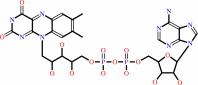 FAD
FAD
|
 Iron-sulfur
|
|
|
|
|
|
|
Molecule diagrams generated from .mol files obtained from the
KEGG ftp site
|
|
|
|
|
|
|
|
|
|
|
|
|
|
 |
|
|
|
|
|
|
| |
|
|
| |
|
DOI no:
|
J Biol Chem
279:9424-9431
(2004)
|
|
PubMed id:
|
|
|
|
|
|
| |
|
The quaternary structure of the Saccharomyces cerevisiae succinate dehydrogenase. Homology modeling, cofactor docking, and molecular dynamics simulation studies.
|
|
K.S.Oyedotun,
B.D.Lemire.
|
|
|
|
|
| |
ABSTRACT
|
|
|
|
| |
|
|
Succinate dehydrogenases and fumarate reductases are complex mitochondrial or
bacterial respiratory chain proteins with remarkably similar structures and
functions. Succinate dehydrogenase oxidizes succinate and reduces ubiquinone
using a flavin adenine dinucleotide cofactor and iron-sulfur clusters to
transport electrons. A model of the quaternary structure of the tetrameric
Saccharomyces cerevisiae succinate dehydrogenase was constructed based on the
crystal structures of the Escherichia coli succinate dehydrogenase, the E. coli
fumarate reductase, and the Wolinella succinogenes fumarate reductase. One FAD
and three iron-sulfur clusters were docked into the Sdh1p and Sdh2p catalytic
dimer. One b-type heme and two ubiquinone or inhibitor analog molecules were
docked into the Sdh3p and Sdh4p membrane dimer. The model is consistent with
numerous experimental observations. The calculated free energies of inhibitor
binding are in excellent agreement with the experimentally determined inhibitory
constants. Functionally important residues identified by mutagenesis of the SDH3
and SDH4 genes are located near the two proposed quinone-binding sites, which
are separated by the heme. The proximal quinone-binding site, located nearest
the catalytic dimer, has a considerably more polar environment than the distal
site. Alternative low energy conformations of the membrane subunits were
explored in a molecular dynamics simulation of the dimer embedded in a
phospholipid bilayer. The simulation offers insight into why Sdh4p Cys-78 may be
serving as the second axial ligand for the heme instead of a histidine residue.
We discuss the possible roles of heme and of the two quinone-binding sites in
electron transport.
|
|
|
|
|
|
| |
Selected figure(s)
|
|
|
|
| |
|
|

|
|

|
|
Figure 2.
FIG. 2. Quaternary structure model of the S. cerevisiae
SDH. A, ribbon representation of SDH. Sdh1p, Sdh2p, Sdh3p, and
Sdh4p are shown in gold, green, red, and blue, respectively. The
iron-sulfur clusters are shown as cyan (S atoms) and red (Fe
atoms); FAD and heme b are shown as purple; quinones are shown
in yellow. B, superposition of the S. cerevisiae SDH (blue) with
the E. coli SDH (yellow). C, structure of the flavoprotein
(Sdh1p). His-62, which is covalently linked to the FAD is shown
in red. D, the iron-sulfur protein (Sdh2p) with the three
iron-sulfur clusters.
|
|
Figure 7.
FIG. 7. A, averaged structure of the Sdh2p-Sdh3p-Sdh4p
trimer calculated after MD simulation and the pathway of
electron transfer. A, superimposition of the SDH trimer
structure after molecular dynamics (blue) with the starting
conformation (yellow). Sdh4p residues that are most mobile
during molecular dynamics simulation are colored red. The
average structure was calculated from the equilibrium ensemble
of the last 500 ps using the g_rmsf utility of GROMACS. B,
structure of the heme-binding site after a 5-ns molecular
dynamics simulation. C, cofactor location and pathway of
electron transfer. Edge-to-edge distances (Å) between the
cofactors are indicated.
|
|
|
|
|
|
| |
The above figures are
reprinted
by permission from the ASBMB:
J Biol Chem
(2004,
279,
9424-9431)
copyright 2004.
|
|
| |
Figures were
selected
by an automated process.
|
|
|
|
|
|
|
|
|
|
|
|
|
|
|
|
 |
 |
 |
|
Literature references that cite this PDB file's key reference
|
|
|
| |
PubMed id
|
|
Reference
|
|
|
|
|
|
H.Cao,
M.Yue,
S.Li,
X.Bai,
X.Zhao,
and
Y.Du
(2011).
The impact of MIG1 and/or MIG2 disruption on aerobic metabolism of succinate dehydrogenase negative Saccharomyces cerevisiae.
|
| |
Appl Microbiol Biotechnol,
89,
733-738.
|
|
|
|
|
|
|
J.Zheng,
C.Wei,
L.Zhao,
L.Liu,
W.Leng,
W.Li,
and
Q.Jin
(2011).
Combining blue native polyacrylamide gel electrophoresis with liquid chromatography tandem mass spectrometry as an effective strategy for analyzing potential membrane protein complexes of Mycobacterium bovis bacillus Calmette-Guérin.
|
| |
BMC Genomics,
12,
40.
|
|
|
|
|
|
|
R.Costenoble,
P.Picotti,
L.Reiter,
R.Stallmach,
M.Heinemann,
U.Sauer,
and
R.Aebersold
(2011).
Comprehensive quantitative analysis of central carbon and amino-acid metabolism in Saccharomyces cerevisiae under multiple conditions by targeted proteomics.
|
| |
Mol Syst Biol,
7,
464.
|
|
|
|
|
|
|
T.van Alen,
H.Claus,
R.P.Zahedi,
J.Groh,
H.Blazyca,
M.Lappann,
A.Sickmann,
and
U.Vogel
(2010).
Comparative proteomic analysis of biofilm and planktonic cells of Neisseria meningitidis.
|
| |
Proteomics,
10,
4512-4521.
|
|
|
|
|
|
|
W.Sun,
S.Yuan,
and
K.C.Li
(2008).
Trait-trait dynamic interaction: 2D-trait eQTL mapping for genetic variation study.
|
| |
BMC Genomics,
9,
242.
|
|
|
|
|
|
|
L.R.Forrest,
C.L.Tang,
and
B.Honig
(2006).
On the accuracy of homology modeling and sequence alignment methods applied to membrane proteins.
|
| |
Biophys J,
91,
508-517.
|
|
|
|
|
|
|
L.S.Huang,
T.M.Borders,
J.T.Shen,
C.J.Wang,
and
E.A.Berry
(2005).
Crystallization of mitochondrial respiratory complex II from chicken heart: a membrane-protein complex diffracting to 2.0 A.
|
| |
Acta Crystallogr D Biol Crystallogr,
61,
380-387.
|
|
|
|
|
|
The most recent references are shown first.
Citation data come partly from CiteXplore and partly
from an automated harvesting procedure. Note that this is likely to be
only a partial list as not all journals are covered by
either method. However, we are continually building up the citation data
so more and more references will be included with time.
|
| | |


 Links
Links


