 |
PDBsum entry 1nzv

|
|
|
|
|
 |
Contents |
 |
|
|
|
|
|
|
|
|
|
|
|
|
|
|
* Residue conservation analysis
|
|
|
|
|
|
|
|
|
|
Enzyme class:
|
|
Chains A, B:
E.C.2.7.10.2
- non-specific protein-tyrosine kinase.
|
|
|
|
|
|
|
Reaction:
|
|
L-tyrosyl-[protein] + ATP = O-phospho-L-tyrosyl-[protein] + ADP + H+
|
|
|
|
|
|
L-tyrosyl-[protein]
|
+
|
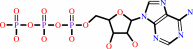 ATP
ATP
|
=
|
O-phospho-L-tyrosyl-[protein]
|
+
|
 ADP
ADP
|
+
|
H(+)
|
|
|
|
|
|
|
|
|
|
|
|
|
Molecule diagrams generated from .mol files obtained from the
KEGG ftp site
|
|
|
|
|
|
|
|
|
|
|
|
|
|
 |
|
|
|
|
|
|
| |
|
|
| |
|
DOI no:
|
J Mol Biol
328:655-668
(2003)
|
|
PubMed id:
|
|
|
|
|
|
| |
|
Structural and thermodynamic basis for the interaction of the Src SH2 domain with the activated form of the PDGF beta-receptor.
|
|
O.Y.Lubman,
G.Waksman.
|
|
|
|
|
| |
ABSTRACT
|
|
|
|
| |
|
|
Recruitment of the Src kinase to the activated form of the platelet-derived
growth factor (PDGF) receptor involves recognition of a unique sequence motif in
the juxtamembrane region of the receptor by the Src homology 2 (SH2) domain of
the enzyme. This motif contains two phosphotyrosine residues separated by one
residue (sequence pYIpYV where pY indicates a phosphotyrosine). Here, we provide
the thermodynamic and structural basis for the binding of this motif by the Src
SH2 domain. We show that the second phosphorylation event increases the free
energy window for specific interaction and that the physiological target is
exquisitely designed for the task of recruiting specifically an SH2 domain which
otherwise demonstrates very little intrinsic ability to discriminate sequences
C-terminal to the first phosphorylation event. Surprisingly, we show that water
plays a role in the recognition process.
|
|
|
|
|
|
| |
Selected figure(s)
|
|
|
|
| |
|
|

|
|

|
|
Figure 3.
Figure 3. Details of the interactions between the +1 and +2
pTyr positions and the Src SH2 domain. (A) Stereo-ribbon diagram
of the Src SH2 domain bound to the pYEpYI complex.[56.]
Side-chains in the SH2 domain that interact with the +1 Glu and
+2 pTyr are shown in ball-and stick representation with carbon
atoms in dark gray, nitrogen in blue, oxygen in red, and
phosphorus in magenta. The corresponding residues are labeled.
The peptide is represented as in Figure 1(C) with thicker bonds.
Only the +2 pTyr and +1 Glu are labeled. Water molecules are
shown as balls, red for those observed in both the bound and
unbound forms of the SH2 domain, black for those only observed
in the bound form. Water molecules are labeled from 1 to 13 in
Figure 3, Figure 4 and Figure 5. (B) Schematic diagram of
interactions represented in A between the +1 Glu and +2 pTyr
residues and the Src SH2 domain. Residues in the protein are
shown in blue while the peptide is in black. Water molecules are
labeled as in (A). Contacts are indicated by dotted lines
linking the contacting atoms and the distances between
contacting atoms are indicated. Red dotted lines indicate
contact with water molecules. Black dotted lines indicate direct
contacts between peptide and protein.
|
|
Figure 5.
Figure 5. Details of the interactions between the -1 Gln
and 0-pTyr of the pYEpYI motif and the Src SH2 domain.[56.]
Interactions are depicted in a stereo-ribbon diagram in (A) and
in a schematic diagram in (B). Representation and labeling are
as in Figure 3.
|
|
|
|
|
|
| |
The above figures are
reprinted
by permission from Elsevier:
J Mol Biol
(2003,
328,
655-668)
copyright 2003.
|
|
| |
Figures were
selected
by an automated process.
|
|
|
|
|
|
|
|
|
|
|
|
|
|
|
|
 |
 |
 |
|
Literature references that cite this PDB file's key reference
|
|
|
| |
PubMed id
|
|
Reference
|
|
|
|
|
|
G.De Fabritiis,
S.Geroult,
P.V.Coveney,
and
G.Waksman
(2008).
Insights from the energetics of water binding at the domain-ligand interface of the Src SH2 domain.
|
| |
Proteins,
72,
1290-1297.
|
|
|
|
|
|
|
I.E.Sánchez,
P.Beltrao,
F.Stricher,
J.Schymkowitz,
J.Ferkinghoff-Borg,
F.Rousseau,
and
L.Serrano
(2008).
Genome-wide prediction of SH2 domain targets using structural information and the FoldX algorithm.
|
| |
PLoS Comput Biol,
4,
e1000052.
|
|
|
|
|
|
|
S.Geroult,
M.Hooda,
S.Virdee,
and
G.Waksman
(2007).
Prediction of solvation sites at the interface of Src SH2 domain complexes using molecular dynamics simulations.
|
| |
Chem Biol Drug Des,
70,
87-99.
|
|
|
|
|
|
|
F.Nasertorabi,
K.Tars,
K.Becherer,
R.Kodandapani,
L.Liljas,
K.Vuori,
and
K.R.Ely
(2006).
Molecular basis for regulation of Src by the docking protein p130Cas.
|
| |
J Mol Recognit,
19,
30-38.
|
|
|
PDB code:
|
|
|
|
|
|
|
|
S.Geroult,
S.Virdee,
and
G.Waksman
(2006).
The role of water in computational and experimental derivation of binding thermodynamics in SH2 domains.
|
| |
Chem Biol Drug Des,
67,
38-45.
|
|
|
|
|
|
|
C.Lingwood,
M.Mylvaganam,
F.Minhas,
B.Binnington,
D.R.Branch,
and
R.Pomès
(2005).
The sulfogalactose moiety of sulfoglycosphingolipids serves as a mimic of tyrosine phosphate in many recognition processes. Prediction and demonstration of Src homology 2 domain/sulfogalactose binding.
|
| |
J Biol Chem,
280,
12542-12547.
|
|
|
|
|
|
|
P.W.Fowler,
S.Jha,
and
P.V.Coveney
(2005).
Grid-based steered thermodynamic integration accelerates the calculation of binding free energies.
|
| |
Philos Transact A Math Phys Eng Sci,
363,
1999-2015.
|
|
|
|
|
|
The most recent references are shown first.
Citation data come partly from CiteXplore and partly
from an automated harvesting procedure. Note that this is likely to be
only a partial list as not all journals are covered by
either method. However, we are continually building up the citation data
so more and more references will be included with time.
Where a reference describes a PDB structure, the PDB
code is
shown on the right.
|
|
|


 Links
Links


