
|
|
|
|
|
 |
Contents |
 |
|
|
|
|
|
|
|
|
|
|
|
|
* Residue conservation analysis
|
|
|
|
|
|
PDB id:
|
|
|
|
| Name: |
|
Signaling protein
|
|
|
Title:
|
|
Structural evidence for feedback activation by rasgtp of the ras- specific nucleotide exchange factor sos
|
|
Structure:
|
|
Transforming protein p21/h-ras-1. Chain: q, r. Fragment: residues 1-166. Synonym: c-h-ras. Engineered: yes. Mutation: yes. Son of sevenless protein homolog 1. Chain: s. Fragment: residues 566-10466, including the ras guanine nucleotide
|
|
Source:
|
|
Homo sapiens. Human. Organism_taxid: 9606. Gene: hras or hras1. Expressed in: escherichia coli bl21(de3). Expression_system_taxid: 469008. Gene: sos1.
|
|
Biol. unit:
|
|
Trimer (from
)
|
|
Resolution:
|
|
|
3.20Å
|
R-factor:
|
0.223
|
R-free:
|
0.261
|
|
|
Authors:
|
|
S.M.Margarit,H.Sondermann,B.E.Hall,B.Nagar,A.Hoelz,M.Pirruccello, D.Bar-Sagi,J.Kuriyan
|
Key ref:

|
|
S.M.Margarit
et al.
(2003).
Structural evidence for feedback activation by Ras.GTP of the Ras-specific nucleotide exchange factor SOS.
Cell,
112,
685-695.
PubMed id:
DOI:

|
|
|
Date:
|
|
|
04-Feb-03
|
Release date:
|
01-Apr-03
|
|
|
|
|
|
|
PROCHECK
|

|
|
|
|
|
Headers
|
|
|
|
References
|
|
|
|
|
|
|
|
|
|
|
|
Enzyme class:
|
|
Chains Q, R:
E.C.3.6.5.2
- small monomeric GTPase.
|
|
|
|
|
|
|
Reaction:
|
|
GTP + H2O = GDP + phosphate + H+
|
|
|
|
|
|
GTP
Bound ligand (Het Group name = )
corresponds exactly
|
+
|
H2O
|
=
|
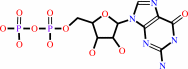 GDP
GDP
|
+
|
 phosphate
|
+
|
H(+)
Bound ligand (Het Group name = )
corresponds exactly
|
|
|
|
|
|
|
|
|
|
|
|
|
Molecule diagrams generated from .mol files obtained from the
KEGG ftp site
|
|
|
|
|
|
|
|
|
|
|
|
|
|
 |
|
|
|
|
|
|
| |
|
|
| |
|
DOI no:
|
Cell
112:685-695
(2003)
|
|
PubMed id:
|
|
|
|
|
|
| |
|
Structural evidence for feedback activation by Ras.GTP of the Ras-specific nucleotide exchange factor SOS.
|
|
S.M.Margarit,
H.Sondermann,
B.E.Hall,
B.Nagar,
A.Hoelz,
M.Pirruccello,
D.Bar-Sagi,
J.Kuriyan.
|
|
|
|
|
| |
ABSTRACT
|
|
|
|
| |
|
|
Growth factor receptors activate Ras by recruiting the nucleotide exchange
factor son of sevenless (SOS) to the cell membrane, thereby triggering the
production of GTP-loaded Ras. Crystallographic analyses of Ras bound to the
catalytic module of SOS have led to the unexpected discovery of a highly
conserved Ras binding site on SOS that is located distal to the active site and
is specific for Ras.GTP. The crystal structures suggest that Ras.GTP stabilizes
the active site of SOS allosterically, and we show that Ras.GTP forms ternary
complexes with SOS(cat) in solution and increases significantly the rate of
SOS(cat)-stimulated nucleotide release from Ras. These results demonstrate the
existence of a positive feedback mechanism for the spatial and temporal
regulation of Ras.
|
|
|
|
|
|
| |
Selected figure(s)
|
|
|
|
| |
|
|

|
|

|
|
Figure 3.
Figure 3. Views of the Distal Ras:SOS^cat Interface(A) The
binding footprint on Ras of SOS^cat (left, structure D) and
PI3-kinase (right, PDB code 1HE8). The structures of Ras shown
here are for the complex with the GTP analog GppNp in both
cases. Residues that make contact with SOS or PI3-kinase are
colored purple.(B) The molecular surface of SOS^cat, showing the
binding footprint of Ras·GTP on SOS^cat. Regions of the
surface of SOS that are occluded by the distal Ras·GTP
molecule are colored blue. The structure shown is that of the
Ras^Y64A·GppNp:SOS^cat:Ras (nucleotide-free) complex
(structure D).(C) Differences between Ras·GDP (Milburn et
al., 1990) and the distal Ras^Y64A·GppNp molecule. The
backbone of Ras·GDP is shown in red and that of
Ras^Y64A·GppNp in green. GppNp is shown in orange with
Mg^2+ ion drawn as a magenta sphere. The position of the alanine
residue at residue 64 of Ras^Y64A is shown by the blue sphere.
Side chains of Ras^Y64A are shown with carbon atoms colored
blue, while side chains of Ras·GDP are shown in purple.
|
|
Figure 4.
Figure 4. Specificity for Ras·GTP at the Distal
Interface(A) Interface between Ras·GTP and the distal
binding site on the REM domain. The entire ternary complex, in
the view used for the expanded illustration (middle, right), is
shown on the left. In the middle, some of the key residues at
the distal Ras:REM domain interface are indicated. The GTP
analog GppNp is shown in orange, and the Mg^2+ ion is shown as a
magenta sphere. The backbone of Ras^Y64A is shown in green. Note
the presence of alanine instead of tyrosine at residue 64 in
Ras. The molecular surface of SOS^cat is shown at the right,
colored according to the conservation in sequence between human
SOS1 and SOS from Drosophila, Anopheles, and C. elegans.
Sequence similarity was calculated based on the BLOSUM 62 matrix
(Henikoff and Henikoff, 1993). Residues that are invariant (100%
identical) between the four SOS sequences are colored red, with
purple, orange, and yellow indicating sequence similarity at the
90%, 80%, and 70% levels, respectively.(B) Details of the
interface between Ras·GTP and the distal binding site on
the cdc25 domain. The helical hairpin of SOS and the hairpin
base (see text) are colored red. The surface of SOS^cat, shown
on the right in each panel is colored as in (A).
|
|
|
|
|
|
| |
The above figures are
reprinted
by permission from Cell Press:
Cell
(2003,
112,
685-695)
copyright 2003.
|
|
| |
Figures were
selected
by an automated process.
|
|
|
|
|
|
|
|
|
|
|
|
|
|
|
|
 |
 |
 |
|
Literature references that cite this PDB file's key reference
|
|
|
| |
PubMed id
|
|
Reference
|
|
|
|
|
|
L.Gremer,
T.Merbitz-Zahradnik,
R.Dvorsky,
I.C.Cirstea,
C.P.Kratz,
M.Zenker,
A.Wittinghofer,
and
M.R.Ahmadian
(2011).
Germline KRAS mutations cause aberrant biochemical and physical properties leading to developmental disorders.
|
| |
Hum Mutat,
32,
33-43.
|
|
|
|
|
|
|
P.D.Mace,
Y.Wallez,
M.K.Dobaczewska,
J.J.Lee,
H.Robinson,
E.B.Pasquale,
and
S.J.Riedl
(2011).
NSP-Cas protein structures reveal a promiscuous interaction module in cell signaling.
|
| |
Nat Struct Mol Biol,
18,
1381-1387.
|
|
|
PDB codes:
|
|
|
|
|
|
|
|
P.L.Kastritis,
I.H.Moal,
H.Hwang,
Z.Weng,
P.A.Bates,
A.M.Bonvin,
and
J.Janin
(2011).
A structure-based benchmark for protein-protein binding affinity.
|
| |
Protein Sci,
20,
482-491.
|
|
|
|
|
|
|
R.N.Germain,
M.Meier-Schellersheim,
A.Nita-Lazar,
and
I.D.Fraser
(2011).
Systems biology in immunology: a computational modeling perspective.
|
| |
Annu Rev Immunol,
29,
527-585.
|
|
|
|
|
|
|
A.K.Chakraborty,
and
A.Kosmrlj
(2010).
Statistical mechanical concepts in immunology.
|
| |
Annu Rev Phys Chem,
61,
283-303.
|
|
|
|
|
|
|
A.K.Chakraborty,
and
J.Das
(2010).
Pairing computation with experimentation: a powerful coupling for understanding T cell signalling.
|
| |
Nat Rev Immunol,
10,
59-71.
|
|
|
|
|
|
|
D.Vigil,
J.Cherfils,
K.L.Rossman,
and
C.J.Der
(2010).
Ras superfamily GEFs and GAPs: validated and tractable targets for cancer therapy?
|
| |
Nat Rev Cancer,
10,
842-857.
|
|
|
|
|
|
|
J.B.Bruning,
A.A.Parent,
G.Gil,
M.Zhao,
J.Nowak,
M.C.Pace,
C.L.Smith,
P.V.Afonine,
P.D.Adams,
J.A.Katzenellenbogen,
and
K.W.Nettles
(2010).
Coupling of receptor conformation and ligand orientation determine graded activity.
|
| |
Nat Chem Biol,
6,
837-843.
|
|
|
PDB codes:
|
|
|
|
|
|
|
|
J.Gureasko,
O.Kuchment,
D.L.Makino,
H.Sondermann,
D.Bar-Sagi,
and
J.Kuriyan
(2010).
Role of the histone domain in the autoinhibition and activation of the Ras activator Son of Sevenless.
|
| |
Proc Natl Acad Sci U S A,
107,
3430-3435.
|
|
|
PDB code:
|
|
|
|
|
|
|
|
J.T.Groves,
and
J.Kuriyan
(2010).
Molecular mechanisms in signal transduction at the membrane.
|
| |
Nat Struct Mol Biol,
17,
659-665.
|
|
|
|
|
|
|
K.K.Yadav,
and
D.Bar-Sagi
(2010).
Allosteric gating of Son of sevenless activity by the histone domain.
|
| |
Proc Natl Acad Sci U S A,
107,
3436-3440.
|
|
|
|
|
|
|
M.Artomov,
M.Kardar,
and
A.K.Chakraborty
(2010).
Only signaling modules that discriminate sharply between stimulatory and nonstimulatory inputs require basal signaling for fast cellular responses.
|
| |
J Chem Phys,
133,
105101.
|
|
|
|
|
|
|
M.T.Mazhab-Jafari,
C.B.Marshall,
M.Smith,
G.M.Gasmi-Seabrook,
V.Stambolic,
R.Rottapel,
B.G.Neel,
and
M.Ikura
(2010).
Real-time NMR study of three small GTPases reveals that fluorescent 2'(3')-O-(N-methylanthraniloyl)-tagged nucleotides alter hydrolysis and exchange kinetics.
|
| |
J Biol Chem,
285,
5132-5136.
|
|
|
|
|
|
|
M.Tartaglia,
and
B.D.Gelb
(2010).
Disorders of dysregulated signal traffic through the RAS-MAPK pathway: phenotypic spectrum and molecular mechanisms.
|
| |
Ann N Y Acad Sci,
1214,
99.
|
|
|
|
|
|
|
M.Tartaglia,
G.Zampino,
and
B.D.Gelb
(2010).
Noonan syndrome: clinical aspects and molecular pathogenesis.
|
| |
Mol Syndromol,
1,
2.
|
|
|
|
|
|
|
S.Jeong,
S.R.Han,
Y.J.Lee,
J.H.Kim,
and
S.W.Lee
(2010).
Identification of RNA aptamer specific to mutant KRAS protein.
|
| |
Oligonucleotides,
20,
155-161.
|
|
|
|
|
|
|
W.A.Andrade,
A.M.Silva,
V.S.Alves,
A.P.Salgado,
M.B.Melo,
H.M.Andrade,
F.V.Dall'Orto,
S.A.Garcia,
T.N.Silveira,
and
R.T.Gazzinelli
(2010).
Early endosome localization and activity of RasGEF1b, a toll-like receptor-inducible Ras guanine-nucleotide exchange factor.
|
| |
Genes Immun,
11,
447-457.
|
|
|
|
|
|
|
A.F.Neuwald
(2009).
The charge-dipole pocket: a defining feature of signaling pathway GTPase on/off switches.
|
| |
J Mol Biol,
390,
142-153.
|
|
|
|
|
|
|
A.K.Chakraborty,
J.Das,
J.Zikherman,
M.Yang,
C.C.Govern,
M.Ho,
A.Weiss,
and
J.Roose
(2009).
Molecular origin and functional consequences of digital signaling and hysteresis during Ras activation in lymphocytes.
|
| |
Sci Signal,
2,
pt2.
|
|
|
|
|
|
|
C.B.McDonald,
K.L.Seldeen,
B.J.Deegan,
and
A.Farooq
(2009).
SH3 domains of Grb2 adaptor bind to PXpsiPXR motifs within the Sos1 nucleotide exchange factor in a discriminate manner.
|
| |
Biochemistry,
48,
4074-4085.
|
|
|
|
|
|
|
J.Das,
M.Ho,
J.Zikherman,
C.Govern,
M.Yang,
A.Weiss,
A.K.Chakraborty,
and
J.P.Roose
(2009).
Digital signaling and hysteresis characterize ras activation in lymphoid cells.
|
| |
Cell,
136,
337-351.
|
|
|
|
|
|
|
J.H.Raaijmakers,
and
J.L.Bos
(2009).
Specificity in ras and rap signaling.
|
| |
J Biol Chem,
284,
10995-10999.
|
|
|
|
|
|
|
M.Sajish,
S.Kalayil,
S.K.Verma,
V.K.Nandicoori,
and
B.Prakash
(2009).
The significance of EXDD and RXKD motif conservation in Rel proteins.
|
| |
J Biol Chem,
284,
9115-9123.
|
|
|
|
|
|
|
M.Tyagi,
B.A.Shoemaker,
S.H.Bryant,
and
A.R.Panchenko
(2009).
Exploring functional roles of multibinding protein interfaces.
|
| |
Protein Sci,
18,
1674-1683.
|
|
|
|
|
|
|
T.S.Freedman,
H.Sondermann,
O.Kuchment,
G.D.Friedland,
T.Kortemme,
and
J.Kuriyan
(2009).
Differences in flexibility underlie functional differences in the Ras activators son of sevenless and Ras guanine nucleotide releasing factor 1.
|
| |
Structure,
17,
41-53.
|
|
|
|
|
|
|
X.Liao,
J.Su,
and
M.Mrksich
(2009).
An adaptor domain-mediated autocatalytic interfacial kinase reaction.
|
| |
Chemistry,
15,
12303-12309.
|
|
|
|
|
|
|
C.Liu,
M.Takahashi,
Y.Li,
S.Song,
T.J.Dillon,
U.Shinde,
and
P.J.Stork
(2008).
Ras is required for the cyclic AMP-dependent activation of Rap1 via Epac2.
|
| |
Mol Cell Biol,
28,
7109-7125.
|
|
|
|
|
|
|
G.M.Findlay,
and
T.Pawson
(2008).
How is SOS activated? Let us count the ways.
|
| |
Nat Struct Mol Biol,
15,
538-540.
|
|
|
|
|
|
|
H.Rehmann,
E.Arias-Palomo,
M.A.Hadders,
F.Schwede,
O.Llorca,
and
J.L.Bos
(2008).
Structure of Epac2 in complex with a cyclic AMP analogue and RAP1B.
|
| |
Nature,
455,
124-127.
|
|
|
PDB code:
|
|
|
|
|
|
|
|
J.Gureasko,
W.J.Galush,
S.Boykevisch,
H.Sondermann,
D.Bar-Sagi,
J.T.Groves,
and
J.Kuriyan
(2008).
Membrane-dependent signal integration by the Ras activator Son of sevenless.
|
| |
Nat Struct Mol Biol,
15,
452-461.
|
|
|
|
|
|
|
L.Buday,
and
J.Downward
(2008).
Many faces of Ras activation.
|
| |
Biochim Biophys Acta,
1786,
178-187.
|
|
|
|
|
|
|
P.Koenig,
M.Oreb,
K.Rippe,
C.Muhle-Goll,
I.Sinning,
E.Schleiff,
and
I.Tews
(2008).
On the significance of Toc-GTPase homodimers.
|
| |
J Biol Chem,
283,
23104-23112.
|
|
|
PDB code:
|
|
|
|
|
|
|
|
R.Tanizaki,
A.Katsumi,
H.Kiyoi,
S.Kunishima,
T.Iwasaki,
Y.Ishikawa,
M.Kobayashi,
A.Abe,
T.Matsushita,
T.Watanabe,
T.Kojima,
K.Kaibuchi,
S.Kojima,
and
T.Naoe
(2008).
Mutational analysis of SOS1 gene in acute myeloid leukemia.
|
| |
Int J Hematol,
88,
460-462.
|
|
|
|
|
|
|
V.Adler,
W.Bowne,
I.Kamran,
J.Michl,
F.K.Friedman,
E.Chin,
M.Zenilman,
and
M.R.Pincus
(2008).
Two peptides derived from ras-p21 induce either phenotypic reversion or tumor cell necrosis of ras-transformed human cancer cells.
|
| |
Cancer Chemother Pharmacol,
62,
491-498.
|
|
|
|
|
|
|
Y.Li,
and
M.Fivaz
(2008).
Feedback-mediated neuronal competition for survival cues regulates innervation of a target tissue.
|
| |
Bioessays,
30,
929-933.
|
|
|
|
|
|
|
A.Delprato,
and
D.G.Lambright
(2007).
Structural basis for Rab GTPase activation by VPS9 domain exchange factors.
|
| |
Nat Struct Mol Biol,
14,
406-412.
|
|
|
PDB code:
|
|
|
|
|
|
|
|
A.E.Roberts,
T.Araki,
K.D.Swanson,
K.T.Montgomery,
T.A.Schiripo,
V.A.Joshi,
L.Li,
Y.Yassin,
A.M.Tamburino,
B.G.Neel,
and
R.S.Kucherlapati
(2007).
Germline gain-of-function mutations in SOS1 cause Noonan syndrome.
|
| |
Nat Genet,
39,
70-74.
|
|
|
|
|
|
|
C.P.Kratz,
C.M.Niemeyer,
and
M.Zenker
(2007).
An unexpected new role of mutant Ras: perturbation of human embryonic development.
|
| |
J Mol Med,
85,
227-235.
|
|
|
|
|
|
|
J.L.Bos,
H.Rehmann,
and
A.Wittinghofer
(2007).
GEFs and GAPs: critical elements in the control of small G proteins.
|
| |
Cell,
129,
865-877.
|
|
|
|
|
|
|
J.P.DiNitto,
A.Delprato,
M.T.Gabe Lee,
T.C.Cronin,
S.Huang,
A.Guilherme,
M.P.Czech,
and
D.G.Lambright
(2007).
Structural basis and mechanism of autoregulation in 3-phosphoinositide-dependent Grp1 family Arf GTPase exchange factors.
|
| |
Mol Cell,
28,
569-583.
|
|
|
PDB codes:
|
|
|
|
|
|
|
|
J.P.Roose,
M.Mollenauer,
M.Ho,
T.Kurosaki,
and
A.Weiss
(2007).
Unusual interplay of two types of Ras activators, RasGRP and SOS, establishes sensitive and robust Ras activation in lymphocytes.
|
| |
Mol Cell Biol,
27,
2732-2745.
|
|
|
|
|
|
|
K.Modzelewska,
M.G.Elgort,
J.Huang,
G.Jongeward,
A.Lauritzen,
C.H.Yoon,
P.W.Sternberg,
and
N.Moghal
(2007).
An activating mutation in sos-1 identifies its Dbl domain as a critical inhibitor of the epidermal growth factor receptor pathway during Caenorhabditis elegans vulval development.
|
| |
Mol Cell Biol,
27,
3695-3707.
|
|
|
|
|
|
|
K.Shannon,
and
G.Bollag
(2007).
Sending out an SOS.
|
| |
Nat Genet,
39,
8-9.
|
|
|
|
|
|
|
L.A.Cohen,
A.Honda,
P.Varnai,
F.D.Brown,
T.Balla,
and
J.G.Donaldson
(2007).
Active Arf6 recruits ARNO/cytohesin GEFs to the PM by binding their PH domains.
|
| |
Mol Biol Cell,
18,
2244-2253.
|
|
|
|
|
|
|
M.M.McKay,
and
D.K.Morrison
(2007).
Integrating signals from RTKs to ERK/MAPK.
|
| |
Oncogene,
26,
3113-3121.
|
|
|
|
|
|
|
M.Tartaglia,
L.A.Pennacchio,
C.Zhao,
K.K.Yadav,
V.Fodale,
A.Sarkozy,
B.Pandit,
K.Oishi,
S.Martinelli,
W.Schackwitz,
A.Ustaszewska,
J.Martin,
J.Bristow,
C.Carta,
F.Lepri,
C.Neri,
I.Vasta,
K.Gibson,
C.J.Curry,
J.P.Siguero,
M.C.Digilio,
G.Zampino,
B.Dallapiccola,
D.Bar-Sagi,
and
B.D.Gelb
(2007).
Gain-of-function SOS1 mutations cause a distinctive form of Noonan syndrome.
|
| |
Nat Genet,
39,
75-79.
|
|
|
|
|
|
|
M.Zenker,
D.Horn,
D.Wieczorek,
J.Allanson,
S.Pauli,
I.van der Burgt,
H.G.Doerr,
H.Gaspar,
M.Hofbeck,
G.Gillessen-Kaesbach,
A.Koch,
P.Meinecke,
S.Mundlos,
A.Nowka,
A.Rauch,
S.Reif,
C.von Schnakenburg,
H.Seidel,
L.E.Wehner,
C.Zweier,
S.Bauhuber,
V.Matejas,
C.P.Kratz,
C.Thomas,
and
K.Kutsche
(2007).
SOS1 is the second most common Noonan gene but plays no major role in cardio-facio-cutaneous syndrome.
|
| |
J Med Genet,
44,
651-656.
|
|
|
|
|
|
|
S.I.Jang,
E.J.Lee,
P.S.Hart,
M.Ramaswami,
D.Pallos,
and
T.C.Hart
(2007).
Germ line gain of function with SOS1 mutation in hereditary gingival fibromatosis.
|
| |
J Biol Chem,
282,
20245-20255.
|
|
|
|
|
|
|
S.Schubbert,
K.Shannon,
and
G.Bollag
(2007).
Hyperactive Ras in developmental disorders and cancer.
|
| |
Nat Rev Cancer,
7,
295-308.
|
|
|
|
|
|
|
W.B.Bowne,
J.Michl,
M.H.Bluth,
M.E.Zenilman,
and
M.R.Pincus
(2007).
Novel peptides from the RAS-p21 and p53 proteins for the treatment of cancer.
|
| |
Cancer Ther,
5,
331-344.
|
|
|
|
|
|
|
A.B.Goryachev,
and
A.V.Pokhilko
(2006).
Computational model explains high activity and rapid cycling of Rho GTPases within protein complexes.
|
| |
PLoS Comput Biol,
2,
e172.
|
|
|
|
|
|
|
B.Ford,
V.Hornak,
H.Kleinman,
and
N.Nassar
(2006).
Structure of a transient intermediate for GTP hydrolysis by ras.
|
| |
Structure,
14,
427-436.
|
|
|
PDB codes:
|
|
|
|
|
|
|
|
C.Carta,
F.Pantaleoni,
G.Bocchinfuso,
L.Stella,
I.Vasta,
A.Sarkozy,
C.Digilio,
A.Palleschi,
A.Pizzuti,
P.Grammatico,
G.Zampino,
B.Dallapiccola,
B.D.Gelb,
and
M.Tartaglia
(2006).
Germline missense mutations affecting KRAS Isoform B are associated with a severe Noonan syndrome phenotype.
|
| |
Am J Hum Genet,
79,
129-135.
|
|
|
|
|
|
|
E.Y.Shin,
C.S.Lee,
T.G.Cho,
Y.G.Kim,
S.Song,
Y.S.Juhnn,
S.C.Park,
E.Manser,
and
E.G.Kim
(2006).
betaPak-interacting exchange factor-mediated Rac1 activation requires smgGDS guanine nucleotide exchange factor in basic fibroblast growth factor-induced neurite outgrowth.
|
| |
J Biol Chem,
281,
35954-35964.
|
|
|
|
|
|
|
H.Rehmann,
J.Das,
P.Knipscheer,
A.Wittinghofer,
and
J.L.Bos
(2006).
Structure of the cyclic-AMP-responsive exchange factor Epac2 in its auto-inhibited state.
|
| |
Nature,
439,
625-628.
|
|
|
PDB code:
|
|
|
|
|
|
|
|
H.Yang,
and
R.R.Mattingly
(2006).
The Ras-GRF1 exchange factor coordinates activation of H-Ras and Rac1 to control neuronal morphology.
|
| |
Mol Biol Cell,
17,
2177-2189.
|
|
|
|
|
|
|
J.L.Bos
(2006).
Epac proteins: multi-purpose cAMP targets.
|
| |
Trends Biochem Sci,
31,
680-686.
|
|
|
|
|
|
|
J.Liao,
S.M.Planchon,
J.C.Wolfman,
and
A.Wolfman
(2006).
Growth factor-dependent AKT activation and cell migration requires the function of c-K(B)-Ras versus other cellular ras isoforms.
|
| |
J Biol Chem,
281,
29730-29738.
|
|
|
|
|
|
|
J.R.Peterson,
and
J.Chernoff
(2006).
Src transforms in a Cool way.
|
| |
Nat Cell Biol,
8,
905-907.
|
|
|
|
|
|
|
S.Boykevisch,
C.Zhao,
H.Sondermann,
P.Philippidou,
S.Halegoua,
J.Kuriyan,
and
D.Bar-Sagi
(2006).
Regulation of ras signaling dynamics by Sos-mediated positive feedback.
|
| |
Curr Biol,
16,
2173-2179.
|
|
|
|
|
|
|
T.S.Freedman,
H.Sondermann,
G.D.Friedland,
T.Kortemme,
D.Bar-Sagi,
S.Marqusee,
and
J.Kuriyan
(2006).
A Ras-induced conformational switch in the Ras activator Son of sevenless.
|
| |
Proc Natl Acad Sci U S A,
103,
16692-16697.
|
|
|
PDB codes:
|
|
|
|
|
|
|
|
Y.Li,
S.Asuri,
J.F.Rebhun,
A.F.Castro,
N.C.Paranavitana,
and
L.A.Quilliam
(2006).
The RAP1 guanine nucleotide exchange factor Epac2 couples cyclic AMP and Ras signals at the plasma membrane.
|
| |
J Biol Chem,
281,
2506-2514.
|
|
|
|
|
|
|
B.B.Friday,
and
A.A.Adjei
(2005).
K-ras as a target for cancer therapy.
|
| |
Biochim Biophys Acta,
1756,
127-144.
|
|
|
|
|
|
|
D.Baird,
Q.Feng,
and
R.A.Cerione
(2005).
The Cool-2/alpha-Pix protein mediates a Cdc42-Rac signaling cascade.
|
| |
Curr Biol,
15,
1.
|
|
|
|
|
|
|
H.Sondermann,
B.Nagar,
D.Bar-Sagi,
and
J.Kuriyan
(2005).
Computational docking and solution x-ray scattering predict a membrane-interacting role for the histone domain of the Ras activator son of sevenless.
|
| |
Proc Natl Acad Sci U S A,
102,
16632-16637.
|
|
|
|
|
|
|
K.L.Rossman,
C.J.Der,
and
J.Sondek
(2005).
GEF means go: turning on RHO GTPases with guanine nucleotide-exchange factors.
|
| |
Nat Rev Mol Cell Biol,
6,
167-180.
|
|
|
|
|
|
|
M.A.White,
and
R.G.Anderson
(2005).
Signaling networks in living cells.
|
| |
Annu Rev Pharmacol Toxicol,
45,
587-603.
|
|
|
|
|
|
|
N.Mitin,
K.L.Rossman,
and
C.J.Der
(2005).
Signaling interplay in Ras superfamily function.
|
| |
Curr Biol,
15,
R563-R574.
|
|
|
|
|
|
|
O.Brandman,
J.E.Ferrell,
R.Li,
and
T.Meyer
(2005).
Interlinked fast and slow positive feedback loops drive reliable cell decisions.
|
| |
Science,
310,
496-498.
|
|
|
|
|
|
|
O.Rocks,
A.Peyker,
M.Kahms,
P.J.Verveer,
C.Koerner,
M.Lumbierres,
J.Kuhlmann,
H.Waldmann,
A.Wittinghofer,
and
P.I.Bastiaens
(2005).
An acylation cycle regulates localization and activity of palmitoylated Ras isoforms.
|
| |
Science,
307,
1746-1752.
|
|
|
|
|
|
|
R.Mishra,
S.K.Gara,
S.Mishra,
and
B.Prakash
(2005).
Analysis of GTPases carrying hydrophobic amino acid substitutions in lieu of the catalytic glutamine: implications for GTP hydrolysis.
|
| |
Proteins,
59,
332-338.
|
|
|
|
|
|
|
S.Smith,
M.Hyde,
and
M.R.Pincus
(2005).
Comparison of the predicted structures of loops in the ras-SOS protein bound to a single ras-p21 protein with the crystallographically determined structures in SOS bound to two ras-p21 proteins.
|
| |
Protein J,
24,
391-398.
|
|
|
|
|
|
|
A.Delprato,
E.Merithew,
and
D.G.Lambright
(2004).
Structure, exchange determinants, and family-wide rab specificity of the tandem helical bundle and Vps9 domains of Rabex-5.
|
| |
Cell,
118,
607-617.
|
|
|
PDB code:
|
|
|
|
|
|
|
|
H.Sondermann,
S.M.Soisson,
S.Boykevisch,
S.S.Yang,
D.Bar-Sagi,
and
J.Kuriyan
(2004).
Structural analysis of autoinhibition in the Ras activator Son of sevenless.
|
| |
Cell,
119,
393-405.
|
|
|
PDB codes:
|
|
|
|
|
|
|
|
J.J.Zhao,
T.M.Roberts,
and
W.C.Hahn
(2004).
Functional genetics and experimental models of human cancer.
|
| |
Trends Mol Med,
10,
344-350.
|
|
|
|
|
|
|
K.S.Shim,
C.Schmutte,
G.Tombline,
C.D.Heinen,
and
R.Fishel
(2004).
hXRCC2 enhances ADP/ATP processing and strand exchange by hRAD51.
|
| |
J Biol Chem,
279,
30385-30394.
|
|
|
|
|
|
|
M.G.Tomlinson,
V.L.Heath,
C.W.Turck,
S.P.Watson,
and
A.Weiss
(2004).
SHIP family inositol phosphatases interact with and negatively regulate the Tec tyrosine kinase.
|
| |
J Biol Chem,
279,
55089-55096.
|
|
|
|
|
|
|
M.Reth,
and
T.Brummer
(2004).
Feedback regulation of lymphocyte signalling.
|
| |
Nat Rev Immunol,
4,
269-277.
|
|
|
|
|
|
|
S.J.Silver,
F.Chen,
L.Doyon,
A.W.Zink,
and
I.Rebay
(2004).
New class of Son-of-sevenless (Sos) alleles highlights the complexities of Sos function.
|
| |
Genesis,
39,
263-272.
|
|
|
|
|
|
|
T.Boesen,
S.S.Mohammad,
G.D.Pavitt,
and
G.R.Andersen
(2004).
Structure of the catalytic fragment of translation initiation factor 2B and identification of a critically important catalytic residue.
|
| |
J Biol Chem,
279,
10584-10592.
|
|
|
PDB code:
|
|
|
|
|
|
|
|
W.T.Arthur,
L.A.Quilliam,
and
J.A.Cooper
(2004).
Rap1 promotes cell spreading by localizing Rac guanine nucleotide exchange factors.
|
| |
J Cell Biol,
167,
111-122.
|
|
|
|
|
|
|
Y.Aiba,
M.Oh-hora,
S.Kiyonaka,
Y.Kimura,
A.Hijikata,
Y.Mori,
and
T.Kurosaki
(2004).
Activation of RasGRP3 by phosphorylation of Thr-133 is required for B cell receptor-mediated Ras activation.
|
| |
Proc Natl Acad Sci U S A,
101,
16612-16617.
|
|
|
|
|
|
|
D.Hochbaum,
T.Tanos,
F.Ribeiro-Neto,
D.Altschuler,
and
O.A.Coso
(2003).
Activation of JNK by Epac is independent of its activity as a Rap guanine nucleotide exchanger.
|
| |
J Biol Chem,
278,
33738-33746.
|
|
|
|
|
|
|
H.Rehmann,
A.Rueppel,
J.L.Bos,
and
A.Wittinghofer
(2003).
Communication between the regulatory and the catalytic region of the cAMP-responsive guanine nucleotide exchange factor Epac.
|
| |
J Biol Chem,
278,
23508-23514.
|
|
|
|
|
|
|
H.Rehmann,
F.Schwede,
S.O.Døskeland,
A.Wittinghofer,
and
J.L.Bos
(2003).
Ligand-mediated activation of the cAMP-responsive guanine nucleotide exchange factor Epac.
|
| |
J Biol Chem,
278,
38548-38556.
|
|
|
|
|
|
|
H.Sondermann,
S.M.Soisson,
D.Bar-Sagi,
and
J.Kuriyan
(2003).
Tandem histone folds in the structure of the N-terminal segment of the ras activator Son of Sevenless.
|
| |
Structure,
11,
1583-1593.
|
|
|
PDB code:
|
|
|
|
|
|
|
The most recent references are shown first.
Citation data come partly from CiteXplore and partly
from an automated harvesting procedure. Note that this is likely to be
only a partial list as not all journals are covered by
either method. However, we are continually building up the citation data
so more and more references will be included with time.
Where a reference describes a PDB structure, the PDB
codes are
shown on the right.
|
 |


 Links
Links


