 |
PDBsum entry 1m14

|
|
|
|
|
 |
Contents |
 |
|
|
|
|
|
|
|
|
|
|
* Residue conservation analysis
|
|
|
|
|
|
|
|
|
|
|
Enzyme class:
|
|
E.C.2.7.10.1
- receptor protein-tyrosine kinase.
|
|
|
|
|
|
|
Reaction:
|
|
L-tyrosyl-[protein] + ATP = O-phospho-L-tyrosyl-[protein] + ADP + H+
|
|
|
|
|
|
L-tyrosyl-[protein]
|
+
|
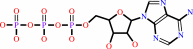 ATP
ATP
|
=
|
O-phospho-L-tyrosyl-[protein]
|
+
|
 ADP
ADP
|
+
|
H(+)
|
|
|
|
|
|
|
|
|
|
|
|
|
Molecule diagrams generated from .mol files obtained from the
KEGG ftp site
|
|
|
|
|
|
|
|
|
|
|
|
|
|
 |
|
|
|
|
|
|
| |
|
|
| |
|
DOI no:
|
J Biol Chem
277:46265-46272
(2002)
|
|
PubMed id:
|
|
|
|
|
|
| |
|
Structure of the epidermal growth factor receptor kinase domain alone and in complex with a 4-anilinoquinazoline inhibitor.
|
|
J.Stamos,
M.X.Sliwkowski,
C.Eigenbrot.
|
|
|
|
|
| |
ABSTRACT
|
|
|
|
| |
|
|
The crystal structure of the kinase domain from the epidermal growth factor
receptor (EGFRK) including forty amino acids from the carboxyl-terminal tail has
been determined to 2.6-A resolution, both with and without an EGFRK-specific
inhibitor currently in Phase III clinical trials as an anti-cancer agent,
erlotinib (OSI-774, CP-358,774, Tarceva(TM)). The EGFR family members are
distinguished from all other known receptor tyrosine kinases in possessing
constitutive kinase activity without a phosphorylation event within their kinase
domains. Despite its lack of phosphorylation, we find that the EGFRK activation
loop adopts a conformation similar to that of the phosphorylated active form of
the kinase domain from the insulin receptor. Surprisingly, key residues of a
putative dimerization motif lying between the EGFRK domain and carboxyl-terminal
substrate docking sites are found in close contact with the kinase domain.
Significant intermolecular contacts involving the carboxyl-terminal tail are
discussed with respect to receptor oligomerization.
|
|
|
|
|
|
| |
Selected figure(s)
|
|
|
|
| |
|
|

|
|

|
|
Figure 2.
Fig. 2. Activation loops. The close structural
correspondence between the EGFRK A-loop (blue) and the A-loop
from the phosphorylated form of the insulin receptor kinase (33)
(gold) is shown. The hydrophobic interaction between Lys836 and
Tyr845 almost exactly reprises that between Arg1155 and Tyr1163
of p-IRK (underlined). The presence of four glutamate residues
in this part of EGFRK has been suggested as a cause for its
intrinsic catalytic activity.
|
|
Figure 4.
Fig. 4. The LVI tripeptide segment of EGFRK is found in
close association with the C-lobe. A solvent-accessible surface
from EGFRK with LVI removed is depicted. Residue Leu955, the
most important as gauged by mutagenesis studies, is found within
what in its absence would be a hydrophobic pit.
|
|
|
|
|
|
| |
The above figures are
reprinted
by permission from the ASBMB:
J Biol Chem
(2002,
277,
46265-46272)
copyright 2002.
|
|
| |
Figures were
selected
by the author.
|
|
|
|
| |
|
|
|
|
|
|
|
|
|
|
|
|
|
|
|
|
|
|
| |
|
|
|
|
| |
It is very likely that the coordinate set in this entry chooses the wrong C-terminal as "belonging" to the rest of the polypeptide chain. Instead, a symmetry-related version that is described in the original Figure 5 is a more likely candidate.
The "LVI pocket" depicted in original Figure 4 is homologous to sites in Abl and Src kinases that are associated with allosteric control of kinase activity. See Hantschel et al. Cell. 2003 Mar 21;112(6):845-57, Nagar et al. Cell. 2003 Mar 21;112(6):859-71, and Cowan-Jacob et al. Structure. 2005 Jun;13(6):861-71.
A 2006 paper in Cell (Zhang et al. Cell. 2006 Jun 16;125(6):1137-49) expands on a crystal packing contact in this crystal structure to show how extracellular dimerization of EGFR probably transduces an allosteric influence to produce the "active" kinase conformation that is seen here. This is the first direct structural evidence of an initial intracellular event in signal transduction in a receptor tyrosine kinase.
Charles Eigenbrot
|
|
|
|
|
|
|
|
|
|
|
|
|
 |
|
 |
 |
 |
|
|
|
|
|
|
|
|
|
|
|
|
|
|
|
|
|
Literature references that cite this PDB file's key reference
|
|
|
| |
PubMed id
|
|
Reference
|
|
|
|
|
|
C.Chidley,
H.Haruki,
M.G.Pedersen,
E.Muller,
and
K.Johnsson
(2011).
A yeast-based screen reveals that sulfasalazine inhibits tetrahydrobiopterin biosynthesis.
|
| |
Nat Chem Biol,
7,
375-383.
|
|
|
|
|
|
|
H.M.Shallal,
and
W.A.Russu
(2011).
Discovery, synthesis, and investigation of the antitumor activity of novel piperazinylpyrimidine derivatives.
|
| |
Eur J Med Chem,
46,
2043-2057.
|
|
|
|
|
|
|
L.Z.Mi,
C.Lu,
Z.Li,
N.Nishida,
T.Walz,
and
T.A.Springer
(2011).
Simultaneous visualization of the extracellular and cytoplasmic domains of the epidermal growth factor receptor.
|
| |
Nat Struct Mol Biol,
18,
984-989.
|
|
|
|
|
|
|
M.Hirata,
Y.Kanai,
S.Naka,
K.Matsumuro,
S.Kagawa,
M.Yoshimoto,
and
Y.Ohmomo
(2011).
Evaluation of radioiodinated quinazoline derivative as a new ligand for EGF receptor tyrosine kinase activity using SPECT.
|
| |
Ann Nucl Med,
25,
117-124.
|
|
|
|
|
|
|
N.Jura,
X.Zhang,
N.F.Endres,
M.A.Seeliger,
T.Schindler,
and
J.Kuriyan
(2011).
Catalytic control in the EGF receptor and its connection to general kinase regulatory mechanisms.
|
| |
Mol Cell,
42,
9.
|
|
|
|
|
|
|
W.A.Cooper,
S.O'toole,
M.Boyer,
L.Horvath,
and
A.Mahar
(2011).
What's new in non-small cell lung cancer for pathologists: the importance of accurate subtyping, EGFR mutations and ALK rearrangements.
|
| |
Pathology,
43,
103-115.
|
|
|
|
|
|
|
Z.Wang,
P.A.Longo,
M.K.Tarrant,
K.Kim,
S.Head,
D.J.Leahy,
and
P.A.Cole
(2011).
Mechanistic insights into the activation of oncogenic forms of EGF receptor.
|
| |
Nat Struct Mol Biol,
18,
1388-1393.
|
|
|
|
|
|
|
B.Sridhar,
K.Ravikumar,
H.Krishnan,
and
A.N.Singh
(2010).
Multicomponent crystals of erlotinib.
|
| |
Acta Crystallogr C,
66,
o33-o38.
|
|
|
|
|
|
|
C.E.Cassidy,
and
W.N.Setzer
(2010).
Cancer-relevant biochemical targets of cytotoxic Lonchocarpus flavonoids: a molecular docking analysis.
|
| |
J Mol Model,
16,
311-326.
|
|
|
|
|
|
|
C.S.Gerbin,
and
R.Landgraf
(2010).
Geldanamycin selectively targets the nascent form of ERBB3 for degradation.
|
| |
Cell Stress Chaperones,
15,
529-544.
|
|
|
|
|
|
|
C.Theeraladanon,
N.Takahashi,
M.Shiina,
K.Hamada,
Y.Takada,
H.Endo,
U.Tateishi,
T.Oka,
K.Ogata,
and
T.Inoue
(2010).
Rational approach to the synthesis, evaluation, and (68)ga labeling of a novel 4-anilinoquinoline epidermal growth factor receptor inhibitor as a new imaging agent that selectively targets the epidermal growth factor receptor tyrosine kinase.
|
| |
Cancer Biother Radiopharm,
25,
479-485.
|
|
|
|
|
|
|
F.A.Pasha,
M.Muddassar,
A.K.Srivastava,
and
S.J.Cho
(2010).
In silico QSAR studies of anilinoquinolines as EGFR inhibitors.
|
| |
J Mol Model,
16,
263-277.
|
|
|
|
|
|
|
G.Pines,
P.H.Huang,
Y.Zwang,
F.M.White,
and
Y.Yarden
(2010).
EGFRvIV: a previously uncharacterized oncogenic mutant reveals a kinase autoinhibitory mechanism.
|
| |
Oncogene,
29,
5850-5860.
|
|
|
|
|
|
|
K.P.Ravindranathan,
V.Mandiyan,
A.R.Ekkati,
J.H.Bae,
J.Schlessinger,
and
W.L.Jorgensen
(2010).
Discovery of novel fibroblast growth factor receptor 1 kinase inhibitors by structure-based virtual screening.
|
| |
J Med Chem,
53,
1662-1672.
|
|
|
PDB code:
|
|
|
|
|
|
|
|
M.Choura,
F.Frikha,
N.Kharrat,
S.Aifa,
and
A.Rebaï
(2010).
Investigating the function of three non-synonymous SNPs in EGFR gene: structural modelling and association with breast cancer.
|
| |
Protein J,
29,
50-54.
|
|
|
|
|
|
|
M.J.Eck,
and
C.H.Yun
(2010).
Structural and mechanistic underpinnings of the differential drug sensitivity of EGFR mutations in non-small cell lung cancer.
|
| |
Biochim Biophys Acta,
1804,
559-566.
|
|
|
|
|
|
|
S.Nandi,
and
M.C.Bagchi
(2010).
3D-QSAR and molecular docking studies of 4-anilinoquinazoline derivatives: a rational approach to anticancer drug design.
|
| |
Mol Divers,
14,
27-38.
|
|
|
|
|
|
|
W.W.Li,
J.J.Chen,
R.L.Zheng,
W.Q.Zhang,
Z.X.Cao,
L.L.Yang,
X.Y.Qing,
L.X.Zhou,
L.Yang,
L.D.Yu,
L.J.Chen,
Y.Q.Wei,
and
S.Y.Yang
(2010).
Taking quinazoline as a general support-Nog to design potent and selective kinase inhibitors: application to FMS-like tyrosine kinase 3.
|
| |
ChemMedChem,
5,
513-516.
|
|
|
|
|
|
|
Z.Cai,
H.Zhang,
J.Liu,
A.Berezov,
R.Murali,
Q.Wang,
and
M.I.Greene
(2010).
Targeting erbB receptors.
|
| |
Semin Cell Dev Biol,
21,
961-966.
|
|
|
|
|
|
|
A.Dixit,
A.Torkamani,
N.J.Schork,
and
G.Verkhivker
(2009).
Computational modeling of structurally conserved cancer mutations in the RET and MET kinases: the impact on protein structure, dynamics, and stability.
|
| |
Biophys J,
96,
858-874.
|
|
|
|
|
|
|
A.Dixit,
and
G.M.Verkhivker
(2009).
Hierarchical modeling of activation mechanisms in the ABL and EGFR kinase domains: thermodynamic and mechanistic catalysts of kinase activation by cancer mutations.
|
| |
PLoS Comput Biol,
5,
e1000487.
|
|
|
|
|
|
|
A.Papakyriakou,
D.Vourloumis,
F.Tzortzatou-Stathopoulou,
and
M.Karpusas
(2009).
Conformational dynamics of the EGFR kinase domain reveals structural features involved in activation.
|
| |
Proteins,
76,
375-386.
|
|
|
|
|
|
|
A.Torkamani,
G.Verkhivker,
and
N.J.Schork
(2009).
Cancer driver mutations in protein kinase genes.
|
| |
Cancer Lett,
281,
117-127.
|
|
|
|
|
|
|
B.T.Mott,
C.Tanega,
M.Shen,
D.J.Maloney,
P.Shinn,
W.Leister,
J.J.Marugan,
J.Inglese,
C.P.Austin,
T.Misteli,
D.S.Auld,
and
C.J.Thomas
(2009).
Evaluation of substituted 6-arylquinazolin-4-amines as potent and selective inhibitors of cdc2-like kinases (Clk).
|
| |
Bioorg Med Chem Lett,
19,
6700-6705.
|
|
|
|
|
|
|
C.Qiu,
M.K.Tarrant,
T.Boronina,
P.A.Longo,
J.M.Kavran,
R.N.Cole,
P.A.Cole,
and
D.J.Leahy
(2009).
In vitro enzymatic characterization of near full length EGFR in activated and inhibited states.
|
| |
Biochemistry,
48,
6624-6632.
|
|
|
|
|
|
|
H.J.Liao,
and
G.Carpenter
(2009).
Cetuximab/C225-induced intracellular trafficking of epidermal growth factor receptor.
|
| |
Cancer Res,
69,
6179-6183.
|
|
|
|
|
|
|
H.S.Ban,
T.Usui,
W.Nabeyama,
H.Morita,
K.Fukuzawa,
and
H.Nakamura
(2009).
Discovery of boron-conjugated 4-anilinoquinazoline as a prolonged inhibitor of EGFR tyrosine kinase.
|
| |
Org Biomol Chem,
7,
4415-4427.
|
|
|
|
|
|
|
J.Michel,
J.Tirado-Rives,
and
W.L.Jorgensen
(2009).
Energetics of displacing water molecules from protein binding sites: consequences for ligand optimization.
|
| |
J Am Chem Soc,
131,
15403-15411.
|
|
|
|
|
|
|
K.S.Yang,
M.X.Ilagan,
D.Piwnica-Worms,
and
L.J.Pike
(2009).
Luciferase fragment complementation imaging of conformational changes in the epidermal growth factor receptor.
|
| |
J Biol Chem,
284,
7474-7482.
|
|
|
|
|
|
|
L.N.Johnson
(2009).
Protein kinase inhibitors: contributions from structure to clinical compounds.
|
| |
Q Rev Biophys,
42,
1.
|
|
|
|
|
|
|
M.A.Lemmon
(2009).
Ligand-induced ErbB receptor dimerization.
|
| |
Exp Cell Res,
315,
638-648.
|
|
|
|
|
|
|
M.H.Seifert
(2009).
Robust optimization of scoring functions for a target class.
|
| |
J Comput Aided Mol Des,
23,
633-644.
|
|
|
|
|
|
|
M.L.Sos,
K.Michel,
T.Zander,
J.Weiss,
P.Frommolt,
M.Peifer,
D.Li,
R.Ullrich,
M.Koker,
F.Fischer,
T.Shimamura,
D.Rauh,
C.Mermel,
S.Fischer,
I.Stückrath,
S.Heynck,
R.Beroukhim,
W.Lin,
W.Winckler,
K.Shah,
T.LaFramboise,
W.F.Moriarty,
M.Hanna,
L.Tolosi,
J.Rahnenführer,
R.Verhaak,
D.Chiang,
G.Getz,
M.Hellmich,
J.Wolf,
L.Girard,
M.Peyton,
B.A.Weir,
T.H.Chen,
H.Greulich,
J.Barretina,
G.I.Shapiro,
L.A.Garraway,
A.F.Gazdar,
J.D.Minna,
M.Meyerson,
K.K.Wong,
and
R.K.Thomas
(2009).
Predicting drug susceptibility of non-small cell lung cancers based on genetic lesions.
|
| |
J Clin Invest,
119,
1727-1740.
|
|
|
|
|
|
|
M.Murillo-Carretero,
A.Torroglosa,
C.Castro,
A.Villalobo,
and
C.Estrada
(2009).
S-Nitrosylation of the epidermal growth factor receptor: a regulatory mechanism of receptor tyrosine kinase activity.
|
| |
Free Radic Biol Med,
46,
471-479.
|
|
|
|
|
|
|
M.Red Brewer,
S.H.Choi,
D.Alvarado,
K.Moravcevic,
A.Pozzi,
M.A.Lemmon,
and
G.Carpenter
(2009).
The juxtamembrane region of the EGF receptor functions as an activation domain.
|
| |
Mol Cell,
34,
641-651.
|
|
|
PDB code:
|
|
|
|
|
|
|
|
N.Jura,
N.F.Endres,
K.Engel,
S.Deindl,
R.Das,
M.H.Lamers,
D.E.Wemmer,
X.Zhang,
and
J.Kuriyan
(2009).
Mechanism for activation of the EGF receptor catalytic domain by the juxtamembrane segment.
|
| |
Cell,
137,
1293-1307.
|
|
|
PDB code:
|
|
|
|
|
|
|
|
R.Bose,
and
X.Zhang
(2009).
The ErbB kinase domain: structural perspectives into kinase activation and inhibition.
|
| |
Exp Cell Res,
315,
649-658.
|
|
|
|
|
|
|
R.L.van Montfort,
and
P.Workman
(2009).
Structure-based design of molecular cancer therapeutics.
|
| |
Trends Biotechnol,
27,
315-328.
|
|
|
|
|
|
|
S.Barchéchath,
C.Williams,
K.Saade,
S.Lauwagie,
and
B.Jean-Claude
(2009).
Rational design of multitargeted tyrosine kinase inhibitors: a novel approach.
|
| |
Chem Biol Drug Des,
73,
380-387.
|
|
|
|
|
|
|
S.E.Telesco,
and
R.Radhakrishnan
(2009).
Atomistic insights into regulatory mechanisms of the HER2 tyrosine kinase domain: a molecular dynamics study.
|
| |
Biophys J,
96,
2321-2334.
|
|
|
|
|
|
|
T.E.Balius,
and
R.C.Rizzo
(2009).
Quantitative prediction of fold resistance for inhibitors of EGFR.
|
| |
Biochemistry,
48,
8435-8448.
|
|
|
|
|
|
|
Y.Rukazenkov,
G.Speake,
G.Marshall,
J.Anderton,
B.R.Davies,
R.W.Wilkinson,
D.Mark Hickinson,
and
A.Swaisland
(2009).
Epidermal growth factor receptor tyrosine kinase inhibitors: similar but different?
|
| |
Anticancer Drugs,
20,
856-866.
|
|
|
|
|
|
|
Z.Tang,
S.Jiang,
R.Du,
E.T.Petri,
A.El-Telbany,
P.S.Chan,
T.Kijima,
S.Dietrich,
K.Matsui,
M.Kobayashi,
S.Sasada,
N.Okamoto,
H.Suzuki,
K.Kawahara,
T.Iwasaki,
K.Nakagawa,
I.Kawase,
J.G.Christensen,
T.Hirashima,
B.Halmos,
R.Salgia,
T.J.Boggon,
J.A.Kern,
and
P.C.Ma
(2009).
Disruption of the EGFR E884-R958 ion pair conserved in the human kinome differentially alters signaling and inhibitor sensitivity.
|
| |
Oncogene,
28,
518-533.
|
|
|
|
|
|
|
A.Kaushansky,
A.Gordus,
B.Chang,
J.Rush,
and
G.MacBeath
(2008).
A quantitative study of the recruitment potential of all intracellular tyrosine residues on EGFR, FGFR1 and IGF1R.
|
| |
Mol Biosyst,
4,
643-653.
|
|
|
|
|
|
|
A.L.Larroque,
B.Peori,
C.Williams,
Y.Q.Fang,
Q.Qiu,
Z.Rachid,
and
B.J.Jean-Claude
(2008).
Synthesis of water soluble bis-triazenoquinazolines: an unusual predicted mode of binding to the epidermal growth factor receptor tyrosine kinase.
|
| |
Chem Biol Drug Des,
71,
374-379.
|
|
|
|
|
|
|
A.Wissner,
and
T.S.Mansour
(2008).
The development of HKI-272 and related compounds for the treatment of cancer.
|
| |
Arch Pharm (Weinheim),
341,
465-477.
|
|
|
|
|
|
|
B.G.Perera,
and
D.J.Maly
(2008).
Design, synthesis and characterization of "clickable" 4-anilinoquinazoline kinase inhibitors.
|
| |
Mol Biosyst,
4,
542-550.
|
|
|
|
|
|
|
C.H.Yun,
K.E.Mengwasser,
A.V.Toms,
M.S.Woo,
H.Greulich,
K.K.Wong,
M.Meyerson,
and
M.J.Eck
(2008).
The T790M mutation in EGFR kinase causes drug resistance by increasing the affinity for ATP.
|
| |
Proc Natl Acad Sci U S A,
105,
2070-2075.
|
|
|
PDB codes:
|
|
|
|
|
|
|
|
C.Qiu,
M.K.Tarrant,
S.H.Choi,
A.Sathyamurthy,
R.Bose,
S.Banjade,
A.Pal,
W.G.Bornmann,
M.A.Lemmon,
P.A.Cole,
and
D.J.Leahy
(2008).
Mechanism of activation and inhibition of the HER4/ErbB4 kinase.
|
| |
Structure,
16,
460-467.
|
|
|
PDB codes:
|
|
|
|
|
|
|
|
D.M.Goldstein,
N.S.Gray,
and
P.P.Zarrinkar
(2008).
High-throughput kinase profiling as a platform for drug discovery.
|
| |
Nat Rev Drug Discov,
7,
391-397.
|
|
|
|
|
|
|
D.R.Caffrey,
E.A.Lunney,
and
D.J.Moshinsky
(2008).
Prediction of specificity-determining residues for small-molecule kinase inhibitors.
|
| |
BMC Bioinformatics,
9,
491.
|
|
|
|
|
|
|
D.Takaya,
M.Takeda-Shitaka,
G.Terashi,
K.Kanou,
M.Iwadate,
and
H.Umeyama
(2008).
Bioinformatics based Ligand-Docking and in-silico screening.
|
| |
Chem Pharm Bull (Tokyo),
56,
742-744.
|
|
|
|
|
|
|
E.R.Wood,
L.M.Shewchuk,
B.Ellis,
P.Brignola,
R.L.Brashear,
T.R.Caferro,
S.H.Dickerson,
H.D.Dickson,
K.H.Donaldson,
M.Gaul,
R.J.Griffin,
A.M.Hassell,
B.Keith,
R.Mullin,
K.G.Petrov,
M.J.Reno,
D.W.Rusnak,
S.M.Tadepalli,
J.C.Ulrich,
C.D.Wagner,
D.E.Vanderwall,
A.G.Waterson,
J.D.Williams,
W.L.White,
and
D.E.Uehling
(2008).
6-Ethynylthieno[3,2-d]- and 6-ethynylthieno[2,3-d]pyrimidin-4-anilines as tunable covalent modifiers of ErbB kinases.
|
| |
Proc Natl Acad Sci U S A,
105,
2773-2778.
|
|
|
PDB code:
|
|
|
|
|
|
|
|
H.F.Chen
(2008).
Computational study of the binding mode of epidermal growth factor receptor kinase inhibitors.
|
| |
Chem Biol Drug Des,
71,
434-446.
|
|
|
|
|
|
|
H.S.Ban,
S.Onagi,
M.Uno,
W.Nabeyama,
and
H.Nakamura
(2008).
Allene as an alternative functional group for drug design: effect of C--C multiple bonds conjugated with quinazolines on the inhibition of EGFR tyrosine kinase.
|
| |
ChemMedChem,
3,
1094-1103.
|
|
|
|
|
|
|
J.Bean,
G.J.Riely,
M.Balak,
J.L.Marks,
M.Ladanyi,
V.A.Miller,
and
W.Pao
(2008).
Acquired resistance to epidermal growth factor receptor kinase inhibitors associated with a novel T854A mutation in a patient with EGFR-mutant lung adenocarcinoma.
|
| |
Clin Cancer Res,
14,
7519-7525.
|
|
|
|
|
|
|
J.Purvis,
V.Ilango,
and
R.Radhakrishnan
(2008).
Role of network branching in eliciting differential short-term signaling responses in the hypersensitive epidermal growth factor receptor mutants implicated in lung cancer.
|
| |
Biotechnol Prog,
24,
540-553.
|
|
|
|
|
|
|
K.M.Ferguson
(2008).
Structure-based view of epidermal growth factor receptor regulation.
|
| |
Annu Rev Biophys,
37,
353-373.
|
|
|
|
|
|
|
L.Z.Mi,
M.J.Grey,
N.Nishida,
T.Walz,
C.Lu,
and
T.A.Springer
(2008).
Functional and structural stability of the epidermal growth factor receptor in detergent micelles and phospholipid nanodiscs.
|
| |
Biochemistry,
47,
10314-10323.
|
|
|
|
|
|
|
M.Abe,
Y.Kuroda,
M.Hirose,
M.Kato,
M.Murakami,
Y.Watanabe,
M.Nakano,
and
T.Handa
(2008).
Inhibition of autophosphorylation of epidermal growth factor receptor by a small peptide not employing an ATP-competitive mechanism.
|
| |
Biopolymers,
89,
40-51.
|
|
|
|
|
|
|
M.Arkin,
and
M.M.Moasser
(2008).
HER-2-directed, small-molecule antagonists.
|
| |
Curr Opin Investig Drugs,
9,
1264-1276.
|
|
|
|
|
|
|
M.D.Jacobs,
P.R.Caron,
and
B.J.Hare
(2008).
Classifying protein kinase structures guides use of ligand-selectivity profiles to predict inactive conformations: structure of lck/imatinib complex.
|
| |
Proteins,
70,
1451-1460.
|
|
|
PDB code:
|
|
|
|
|
|
|
|
M.J.Wieduwilt,
and
M.M.Moasser
(2008).
The epidermal growth factor receptor family: biology driving targeted therapeutics.
|
| |
Cell Mol Life Sci,
65,
1566-1584.
|
|
|
|
|
|
|
M.Landau,
and
N.Ben-Tal
(2008).
Dynamic equilibrium between multiple active and inactive conformations explains regulation and oncogenic mutations in ErbB receptors.
|
| |
Biochim Biophys Acta,
1785,
12-31.
|
|
|
|
|
|
|
R.González Manzano,
E.Martínez Navarro,
E.Eugenieva,
F.J.Fernández Morejón,
J.Farré,
and
A.Brugarolas
(2008).
A novel EGFR nonsense mutation in a non-small-cell lung cancer (NSCLC) patient who did not derive any clinical benefit with combination chemotherapy and erlotinib.
|
| |
Clin Transl Oncol,
10,
442-444.
|
|
|
|
|
|
|
Y.N.Fu,
C.L.Yeh,
H.H.Cheng,
C.H.Yang,
S.F.Tsai,
S.F.Huang,
and
Y.R.Chen
(2008).
EGFR mutants found in non-small cell lung cancer show different levels of sensitivity to suppression of Src: implications in targeting therapy.
|
| |
Oncogene,
27,
957-965.
|
|
|
|
|
|
|
A.Telliez,
M.Desroses,
N.Pommery,
O.Briand,
A.Farce,
G.Laconde,
A.Lemoine,
P.Depreux,
and
J.P.Hénichart
(2007).
Derivatives of Iressa, a Specific Epidermal Growth Factor Receptor Inhibitor, are Powerful Apoptosis Inducers in PC3 Prostatic Cancer Cells.
|
| |
ChemMedChem,
2,
318-332.
|
|
|
|
|
|
|
C.H.Yun,
T.J.Boggon,
Y.Li,
M.S.Woo,
H.Greulich,
M.Meyerson,
and
M.J.Eck
(2007).
Structures of lung cancer-derived EGFR mutants and inhibitor complexes: mechanism of activation and insights into differential inhibitor sensitivity.
|
| |
Cancer Cell,
11,
217-227.
|
|
|
PDB codes:
|
|
|
|
|
|
|
|
D.B.Costa,
B.Halmos,
A.Kumar,
S.T.Schumer,
M.S.Huberman,
T.J.Boggon,
D.G.Tenen,
and
S.Kobayashi
(2007).
BIM mediates EGFR tyrosine kinase inhibitor-induced apoptosis in lung cancers with oncogenic EGFR mutations.
|
| |
PLoS Med,
4,
1669.
|
|
|
|
|
|
|
D.Gu,
W.A.Scaringe,
K.Li,
J.S.Saldivar,
K.A.Hill,
Z.Chen,
K.D.Gonzalez,
and
S.S.Sommer
(2007).
Database of somatic mutations in EGFR with analyses revealing indel hotspots but no smoking-associated signature.
|
| |
Hum Mutat,
28,
760-770.
|
|
|
|
|
|
|
E.F.Brachtel,
A.J.Iafrate,
E.J.Mark,
and
V.Deshpande
(2007).
Cytomorphological correlates of epidermal growth factor receptor mutations in lung carcinoma.
|
| |
Diagn Cytopathol,
35,
257-262.
|
|
|
|
|
|
|
E.M.Bublil,
and
Y.Yarden
(2007).
The EGF receptor family: spearheading a merger of signaling and therapeutics.
|
| |
Curr Opin Cell Biol,
19,
124-134.
|
|
|
|
|
|
|
F.Morgillo,
M.A.Bareschino,
R.Bianco,
G.Tortora,
and
F.Ciardiello
(2007).
Primary and acquired resistance to anti-EGFR targeted drugs in cancer therapy.
|
| |
Differentiation,
75,
788-799.
|
|
|
|
|
|
|
G.M.Verkhivker
(2007).
Exploring sequence-structure relationships in the tyrosine kinome space: functional classification of the binding specificity mechanisms for cancer therapeutics.
|
| |
Bioinformatics,
23,
1919-1926.
|
|
|
|
|
|
|
G.Tortora,
R.Bianco,
G.Daniele,
F.Ciardiello,
J.A.McCubrey,
M.R.Ricciardi,
L.Ciuffreda,
F.Cognetti,
A.Tafuri,
and
M.Milella
(2007).
Overcoming resistance to molecularly targeted anticancer therapies: Rational drug combinations based on EGFR and MAPK inhibition for solid tumours and haematologic malignancies.
|
| |
Drug Resist Updat,
10,
81.
|
|
|
|
|
|
|
H.Zhang,
A.Berezov,
Q.Wang,
G.Zhang,
J.Drebin,
R.Murali,
and
M.I.Greene
(2007).
ErbB receptors: from oncogenes to targeted cancer therapies.
|
| |
J Clin Invest,
117,
2051-2058.
|
|
|
|
|
|
|
J.A.Blair,
D.Rauh,
C.Kung,
C.H.Yun,
Q.W.Fan,
H.Rode,
C.Zhang,
M.J.Eck,
W.A.Weiss,
and
K.M.Shokat
(2007).
Structure-guided development of affinity probes for tyrosine kinases using chemical genetics.
|
| |
Nat Chem Biol,
3,
229-238.
|
|
|
PDB codes:
|
|
|
|
|
|
|
|
J.P.Dawson,
Z.Bu,
and
M.A.Lemmon
(2007).
Ligand-induced structural transitions in ErbB receptor extracellular domains.
|
| |
Structure,
15,
942-954.
|
|
|
|
|
|
|
K.W.Thiel,
and
G.Carpenter
(2007).
Epidermal growth factor receptor juxtamembrane region regulates allosteric tyrosine kinase activation.
|
| |
Proc Natl Acad Sci U S A,
104,
19238-19243.
|
|
|
|
|
|
|
L.Regales,
M.N.Balak,
Y.Gong,
K.Politi,
A.Sawai,
C.Le,
J.A.Koutcher,
D.B.Solit,
N.Rosen,
M.F.Zakowski,
and
W.Pao
(2007).
Development of new mouse lung tumor models expressing EGFR T790M mutants associated with clinical resistance to kinase inhibitors.
|
| |
PLoS ONE,
2,
e810.
|
|
|
|
|
|
|
M.M.Moasser
(2007).
Targeting the function of the HER2 oncogene in human cancer therapeutics.
|
| |
Oncogene,
26,
6577-6592.
|
|
|
|
|
|
|
P.Liu,
T.Sudhaharan,
R.M.Koh,
L.C.Hwang,
S.Ahmed,
I.N.Maruyama,
and
T.Wohland
(2007).
Investigation of the dimerization of proteins from the epidermal growth factor receptor family by single wavelength fluorescence cross-correlation spectroscopy.
|
| |
Biophys J,
93,
684-698.
|
|
|
|
|
|
|
S.Anastasi,
M.F.Baietti,
Y.Frosi,
S.Alemà,
and
O.Segatto
(2007).
The evolutionarily conserved EBR module of RALT/MIG6 mediates suppression of the EGFR catalytic activity.
|
| |
Oncogene,
26,
7833-7846.
|
|
|
|
|
|
|
S.H.Choi,
J.M.Mendrola,
and
M.A.Lemmon
(2007).
EGF-independent activation of cell-surface EGF receptors harboring mutations found in gefitinib-sensitive lung cancer.
|
| |
Oncogene,
26,
1567-1576.
|
|
|
|
|
|
|
V.B.Konkimalla,
V.L.Suhas,
N.R.Chandra,
E.Gebhart,
and
T.Efferth
(2007).
Diagnosis and therapy of oral squamous cell carcinoma.
|
| |
Expert Rev Anticancer Ther,
7,
317-329.
|
|
|
|
|
|
|
W.Xu,
X.Yuan,
K.Beebe,
Z.Xiang,
and
L.Neckers
(2007).
Loss of Hsp90 association up-regulates Src-dependent ErbB2 activity.
|
| |
Mol Cell Biol,
27,
220-228.
|
|
|
|
|
|
|
X.Zhang,
K.A.Pickin,
R.Bose,
N.Jura,
P.A.Cole,
and
J.Kuriyan
(2007).
Inhibition of the EGF receptor by binding of MIG6 to an activating kinase domain interface.
|
| |
Nature,
450,
741-744.
|
|
|
PDB codes:
|
|
|
|
|
|
|
|
Y.Liu,
J.Purvis,
A.Shih,
J.Weinstein,
N.Agrawal,
and
R.Radhakrishnan
(2007).
A multiscale computational approach to dissect early events in the Erb family receptor mediated activation, differential signaling, and relevance to oncogenic transformations.
|
| |
Ann Biomed Eng,
35,
1012-1025.
|
|
|
|
|
|
|
A.Pal,
A.Glekas,
M.Doubrovin,
J.Balatoni,
M.Namavari,
T.Beresten,
D.Maxwell,
S.Soghomonyan,
A.Shavrin,
L.Ageyeva,
R.Finn,
S.M.Larson,
W.Bornmann,
and
J.G.Gelovani
(2006).
Molecular imaging of EGFR kinase activity in tumors with 124I-labeled small molecular tracer and positron emission tomography.
|
| |
Mol Imaging Biol,
8,
262-277.
|
|
|
|
|
|
|
B.Linggi,
Q.C.Cheng,
A.R.Rao,
and
G.Carpenter
(2006).
The ErbB-4 s80 intracellular domain is a constitutively active tyrosine kinase.
|
| |
Oncogene,
25,
160-163.
|
|
|
|
|
|
|
B.Liu,
B.Bernard,
and
J.H.Wu
(2006).
Impact of EGFR point mutations on the sensitivity to gefitinib: insights from comparative structural analyses and molecular dynamics simulations.
|
| |
Proteins,
65,
331-346.
|
|
|
|
|
|
|
C.Dardick,
and
P.Ronald
(2006).
Plant and animal pathogen recognition receptors signal through non-RD kinases.
|
| |
PLoS Pathog,
2,
e2.
|
|
|
|
|
|
|
D.K.Walters,
T.Mercher,
T.L.Gu,
T.O'Hare,
J.W.Tyner,
M.Loriaux,
V.L.Goss,
K.A.Lee,
C.A.Eide,
M.J.Wong,
E.P.Stoffregen,
L.McGreevey,
J.Nardone,
S.A.Moore,
J.Crispino,
T.J.Boggon,
M.C.Heinrich,
M.W.Deininger,
R.D.Polakiewicz,
D.G.Gilliland,
and
B.J.Druker
(2006).
Activating alleles of JAK3 in acute megakaryoblastic leukemia.
|
| |
Cancer Cell,
10,
65-75.
|
|
|
|
|
|
|
D.P.Hughes,
D.G.Thomas,
T.J.Giordano,
K.T.McDonagh,
and
L.H.Baker
(2006).
Essential erbB family phosphorylation in osteosarcoma as a target for CI-1033 inhibition.
|
| |
Pediatr Blood Cancer,
46,
614-623.
|
|
|
|
|
|
|
F.Huang,
D.Kirkpatrick,
X.Jiang,
S.Gygi,
and
A.Sorkin
(2006).
Differential regulation of EGF receptor internalization and degradation by multiubiquitination within the kinase domain.
|
| |
Mol Cell,
21,
737-748.
|
|
|
|
|
|
|
K.Politi,
M.F.Zakowski,
P.D.Fan,
E.A.Schonfeld,
W.Pao,
and
H.E.Varmus
(2006).
Lung adenocarcinomas induced in mice by mutant EGF receptors found in human lung cancers respond to a tyrosine kinase inhibitor or to down-regulation of the receptors.
|
| |
Genes Dev,
20,
1496-1510.
|
|
|
|
|
|
|
M.K.Nyati,
M.A.Morgan,
F.Y.Feng,
and
T.S.Lawrence
(2006).
Integration of EGFR inhibitors with radiochemotherapy.
|
| |
Nat Rev Cancer,
6,
876-885.
|
|
|
|
|
|
|
N.Y.Lee,
T.L.Hazlett,
and
J.G.Koland
(2006).
Structure and dynamics of the epidermal growth factor receptor C-terminal phosphorylation domain.
|
| |
Protein Sci,
15,
1142-1152.
|
|
|
|
|
|
|
P.Pellicena,
and
J.Kuriyan
(2006).
Protein-protein interactions in the allosteric regulation of protein kinases.
|
| |
Curr Opin Struct Biol,
16,
702-709.
|
|
|
|
|
|
|
R.D.Meyer,
X.Qian,
H.C.Guo,
and
N.Rahimi
(2006).
Leucine motif-dependent tyrosine autophosphorylation of type III receptor tyrosine kinases.
|
| |
J Biol Chem,
281,
8620-8627.
|
|
|
|
|
|
|
S.Aifa,
N.Miled,
F.Frikha,
M.R.Aniba,
S.P.Svensson,
and
A.Rebai
(2006).
Electrostatic interactions of peptides flanking the tyrosine kinase domain in the epidermal growth factor receptor provides a model for intracellular dimerization and autophosphorylation.
|
| |
Proteins,
62,
1036-1043.
|
|
|
|
|
|
|
S.Kamath,
and
J.K.Buolamwini
(2006).
Targeting EGFR and HER-2 receptor tyrosine kinases for cancer drug discovery and development.
|
| |
Med Res Rev,
26,
569-594.
|
|
|
|
|
|
|
S.M.Ahmed,
and
R.Salgia
(2006).
Epidermal growth factor receptor mutations and susceptibility to targeted therapy in lung cancer.
|
| |
Respirology,
11,
687-692.
|
|
|
|
|
|
|
S.R.Hubbard
(2006).
EGF receptor activation: push comes to shove.
|
| |
Cell,
125,
1029-1031.
|
|
|
|
|
|
|
X.Zhang,
J.Gureasko,
K.Shen,
P.A.Cole,
and
J.Kuriyan
(2006).
An allosteric mechanism for activation of the kinase domain of epidermal growth factor receptor.
|
| |
Cell,
125,
1137-1149.
|
|
|
PDB codes:
|
|
|
|
|
|
|
|
A.P.Venook
(2005).
Epidermal growth factor receptor-targeted treatment for advanced colorectal carcinoma.
|
| |
Cancer,
103,
2435-2446.
|
|
|
|
|
|
|
E.D.Scheeff,
and
P.E.Bourne
(2005).
Structural evolution of the protein kinase-like superfamily.
|
| |
PLoS Comput Biol,
1,
e49.
|
|
|
|
|
|
|
F.Morgillo,
and
H.Y.Lee
(2005).
Resistance to epidermal growth factor receptor-targeted therapy.
|
| |
Drug Resist Updat,
8,
298-310.
|
|
|
|
|
|
|
H.Yang,
S.K.Kim,
M.Kim,
P.A.Reche,
T.J.Morehead,
I.K.Damon,
R.M.Welsh,
and
E.L.Reinherz
(2005).
Antiviral chemotherapy facilitates control of poxvirus infections through inhibition of cellular signal transduction.
|
| |
J Clin Invest,
115,
379-387.
|
|
|
|
|
|
|
K.L.Chang,
and
S.K.Lau
(2005).
EGFR mutations in non-small cell lung carcinomas may predict response to gefitinib: extension of an emerging paradigm.
|
| |
Adv Anat Pathol,
12,
47-52.
|
|
|
|
|
|
|
M.R.Burgess,
B.J.Skaggs,
N.P.Shah,
F.Y.Lee,
and
C.L.Sawyers
(2005).
Comparative analysis of two clinically active BCR-ABL kinase inhibitors reveals the role of conformation-specific binding in resistance.
|
| |
Proc Natl Acad Sci U S A,
102,
3395-3400.
|
|
|
|
|
|
|
M.Richter,
and
H.Zhang
(2005).
Receptor-targeted cancer therapy.
|
| |
DNA Cell Biol,
24,
271-282.
|
|
|
|
|
|
|
N.Y.Lee,
and
J.G.Koland
(2005).
Conformational changes accompany phosphorylation of the epidermal growth factor receptor C-terminal domain.
|
| |
Protein Sci,
14,
2793-2803.
|
|
|
|
|
|
|
P.Aller,
L.Voiry,
N.Garnier,
and
M.Genest
(2005).
Molecular dynamics (MD) investigations of preformed structures of the transmembrane domain of the oncogenic Neu receptor dimer in a DMPC bilayer.
|
| |
Biopolymers,
77,
184-197.
|
|
|
|
|
|
|
P.Bagossi,
G.Horváth,
G.Vereb,
J.Szöllösi,
and
J.Tözsér
(2005).
Molecular modeling of nearly full-length ErbB2 receptor.
|
| |
Biophys J,
88,
1354-1363.
|
|
|
|
|
|
|
R.K.Thomas,
H.Greulich,
Y.Yuza,
J.C.Lee,
T.Tengs,
W.Feng,
T.H.Chen,
E.Nickerson,
J.Simons,
M.Egholm,
J.M.Rothberg,
W.R.Sellers,
and
M.L.Meyerson
(2005).
Detection of oncogenic mutations in the EGFR gene in lung adenocarcinoma with differential sensitivity to EGFR tyrosine kinase inhibitors.
|
| |
Cold Spring Harb Symp Quant Biol,
70,
73-81.
|
|
|
|
|
|
|
S.A.Kamath,
and
J.K.Buolamwini
(2005).
Asp746 to glycine change may have a greater influence than Cys751 to serine change in accounting for ligand selectivity between EGFR and HER-2 at the ATP site.
|
| |
J Comput Aided Mol Des,
19,
287-291.
|
|
|
|
|
|
|
S.McLaughlin,
S.O.Smith,
M.J.Hayman,
and
D.Murray
(2005).
An electrostatic engine model for autoinhibition and activation of the epidermal growth factor receptor (EGFR/ErbB) family.
|
| |
J Gen Physiol,
126,
41-53.
|
|
|
|
|
|
|
U.Egner,
J.Krätzschmar,
B.Kreft,
H.D.Pohlenz,
and
M.Schneider
(2005).
The target discovery process.
|
| |
Chembiochem,
6,
468-479.
|
|
|
|
|
|
|
W.Pao,
V.A.Miller,
K.A.Politi,
G.J.Riely,
R.Somwar,
M.F.Zakowski,
M.G.Kris,
and
H.Varmus
(2005).
Acquired resistance of lung adenocarcinomas to gefitinib or erlotinib is associated with a second mutation in the EGFR kinase domain.
|
| |
PLoS Med,
2,
e73.
|
|
|
|
|
|
|
W.Xu,
X.Yuan,
Z.Xiang,
E.Mimnaugh,
M.Marcu,
and
L.Neckers
(2005).
Surface charge and hydrophobicity determine ErbB2 binding to the Hsp90 chaperone complex.
|
| |
Nat Struct Mol Biol,
12,
120-126.
|
|
|
|
|
|
|
A.Bennasroune,
A.Gardin,
D.Aunis,
G.Crémel,
and
P.Hubert
(2004).
Tyrosine kinase receptors as attractive targets of cancer therapy.
|
| |
Crit Rev Oncol Hematol,
50,
23-38.
|
|
|
|
|
|
|
D.Alvarado,
A.H.Rice,
and
J.B.Duffy
(2004).
Bipartite inhibition of Drosophila epidermal growth factor receptor by the extracellular and transmembrane domains of Kekkon1.
|
| |
Genetics,
167,
187-202.
|
|
|
|
|
|
|
H.Daub,
K.Specht,
and
A.Ullrich
(2004).
Strategies to overcome resistance to targeted protein kinase inhibitors.
|
| |
Nat Rev Drug Discov,
3,
1001-1010.
|
|
|
|
|
|
|
J.Griffith,
J.Black,
C.Faerman,
L.Swenson,
M.Wynn,
F.Lu,
J.Lippke,
and
K.Saxena
(2004).
The structural basis for autoinhibition of FLT3 by the juxtamembrane domain.
|
| |
Mol Cell,
13,
169-178.
|
|
|
PDB code:
|
|
|
|
|
|
|
|
M.C.Franklin,
K.D.Carey,
F.F.Vajdos,
D.J.Leahy,
A.M.de Vos,
and
M.X.Sliwkowski
(2004).
Insights into ErbB signaling from the structure of the ErbB2-pertuzumab complex.
|
| |
Cancer Cell,
5,
317-328.
|
|
|
PDB code:
|
|
|
|
|
|
|
|
M.Harrison,
J.Li,
Y.Degenhardt,
T.Hoey,
and
S.Powers
(2004).
Wip1-deficient mice are resistant to common cancer genes.
|
| |
Trends Mol Med,
10,
359-361.
|
|
|
|
|
|
|
M.Landau,
S.J.Fleishman,
and
N.Ben-Tal
(2004).
A putative mechanism for downregulation of the catalytic activity of the EGF receptor via direct contact between its kinase and C-terminal domains.
|
| |
Structure,
12,
2265-2275.
|
|
|
|
|
|
|
N.J.Dibb,
S.M.Dilworth,
and
C.D.Mol
(2004).
Switching on kinases: oncogenic activation of BRAF and the PDGFR family.
|
| |
Nat Rev Cancer,
4,
718-727.
|
|
|
|
|
|
|
S.R.Hubbard
(2004).
Juxtamembrane autoinhibition in receptor tyrosine kinases.
|
| |
Nat Rev Mol Cell Biol,
5,
464-471.
|
|
|
|
|
|
|
X.Du,
K.Tabeta,
K.Hoebe,
H.Liu,
N.Mann,
S.Mudd,
K.Crozat,
S.Sovath,
X.Gong,
and
B.Beutler
(2004).
Velvet, a dominant Egfr mutation that causes wavy hair and defective eyelid development in mice.
|
| |
Genetics,
166,
331-340.
|
|
|
|
|
|
|
A.W.Burgess,
H.S.Cho,
C.Eigenbrot,
K.M.Ferguson,
T.P.Garrett,
D.J.Leahy,
M.A.Lemmon,
M.X.Sliwkowski,
C.W.Ward,
and
S.Yokoyama
(2003).
An open-and-shut case? Recent insights into the activation of EGF/ErbB receptors.
|
| |
Mol Cell,
12,
541-552.
|
|
|
|
|
|
|
C.Tischer,
and
P.I.Bastiens
(2003).
Lateral phosphorylation propagation: an aspect of feedback signalling?
|
| |
Nat Rev Mol Cell Biol,
4,
971-974.
|
|
|
|
|
|
|
K.R.Fitch,
K.A.McGowan,
C.D.van Raamsdonk,
H.Fuchs,
D.Lee,
A.Puech,
Y.Hérault,
D.W.Threadgill,
M.Hrabé de Angelis,
and
G.S.Barsh
(2003).
Genetics of dark skin in mice.
|
| |
Genes Dev,
17,
214-228.
|
|
|
|
|
|
The most recent references are shown first.
Citation data come partly from CiteXplore and partly
from an automated harvesting procedure. Note that this is likely to be
only a partial list as not all journals are covered by
either method. However, we are continually building up the citation data
so more and more references will be included with time.
Where a reference describes a PDB structure, the PDB
code is
shown on the right.
|
|


 Links
Links


