|
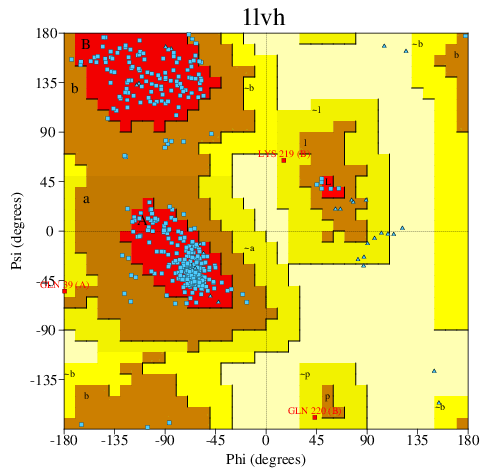
PDBsum entry 1lvh

|
|
|
|
|
 |
Contents |
 |
|
|
|
|
|
|
|
|
|
|
|
|
* Residue conservation analysis
|
|
|
|
|
References listed in PDB file
|
|
|
Key reference
|
|
|
Title
|
|
Caught in the act: the structure of phosphorylated beta-Phosphoglucomutase from lactococcus lactis.
|
|
|
Authors
|
|
S.D.Lahiri,
G.Zhang,
D.Dunaway-Mariano,
K.N.Allen.
|
|
|
Ref.
|
|
Biochemistry, 2002,
41,
8351-8359.
[DOI no: ]
|
|
|
PubMed id
|
|
|
|
|
|
Abstract
|
|
|
Phosphoglucomutases catalyze the interconversion of D-glucose 1-phosphate and
D-glucose 6-phosphate, a reaction central to energy metabolism in all cells and
to the synthesis of cell wall polysaccharides in bacterial cells. Two classes of
phosphoglucomutases (alpha-PGM and beta-PGM) are distinguished on the basis of
their specificity for alpha- and beta-glucose-1-phosphate. beta-PGM is a member
of the haloacid dehalogenase (HAD) superfamily, which includes the sarcoplasmic
Ca(2+)-ATPase, phosphomannomutase, and phosphoserine phosphatase. beta-PGM is
unusual among family members in that the common phosphoenzyme intermediate
exists as a stable ground-state complex in this enzyme. Herein we report, for
the first time, the three-dimensional structure of a beta-PGM and the first view
of the true phosphoenzyme intermediate in the HAD superfamily. The crystal
structure of the Mg(II) complex of phosphorylated beta-phosphoglucomutase
(beta-PGM) from Lactococcus lactis has been determined to 2.3 A resolution by
multiwavelength anomalous diffraction (MAD) phasing on selenomethionine, and
refined to an R(cryst) = 0.24 and R(free) = 0.28. The active site of beta-PGM is
located between the core and the cap domain and is freely solvent accessible.
The residues within a 6 A radius of the phosphorylated Asp8 include Asp10,
Thr16, Ser114, Lys145, Glu169, and Asp170. The cofactor Mg(2+) is liganded with
octahedral coordination geometry by the carboxylate side chains of Asp8, Glu169,
Asp170, and the backbone carbonyl oxygen of Asp10 along with one oxygen from the
Asp8-phosphoryl group and one water ligand. The phosphate group of the
phosphoaspartyl residue, Asp8, interacts with the side chains of Ser114 and
Lys145. The absence of a base residue near the aspartyl phosphate group accounts
for the persistence of the phosphorylated enzyme under physiological conditions.
Substrate docking shows that glucose-6-P can bind to the active site of
phosphorylated beta-PGM in such a way as to position the C(1)OH near the
phosphoryl group of the phosphorylated Asp8 and the C(6) phosphoryl group near
the carboxylate group of Asp10. This result suggests a novel two-base mechanism
for phosphoryl group transfer in a phosphorylated sugar.
|
|
|
Secondary reference #1
|
|
|
Title
|
|
Crystallization and preliminary X-Ray diffraction studies of beta-Phosphoglucomutase from lactococcus lactus.
|
|
|
Authors
|
|
S.D.Lahiri,
G.Zhang,
P.Radstrom,
D.Dunaway-Mariano,
K.N.Allen.
|
|
|
Ref.
|
|
Acta Crystallogr D Biol Crystallogr, 2002,
58,
324-326.
[DOI no: ]
|
|
|
PubMed id
|
|
|
|
|
|
|
|
|
|

|
|
Figure 1.
Figure 1 Diffraction of SeMet-substituted  -PGM
crystals using synchroton radiation on beamline BM14-D at the
Advanced Photon Source (see text for details). The resolution at
the edge of the plate is 2.2 Å. -PGM
crystals using synchroton radiation on beamline BM14-D at the
Advanced Photon Source (see text for details). The resolution at
the edge of the plate is 2.2 Å.
|
|
|
|
|
|
The above figure is
reproduced from the cited reference
with permission from the IUCr
|
|
|
|
|
|
|