 |
PDBsum entry 1l9r

|
|
|
|
|
|

|

|

|

|
|

|
|

|
|

|
|

|
|

|
|

|
|
|
 |

|

|
|
|
|
|
|
|
|
|
|
|
|
|
|
|
|
|
|
|
|
|
|
|
|
|
|
|
|
|
|
|
|
|
|
|
Oxidoreductase
|
PDB id
|
|
|
|
1l9r
|
|
|
|
|
|
|
|
|
|
|
|
|
|
|

|

|

|
|
|
|
|
|
|
|
 |
Contents |
 |
|
|
|
|
|
|
|
|
|
|
|
|
|
|
* Residue conservation analysis
|
|
|
|
|
|
|
|
|
|
|
Enzyme class:
|
|
E.C.1.7.2.1
- nitrite reductase (NO-forming).
|
|
|
|
|
|
|
Reaction:
|
|
nitric oxide + Fe(III)-[cytochrome c] + H2O = Fe(II)-[cytochrome c] + nitrite + 2 H+
|
|
|
|
|
|
 nitric oxide
|
+
|
Fe(III)-[cytochrome c]
|
+
|
H2O
|
=
|
Fe(II)-[cytochrome c]
|
+
|
 nitrite
|
+
|
2
×
H(+)
Bound ligand (Het Group name = )
corresponds exactly
|
|
|
|
|
|
|
|
|
|
Cofactor:
|
|
Cu cation or Fe cation; FAD
|
|
|
|
|
|
Cu cation
|
or
|
Fe cation
|
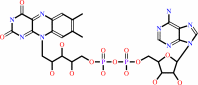 FAD
FAD
|
|
|
|
|
|
|
Molecule diagrams generated from .mol files obtained from the
KEGG ftp site
|
|
|
|
|
|
|
|
|
|
|
|
|
|
 |
|
|
|
|
|
|
| |
|
|
| |
|
DOI no:
|
Protein Sci
12:248-256
(2003)
|
|
PubMed id:
|
|
|
|
|
|
| |
|
Directing the mode of nitrite binding to a copper-containing nitrite reductase from Alcaligenes faecalis S-6: characterization of an active site isoleucine.
|
|
M.J.Boulanger,
M.E.Murphy.
|
|
|
|
|
| |
ABSTRACT
|
|
|
|
| |
|
|
Unlike the heme cd(1)-based nitrite reductase enzymes, the molecular mechanism
of copper-containing nitrite reductases remains controversial. A key source of
controversy is the productive binding mode of nitrite in the active site. To
identify and characterize the molecular determinants associated with nitrite
binding, we applied a combinatorial mutagenesis approach to generate a small
library of six variants at position 257 in nitrite reductase from Alcaligenes
faecalis S-6. The activities of these six variants span nearly two orders of
magnitude with one variant, I257V, the only observed natural substitution for
Ile257, showing greater activity than the native enzyme. High-resolution (> 1.8
A) nitrite-soaked crystal structures of these variants display different modes
of nitrite binding that correlate well with the altered activities. These
studies identify for the first time that the highly conserved Ile257 in the
native enzyme is a key molecular determinant in directing a catalytically
competent mode of nitrite binding in the active site. The O-coordinate bidentate
binding mode of nitrite observed in native and mutant forms with high activity
supports a catalytic model distinct from the heme cd(1) NiRs. (The atomic
coordinates for I257V[NO(2)(-)], I257L[NO(2)(-)], I257A[NO(2)(-)],
AfNiR have been deposited
in the Protein Data Bank [PDB identification codes are listed in Table 2].)
|
|
|
|
|
|
| |
Selected figure(s)
|
|
|
|
| |
|
|

|
|
Figure 1.
Figure 1. Crystal structures of the six nitrite-soaked I257
variants in the upper six panels. Hydrogen bonds are shown as
dashed gray lines with ligand bonds drawn in solid, dark gray
lines. Water molecules are drawn as aquamarine spheres. Copper
atoms are gray; nitrogen atoms are dark blue, oxygen atoms are
red, and sulfur atoms are yellow. The backbone of monomers B and
C are shown in burgundy and in teal, respectively. Bonds of the
nitrite molecule bound in the active site are white. Omit Fo-Fc
electron density maps are contoured at 4  and drawn as
a green wire mesh. Panels A and B depict the multiple
conformations of the nitrite bound in the active site of the
Ile257 variants and including nitrite bound to the oxidized D98N
(black atoms) and H255N (gray atoms) crystal structures
(Boulanger and Murphy 2001). With the exception of the purple
nitrite molecules in panel B, nitrite molecules are blue to red
with increasing specific activity: Red, I257V[NO[2]^-]; orange,
native NiR from Alcaligenes faecalis S-6; light orange,
I257L[NO[2]^-]; yellow, I257M[NO[2]^-]; green, I257A[NO[2]^-];
cyan, I257G[NO[2]^-]; blue, I257T[NO[2]^-]. and drawn as
a green wire mesh. Panels A and B depict the multiple
conformations of the nitrite bound in the active site of the
Ile257 variants and including nitrite bound to the oxidized D98N
(black atoms) and H255N (gray atoms) crystal structures
(Boulanger and Murphy 2001). With the exception of the purple
nitrite molecules in panel B, nitrite molecules are blue to red
with increasing specific activity: Red, I257V[NO[2]^-]; orange,
native NiR from Alcaligenes faecalis S-6; light orange,
I257L[NO[2]^-]; yellow, I257M[NO[2]^-]; green, I257A[NO[2]^-];
cyan, I257G[NO[2]^-]; blue, I257T[NO[2]^-].
|
|
|
|
|
|
| |
The above figure is
reprinted
by permission from the Protein Society:
Protein Sci
(2003,
12,
248-256)
copyright 2003.
|
|
| |
Figure was
selected
by an automated process.
|
|
|
|
|
|
|
|
|
|
|
|
|
|
|
|
 |
 |
 |
|
Literature references that cite this PDB file's key reference
|
|
|
| |
PubMed id
|
|
Reference
|
|
|
|
|
|
I.S.MacPherson,
F.I.Rosell,
M.Scofield,
A.G.Mauk,
and
M.E.Murphy
(2010).
Directed evolution of copper nitrite reductase to a chromogenic reductant.
|
| |
Protein Eng Des Sel,
23,
137-145.
|
|
|
PDB codes:
|
|
|
|
|
|
|
|
S.Ghosh,
A.Dey,
Y.Sun,
C.P.Scholes,
and
E.I.Solomon
(2009).
Spectroscopic and computational studies of nitrite reductase: proton induced electron transfer and backbonding contributions to reactivity.
|
| |
J Am Chem Soc,
131,
277-288.
|
|
|
|
|
|
|
S.V.Antonyuk,
R.W.Strange,
G.Sawers,
R.R.Eady,
and
S.S.Hasnain
(2005).
Atomic resolution structures of resting-state, substrate- and product-complexed Cu-nitrite reductase provide insight into catalytic mechanism.
|
| |
Proc Natl Acad Sci U S A,
102,
12041-12046.
|
|
|
PDB codes:
|
|
|
|
|
|
|
The most recent references are shown first.
Citation data come partly from CiteXplore and partly
from an automated harvesting procedure. Note that this is likely to be
only a partial list as not all journals are covered by
either method. However, we are continually building up the citation data
so more and more references will be included with time.
Where a reference describes a PDB structure, the PDB
codes are
shown on the right.
|
|


 Links
Links


