|
PDBsum entry 1k5u

|
|
|
|
|
|

|
|

|
|

|
|

|
|

|
|

|
|

|
|
|
 |

|

|
|
|
|
|
|
|
|
|
|
|
|
|
|
|
|
|
|
|
|
|
|
|
|
|
|
|
|
|
|
|
|
Hormone/growth factor
|
PDB id
|
|
|
|
1k5u
|
|
|
|
|
|
|
|
|
|
|
|
|
|
|

|

|

|
|
|
|
|
|
|
|
 |
Contents |
 |
|
|
|
|
|
|
|
|
|
|
|
|
* Residue conservation analysis
|
|
|
|
|
References listed in PDB file
|
|
|
Key reference
|
|
|
Title
|
|
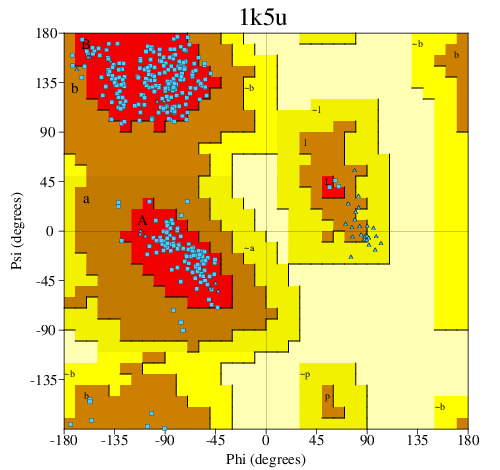
Alternative type i and i' Turn conformations in the beta8/beta9 beta-Hairpin of human acidic fibroblast growth factor.
|
|
|
Authors
|
|
J.Kim,
S.I.Blaber,
M.Blaber.
|
|
|
Ref.
|
|
Protein Sci, 2002,
11,
459-466.
[DOI no: ]
|
|
|
PubMed id
|
|
|
|
|
|
Abstract
|
|
|
Human acidic fibroblast growth factor (FGF-1) has a beta-trefoil structure, one
of the fundamental protein superfolds. The X-ray crystal structures of wild-type
and various mutant forms of FGF-1 have been solved in five different space
groups: C2, C222(1), P2(1) (four molecules/asu), P2(1) (three molecules/asu),
and P2(1)2(1)2(1). These structures reveal two characteristically different
conformations for the beta8/beta9 beta-hairpin comprising residue positions
90-94. This region in the wild-type FGF-1 structure (P2(1), four molecules/asu),
a his-tagged His93-->Gly mutant (P2(1), three molecules/asu) and a his-tagged
Asn106-->Gly mutant (P2(1)2(1)2(1)) adopts a 3:5 beta-hairpin known as a type I
(1-4) G1 beta-bulge (containing a type I turn). However, a his-tagged form of
wild-type FGF-1 (C222(1)) and a his-tagged Leu44-->Phe mutant (C2) adopt a 3:3
beta-hairpin (containing a type I' turn) for this same region. A feature that
distinguishes these two types of beta-hairpin structures is the number and
location of side chain positions with eclipsed C(beta) and main-chain carbonyl
oxygen groups (Psi is equivalent to +60 degrees). The effects of glycine
mutations upon stability, at positions within the hairpin, have been used to
identify the most likely structure in solution. Type I' turns in the structural
data bank are quite rare, and a survey of these turns reveals that a large
percentage exhibit crystal contacts within 3.0 A. This suggests that many of the
type I' turns in X-ray structures may be adopted due to crystal packing effects.
|
|
|
|

|
|

|
|
Figure 1.
Fig. 1. Relaxed stereodiagram of human FGF-1 (Blaber et al.
1996) showing the location of the ß8/ß9 turn region and the
90-94 ß-hairpin (dark gray). The view is down the pseudo
threefold axis of symmetry present in the ß-trefoil
architecture. Region 90-94 is related to the N- and C-termini by
this internal symmetry.
|
|
Figure 4.
Fig. 4. Distribution of the distances between type I` turns
and crystal contacts from 116 type I` turns in the structural
databank.
|
|
|
|
|
|
The above figures are
reprinted
by permission from the Protein Society:
Protein Sci
(2002,
11,
459-466)
copyright 2002.
|
|
|
|
|
|
|