 |
PDBsum entry 1k0p

|
|
|
|
|
 |
Contents |
 |
|
|
|
|
|
|
|
|
* Residue conservation analysis
|
|
|
|
|
|
|
|
|
|
|
Enzyme class:
|
|
E.C.2.7.7.7
- DNA-directed Dna polymerase.
|
|
|
|
|
|
|
Reaction:
|
|
DNA(n) + a 2'-deoxyribonucleoside 5'-triphosphate = DNA(n+1) + diphosphate
|
|
|
|
|
|
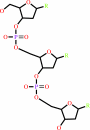 DNA(n)
|
+
|
2'-deoxyribonucleoside 5'-triphosphate
|
=
|
DNA(n+1)
|
+
|
 diphosphate
|
|
|
|
|
|
|
|
|
|
|
|
|
Molecule diagrams generated from .mol files obtained from the
KEGG ftp site
|
|
|
|
|
|
|
|
|
|
|
|
|
|
 |
|
|
|
|
|
|
| |
|
|
| |
|
DOI no:
|
Biochim Biophys Acta
1651:163-171
(2003)
|
|
PubMed id:
|
|
|
|
|
|
| |
|
Nuclear magnetic resonance structures of the zinc finger domain of human DNA polymerase-alpha.
|
|
F.Evanics,
L.Maurmann,
W.W.Yang,
R.N.Bose.
|
|
|
|
|
| |
ABSTRACT
|
|
|
|
| |
|
|
The carboxy terminus of the human DNA polymerase-alpha contains a zinc finger
motif. Three-dimensional structures of this motif containing 38 amino acid
residues, W L I C E E P T C R N R T R H L P L Q F S R T G P L C P A C M K A T L
Q P E, were determined by nuclear magnetic resonance (NMR) spectroscopy. The
structures reveal an alpha-helix-like domain at the amino terminus, extending 13
residues from L2 through H15 with an interruption at the sixth residue. The
helix region is followed by three turns (H15-L18, T23-L26 and L26-A29), all of
which involve proline. The first turn appears to be type III, judging by the
dihedral angles. The second and third turns appear to be atypical. A second,
shorter helix is formed at the carboxy terminus extending from C30 through L35.
A fourth type III turn starting at L35 was also observed in the structure.
Proline serves as the third residue of all the turns. Four cysteine residues,
two located at the beginning of the helix at the N-terminus and two at the
carboxy end, are coordinated to Zn(II), facilitating the formation of a loop.
One of the cysteines at the carboxy terminus is part of the atypical turn, while
the other is the part of the short helix. These structural features are
consistent with the circular dichroism (CD) measurements which indicate the
presence of 45% helix, 11% beta turns and 19% non-ordered secondary structures.
The zinc finger motif described here is different from those observed for C(4),
C(2)H(2), and C(2)HC modules reported in the literature. In particular,
polymerase-alpha structures exhibit helix-turn-helix motif while most zinc
finger proteins show anti-parallel sheet and helix. Several residues capable of
binding DNA, T, R, N, and H are located in the helical region. These structural
features imply that the zinc finger motif is most likely involved in binding DNA
prior to replication, presumably through the helical region. These results are
discussed in the context of other eukaryotic and prokaryotic DNA polymerases
belonging to the polymerase B family.
|
|
|
|
|
|
|
|
|
|
|
|
|
|
|
|
|
|
 |
 |
 |
|
Literature references that cite this PDB file's key reference
|
|
|
| |
PubMed id
|
|
Reference
|
|
|
|
|
|
L.Maurmann,
and
R.N.Bose
(2010).
Unwinding of zinc finger domain of DNA polymerase I by cis-diamminedichloroplatinum(II).
|
| |
Dalton Trans,
39,
7968-7979.
|
|
|
|
|
|
|
J.Sanchez Garcia,
A.G.Baranovskiy,
E.V.Knatko,
F.C.Gray,
T.H.Tahirov,
and
S.A.MacNeill
(2009).
Functional mapping of the fission yeast DNA polymerase delta B-subunit Cdc1 by site-directed and random pentapeptide insertion mutagenesis.
|
| |
BMC Mol Biol,
10,
82.
|
|
|
|
|
|
|
S.Klinge,
R.Núñez-Ramírez,
O.Llorca,
and
L.Pellegrini
(2009).
3D architecture of DNA Pol alpha reveals the functional core of multi-subunit replicative polymerases.
|
| |
EMBO J,
28,
1978-1987.
|
|
|
PDB code:
|
|
|
|
|
|
|
|
T.H.Tahirov,
K.S.Makarova,
I.B.Rogozin,
Y.I.Pavlov,
and
E.V.Koonin
(2009).
Evolution of DNA polymerases: an inactivated polymerase-exonuclease module in Pol epsilon and a chimeric origin of eukaryotic polymerases from two classes of archaeal ancestors.
|
| |
Biol Direct,
4,
11.
|
|
|
|
|
|
|
A.I.Anzellotti,
and
N.P.Farrell
(2008).
Zinc metalloproteins as medicinal targets.
|
| |
Chem Soc Rev,
37,
1629-1651.
|
|
|
|
|
|
|
J.Sanchez Garcia,
L.F.Ciufo,
X.Yang,
S.E.Kearsey,
and
S.A.MacNeill
(2004).
The C-terminal zinc finger of the catalytic subunit of DNA polymerase delta is responsible for direct interaction with the B-subunit.
|
| |
Nucleic Acids Res,
32,
3005-3016.
|
|
|
|
|
|
The most recent references are shown first.
Citation data come partly from CiteXplore and partly
from an automated harvesting procedure. Note that this is likely to be
only a partial list as not all journals are covered by
either method. However, we are continually building up the citation data
so more and more references will be included with time.
Where a reference describes a PDB structure, the PDB
code is
shown on the right.
|
|


 Links
Links


