
|
|
|
|
|
 |
Contents |
 |
|
|
|
|
|
|
|
|
|
|
|
|
* Residue conservation analysis
|
|
|
|
|
|
|
|
|
|
Enzyme class 1:
|
|
Chains A, B:
E.C.2.7.7.-
- ?????
|
|
|
|
|
|
|
Enzyme class 2:
|
|
Chains A, B:
E.C.2.7.7.49
- RNA-directed Dna polymerase.
|
|
|
|
|
|
|
Reaction:
|
|
DNA(n) + a 2'-deoxyribonucleoside 5'-triphosphate = DNA(n+1) + diphosphate
|
|
|
|
|
|
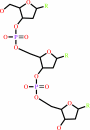 DNA(n)
|
+
|
2'-deoxyribonucleoside 5'-triphosphate
|
=
|
DNA(n+1)
|
+
|
 diphosphate
|
|
|
|
|
|
|
|
|
|
Enzyme class 3:
|
|
Chains A, B:
E.C.2.7.7.7
- DNA-directed Dna polymerase.
|
|
|
|
|
|
|
Reaction:
|
|
DNA(n) + a 2'-deoxyribonucleoside 5'-triphosphate = DNA(n+1) + diphosphate
|
|
|
|
|
|
DNA(n)
|
+
|
2'-deoxyribonucleoside 5'-triphosphate
|
=
|
DNA(n+1)
|
+
|
diphosphate
|
|
|
|
|
|
|
|
|
|
Enzyme class 4:
|
|
Chains A, B:
E.C.3.1.-.-
|
|
|
|
|
|
|
Enzyme class 5:
|
|
Chains A, B:
E.C.3.1.13.2
- exoribonuclease H.
|
|
|
|
|
|
|
Reaction:
|
|
Exonucleolytic cleavage to 5'-phosphomonoester oligonucleotides in both 5'- to 3'- and 3'- to 5'-directions.
|
|
|
|
|
|
Enzyme class 6:
|
|
Chains A, B:
E.C.3.1.26.13
- retroviral ribonuclease H.
|
|
|
|
|
|
|
Enzyme class 7:
|
|
Chains A, B:
E.C.3.4.23.16
- HIV-1 retropepsin.
|
|
|
|
|
|
|
Reaction:
|
|
Specific for a P1 residue that is hydrophobic, and P1' variable, but often Pro.
|
|
|
|
|
|
|
|
|
Note, where more than one E.C. class is given (as above), each may
correspond to a different protein domain or, in the case of polyprotein
precursors, to a different mature protein.
|
|
|
|
Molecule diagrams generated from .mol files obtained from the
KEGG ftp site
|
|
|
|
|
|
|
|
|
|
|
|
|
|
 |
|
|
|
|
|
|
| |
|
|
| |
|
DOI no:
|
J Mol Biol
312:795-805
(2001)
|
|
PubMed id:
|
|
|
|
|
|
| |
|
Structural mechanisms of drug resistance for mutations at codons 181 and 188 in HIV-1 reverse transcriptase and the improved resilience of second generation non-nucleoside inhibitors.
|
|
J.Ren,
C.Nichols,
L.Bird,
P.Chamberlain,
K.Weaver,
S.Short,
D.I.Stuart,
D.K.Stammers.
|
|
|
|
|
| |
ABSTRACT
|
|
|
|
| |
|
|
Mutations at either Tyr181 or Tyr188 within HIV-1 reverse transcriptase (RT)
give high level resistance to many first generation non-nucleoside inhibitors
(NNRTIs) such as the anti-AIDS drug nevirapine. By comparison second generation
inhibitors, for instance the drug efavirenz, show much greater resilience to
these mutations. In order to understand the structural basis for these
differences we have determined a series of seven crystal structures of mutant
RTs in complexes with first and second generation NNRTIs as well as one example
of an unliganded mutant RT. These are Tyr181Cys RT (TNK-651) to 2.4 A, Tyr181Cys
RT (efavirenz) to 2.6 A, Tyr181Cys RT (nevirapine) to 3.0 A, Tyr181Cys RT
(PETT-2) to 3.0 A, Tyr188Cys RT (nevirapine) to 2.6 A, Tyr188Cys RT (UC-781) to
2.6 A and Tyr188Cys RT (unliganded) to 2.8 A resolution. In the two previously
published structures of HIV-1 reverse transcriptase with mutations at 181 or 188
no side-chain electron density was observed within the p66 subunit (which
contains the inhibitor binding pocket) for the mutated residues. In contrast the
mutated side-chains can be seen in the NNRTI pocket for all seven structures
reported here, eliminating the possibility that disordering contributes to the
mechanism of resistance. In the case of the second generation compounds
efavirenz with Tyr181Cys RT and UC-781 with Tyr188Cys RT there are only small
rearrangements of either inhibitor within the binding site compared to wild-type
RT and also for the first generation compounds TNK-651, PETT-2 and nevirapine
with Tyr181Cys RT. For nevirapine with the Tyr188Cys RT there is however a more
substantial movement of the drug molecule. We conclude that protein
conformational changes and rearrangements of drug molecules within the mutated
sites are not general features of these particular inhibitor/mutant
combinations. The main contribution to drug resistance for Tyr181Cys and
Tyr188Cys RT mutations is the loss of aromatic ring stacking interactions for
first generation compounds, providing a simple explanation for the resilience of
second generation NNRTIs, as such interactions make much less significant
contribution to their binding.
|
|
|
|
|
|
| |
Selected figure(s)
|
|
|
|
| |
|
|

|
|

|
|
Figure 3.
Figure 3. Stereo-diagram comparing the NNRTI binding sites
of wild-type and Tyr181Cys mutant RTs for the following
complexes: (a) nevirapine, (b) TNK-651, (c) PETT-2, and (d)
efavirenz. The thinner bonds show the main-chain backbone with
wild-type RT coloured as dark grey and the mutant RT as light
grey. Side-chains and the inhibitors are shown with thicker
bonds with wild-type RT coloured brown and mutant RT as green.
For clarity the side-chain of 181 and inhibitor are shown in red
for wild-type RT and in cyan for the mutant. The broken yellow
lines represent hydrogen bonds.
|
|
Figure 4.
Figure 4. Stereo-diagram comparing the NNRTI binding sites
of wild-type and Tyr188Cys mutant RTs for the following: (a)
unliganded, (b) nevirapine complex and (c) UC-781 complex. The
colour scheme for backbone, inhibitors and side-chains is the
same as in Figure 3.
|
|
|
|
|
|
| |
The above figures are
reprinted
by permission from Elsevier:
J Mol Biol
(2001,
312,
795-805)
copyright 2001.
|
|
| |
Figures were
selected
by an automated process.
|
|
|
|
|
|
|
|
|
|
|
|
|
|
|
|
 |
 |
 |
|
Literature references that cite this PDB file's key reference
|
|
|
| |
PubMed id
|
|
Reference
|
|
|
|
|
|
A.Engelman,
and
P.Cherepanov
(2012).
The structural biology of HIV-1: mechanistic and therapeutic insights.
|
| |
Nat Rev Microbiol,
10,
279-290.
|
|
|
|
|
|
|
M.Chourasia,
G.M.Sastry,
and
G.N.Sastry
(2011).
Aromatic-Aromatic Interactions Database, A(2)ID: an analysis of aromatic π-networks in proteins.
|
| |
Int J Biol Macromol,
48,
540-552.
|
|
|
|
|
|
|
M.Yu,
Z.Li,
S.Liu,
E.Fan,
C.Pannecouque,
E.De Clercq,
and
X.Liu
(2011).
Synthesis and biological evaluation of 6-substituted 5-alkyl-2-(phenylaminocarbonylmethylthio)pyrimidin-4(3H)-ones as potent HIV-1 NNRTIs.
|
| |
ChemMedChem,
6,
826-833.
|
|
|
|
|
|
|
S.Ibe,
and
W.Sugiura
(2011).
Clinical significance of HIV reverse-transcriptase inhibitor-resistance mutations.
|
| |
Future Microbiol,
6,
295-315.
|
|
|
|
|
|
|
Z.Li,
H.Zhang,
Y.Li,
J.Zhang,
and
H.F.Chen
(2011).
Drug resistant mechanism of diaryltriazine analog inhibitors of HIV-1 reverse transcriptase using molecular dynamics simulation and 3D-QSAR.
|
| |
Chem Biol Drug Des,
77,
63-74.
|
|
|
|
|
|
|
A.Herschhorn,
and
A.Hizi
(2010).
Retroviral reverse transcriptases.
|
| |
Cell Mol Life Sci,
67,
2717-2747.
|
|
|
|
|
|
|
K.A.Delviks-Frankenberry,
G.N.Nikolenko,
and
V.K.Pathak
(2010).
The "Connection" Between HIV Drug Resistance and RNase H.
|
| |
Viruses,
2,
1476-1503.
|
|
|
|
|
|
|
K.Singh,
B.Marchand,
K.A.Kirby,
E.Michailidis,
and
S.G.Sarafianos
(2010).
Structural Aspects of Drug Resistance and Inhibition of HIV-1 Reverse Transcriptase.
|
| |
Viruses,
2,
606-638.
|
|
|
|
|
|
|
R.K.Raju,
N.A.Burton,
and
I.H.Hillier
(2010).
Modelling the binding of HIV-reverse transcriptase and nevirapine: an assessment of quantum mechanical and force field approaches and predictions of the effect of mutations on binding.
|
| |
Phys Chem Chem Phys,
12,
7117-7125.
|
|
|
|
|
|
|
S.Ganguly,
S.Murugesan,
N.Prasanthi,
O.Alptürk,
B.Herman,
and
N.Sluis-Cremer
(2010).
Synthesis and Anti-HIV-1 Activity of a Novel Series of Aminoimidazole Analogs.
|
| |
Lett Drug Des Discov,
7,
318-323.
|
|
|
|
|
|
|
S.E.Nichols,
R.A.Domaoal,
V.V.Thakur,
J.Tirado-Rives,
K.S.Anderson,
and
W.L.Jorgensen
(2009).
Discovery of wild-type and Y181C mutant non-nucleoside HIV-1 reverse transcriptase inhibitors using virtual screening with multiple protein structures.
|
| |
J Chem Inf Model,
49,
1272-1279.
|
|
|
|
|
|
|
S.G.Sarafianos,
B.Marchand,
K.Das,
D.M.Himmel,
M.A.Parniak,
S.H.Hughes,
and
E.Arnold
(2009).
Structure and function of HIV-1 reverse transcriptase: molecular mechanisms of polymerization and inhibition.
|
| |
J Mol Biol,
385,
693-713.
|
|
|
|
|
|
|
C.Spadafora
(2008).
A reverse transcriptase-dependent mechanism plays central roles in fundamental biological processes.
|
| |
Syst Biol Reprod Med,
54,
11-21.
|
|
|
|
|
|
|
E.Magiorkinis,
D.Paraskevis,
H.Sambatakou,
P.Gargalianos,
C.Haida,
A.Vassilakis,
and
A.Hatzakis
(2008).
Emergence of an NNRTI resistance mutation Y181C in an HIV-infected NNRTI-naive patient.
|
| |
AIDS Res Hum Retroviruses,
24,
413-415.
|
|
|
|
|
|
|
M.Landriscina,
S.A.Altamura,
L.Roca,
M.Gigante,
A.Piscazzi,
E.Cavalcanti,
E.Costantino,
C.Barone,
M.Cignarelli,
L.Gesualdo,
and
E.Ranieri
(2008).
Reverse transcriptase inhibitors induce cell differentiation and enhance the immunogenic phenotype in human renal clear-cell carcinoma.
|
| |
Int J Cancer,
122,
2842-2850.
|
|
|
|
|
|
|
P.Srivab,
and
S.Hannongbua
(2008).
A study of the binding energies of efavirenz to wild-type and K103N/Y181C HIV-1 reverse transcriptase based on the ONIOM method.
|
| |
ChemMedChem,
3,
803-811.
|
|
|
|
|
|
|
D.M.Held,
J.D.Kissel,
S.J.Thacker,
D.Michalowski,
D.Saran,
J.Ji,
R.W.Hardy,
J.J.Rossi,
and
D.H.Burke
(2007).
Cross-clade inhibition of recombinant human immunodeficiency virus type 1 (HIV-1), HIV-2, and simian immunodeficiency virus SIVcpz reverse transcriptases by RNA pseudoknot aptamers.
|
| |
J Virol,
81,
5375-5384.
|
|
|
|
|
|
|
F.Ceccherini-Silberstein,
V.Svicher,
T.Sing,
A.Artese,
M.M.Santoro,
F.Forbici,
A.Bertoli,
S.Alcaro,
G.Palamara,
A.d'Arminio Monforte,
J.Balzarini,
A.Antinori,
T.Lengauer,
and
C.F.Perno
(2007).
Characterization and structural analysis of novel mutations in human immunodeficiency virus type 1 reverse transcriptase involved in the regulation of resistance to nonnucleoside inhibitors.
|
| |
J Virol,
81,
11507-11519.
|
|
|
|
|
|
|
S.Modoni,
M.Landriscina,
A.Fabiano,
A.Fersini,
N.Urbano,
A.Ambrosi,
and
M.Cignarelli
(2007).
Reinduction of cell differentiation and 131I uptake in a poorly differentiated thyroid tumor in response to the reverse transcriptase (RT) inhibitor nevirapine.
|
| |
Cancer Biother Radiopharm,
22,
289-295.
|
|
|
|
|
|
|
J.Ren,
C.E.Nichols,
A.Stamp,
P.P.Chamberlain,
R.Ferris,
K.L.Weaver,
S.A.Short,
and
D.K.Stammers
(2006).
Structural insights into mechanisms of non-nucleoside drug resistance for HIV-1 reverse transcriptases mutated at codons 101 or 138.
|
| |
FEBS J,
273,
3850-3860.
|
|
|
PDB codes:
|
|
|
|
|
|
|
|
M.Landriscina,
S.Modoni,
A.Fabiano,
A.Fersini,
C.Barone,
A.Ambrosi,
and
M.Cignarelli
(2006).
Cell differentiation and iodine-131 uptake in poorly differentiated thyroid tumour in response to nevirapine.
|
| |
Lancet Oncol,
7,
877-879.
|
|
|
|
|
|
|
T.M.Steindl,
D.Schuster,
G.Wolber,
C.Laggner,
and
T.Langer
(2006).
High-throughput structure-based pharmacophore modelling as a basis for successful parallel virtual screening.
|
| |
J Comput Aided Mol Des,
20,
703-715.
|
|
|
|
|
|
|
Z.Zhang,
M.Zheng,
L.Du,
J.Shen,
X.Luo,
W.Zhu,
and
H.Jiang
(2006).
Towards discovering dual functional inhibitors against both wild type and K103N mutant HIV-1 reverse transcriptases: molecular docking and QSAR studies on 4,1-benzoxazepinone analogues.
|
| |
J Comput Aided Mol Des,
20,
281-293.
|
|
|
|
|
|
|
B.Rodes,
C.de Mendoza,
M.Rodgers,
A.Newell,
V.Jimenez,
R.M.Lopez-Brugada,
and
V.Soriano
(2005).
Treatment response and drug resistance in patients infected with HIV type 1 group O viruses.
|
| |
AIDS Res Hum Retroviruses,
21,
602-607.
|
|
|
|
|
|
|
I.Sciamanna,
M.Landriscina,
C.Pittoggi,
M.Quirino,
C.Mearelli,
R.Beraldi,
E.Mattei,
A.Serafino,
A.Cassano,
P.Sinibaldi-Vallebona,
E.Garaci,
C.Barone,
and
C.Spadafora
(2005).
Inhibition of endogenous reverse transcriptase antagonizes human tumor growth.
|
| |
Oncogene,
24,
3923-3931.
|
|
|
|
|
|
|
S.Saen-oon,
M.Kuno,
and
S.Hannongbua
(2005).
Binding energy analysis for wild-type and Y181C mutant HIV-1 RT/8-Cl TIBO complex structures: quantum chemical calculations based on the ONIOM method.
|
| |
Proteins,
61,
859-869.
|
|
|
|
|
|
|
X.He,
Y.Mei,
Y.Xiang,
D.W.Zhang,
and
J.Z.Zhang
(2005).
Quantum computational analysis for drug resistance of HIV-1 reverse transcriptase to nevirapine through point mutations.
|
| |
Proteins,
61,
423-432.
|
|
|
|
|
|
|
Y.Mei,
X.He,
Y.Xiang,
D.W.Zhang,
and
J.Z.Zhang
(2005).
Quantum study of mutational effect in binding of efavirenz to HIV-1 RT.
|
| |
Proteins,
59,
489-495.
|
|
|
|
|
|
|
C.Fortin,
and
V.Joly
(2004).
Efavirenz for HIV-1 infection in adults: an overview.
|
| |
Expert Rev Anti Infect Ther,
2,
671-684.
|
|
|
|
|
|
|
J.Auwerx,
M.Stevens,
A.R.Van Rompay,
L.E.Bird,
J.Ren,
E.De Clercq,
B.Oberg,
D.K.Stammers,
A.Karlsson,
and
J.Balzarini
(2004).
The phenylmethylthiazolylthiourea nonnucleoside reverse transcriptase (RT) inhibitor MSK-076 selects for a resistance mutation in the active site of human immunodeficiency virus type 2 RT.
|
| |
J Virol,
78,
7427-7437.
|
|
|
|
|
|
|
J.D.Pata,
W.G.Stirtan,
S.W.Goldstein,
and
T.A.Steitz
(2004).
Structure of HIV-1 reverse transcriptase bound to an inhibitor active against mutant reverse transcriptases resistant to other nonnucleoside inhibitors.
|
| |
Proc Natl Acad Sci U S A,
101,
10548-10553.
|
|
|
PDB code:
|
|
|
|
|
|
|
|
L.Z.Wang,
G.L.Kenyon,
and
K.A.Johnson
(2004).
Novel mechanism of inhibition of HIV-1 reverse transcriptase by a new non-nucleoside analog, KM-1.
|
| |
J Biol Chem,
279,
38424-38432.
|
|
|
|
|
|
|
M.Götte
(2004).
Inhibition of HIV-1 reverse transcription: basic principles of drug action and resistance.
|
| |
Expert Rev Anti Infect Ther,
2,
707-716.
|
|
|
|
|
|
|
N.Sluis-Cremer,
N.A.Temiz,
and
I.Bahar
(2004).
Conformational changes in HIV-1 reverse transcriptase induced by nonnucleoside reverse transcriptase inhibitor binding.
|
| |
Curr HIV Res,
2,
323-332.
|
|
|
|
|
|
|
Y.Gao,
E.Paxinos,
J.Galovich,
R.Troyer,
H.Baird,
M.Abreha,
C.Kityo,
P.Mugyenyi,
C.Petropoulos,
and
E.J.Arts
(2004).
Characterization of a subtype D human immunodeficiency virus type 1 isolate that was obtained from an untreated individual and that is highly resistant to nonnucleoside reverse transcriptase inhibitors.
|
| |
J Virol,
78,
5390-5401.
|
|
|
|
|
|
|
L.Shen,
J.Shen,
X.Luo,
F.Cheng,
Y.Xu,
K.Chen,
E.Arnold,
J.Ding,
and
H.Jiang
(2003).
Steered molecular dynamics simulation on the binding of NNRTI to HIV-1 RT.
|
| |
Biophys J,
84,
3547-3563.
|
|
|
|
|
|
|
J.Ren,
L.E.Bird,
P.P.Chamberlain,
G.B.Stewart-Jones,
D.I.Stuart,
and
D.K.Stammers
(2002).
Structure of HIV-2 reverse transcriptase at 2.35-A resolution and the mechanism of resistance to non-nucleoside inhibitors.
|
| |
Proc Natl Acad Sci U S A,
99,
14410-14415.
|
|
|
PDB code:
|
|
|
|
|
|
|
|
L.Menéndez-Arias
(2002).
Targeting HIV: antiretroviral therapy and development of drug resistance.
|
| |
Trends Pharmacol Sci,
23,
381-388.
|
|
|
|
|
|
The most recent references are shown first.
Citation data come partly from CiteXplore and partly
from an automated harvesting procedure. Note that this is likely to be
only a partial list as not all journals are covered by
either method. However, we are continually building up the citation data
so more and more references will be included with time.
Where a reference describes a PDB structure, the PDB
codes are
shown on the right.
|
 |


 Links
Links


