
|
|
|
|
|
 |
Contents |
 |
|
|
|
|
|
|
|
|
|
|
|


 (+ 2 more)
174 a.a.
(+ 2 more)
174 a.a.
|
|
|
|
|
|
|
|
|
|
|


 408 a.a.
|
|
|
|
|
|
|
|
|
* Residue conservation analysis
|
|
|
|
|
|
PDB id:
|
|
|
|
| Name: |
|
Chaperone
|
|
|
Title:
|
|
Nucleotide-dependent conformational changes in a protease-associated atpase hslu
|
|
Structure:
|
|
Heat shock locus hslv. Chain: c, d, v, x, a, b, z, y. Synonym: atp-dependent protease hslv. Engineered: yes. Heat shock locus hslu. Chain: e, f, g, i. Synonym: atp-dependent hsl protease atp-binding subunit hslu. Engineered: yes
|
|
Source:
|
|
Escherichia coli. Organism_taxid: 469008. Strain: bl21(de3). Cellular_location: cytoplasm. Expressed in: escherichia coli bl21(de3). Expression_system_taxid: 469008.
|
|
Biol. unit:
|
|
Dodecamer (from PDB file)
|
|
Resolution:
|
|
|
2.80Å
|
R-factor:
|
0.261
|
R-free:
|
0.309
|
|
|
Authors:
|
|
J.Wang,J.J.Song,I.S.Seong,M.C.Franklin,S.Kamtekar,S.H.Eom,C.H.Chung
|
Key ref:

|
|
J.Wang
et al.
(2001).
Nucleotide-dependent conformational changes in a protease-associated ATPase HsIU.
Structure,
9,
1107-1116.
PubMed id:
DOI:

|
|
|
Date:
|
|
|
27-Dec-00
|
Release date:
|
14-Nov-01
|
|
|
|
|
|
|
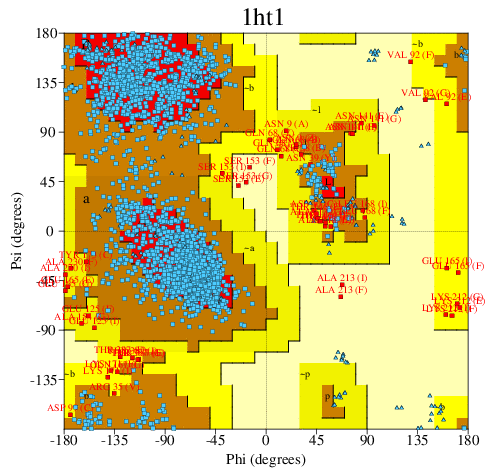
PROCHECK
|
|
|
|
|
|
Headers
|
|
|
|
References
|
|
|
|
|
|
|
|
|
|
|
|
Enzyme class:
|
|
Chains C, D, V, X, A, B, Z, Y:
E.C.3.4.25.2
- HslU--HslV peptidase.
|
|
|
|
|
|
|
|
|
|
|
|
|
|
|
|
|
|
|
 |
|
|
|
|
|
|
| |
|
DOI no:
|
Structure
9:1107-1116
(2001)
|
|
PubMed id:
|
|
|
|
|
|
| |
|
Nucleotide-dependent conformational changes in a protease-associated ATPase HsIU.
|
|
J.Wang,
J.J.Song,
I.S.Seong,
M.C.Franklin,
S.Kamtekar,
S.H.Eom,
C.H.Chung.
|
|
|
|
|
| |
ABSTRACT
|
|
|
|
| |
|
|
BACKGROUND: The bacterial heat shock locus ATPase HslU is an AAA(+) protein that
has structures known in many nucleotide-free and -bound states. Nucleotide is
required for the formation of the biologically active HslU hexameric assembly.
The hexameric HslU ATPase binds the dodecameric HslV peptidase and forms an
ATP-dependent HslVU protease. RESULTS: We have characterized four distinct HslU
conformational states, going sequentially from open to closed: the empty, SO(4),
ATP, and ADP states. The nucleotide binds at a cleft formed by an alpha/beta
domain and an alpha-helical domain in HslU. The four HslU states differ by a
rotation of the alpha-helical domain. This classification leads to a correction
of nucleotide identity in one structure and reveals the ATP hydrolysis-dependent
structural changes in the HslVU complex, including a ring rotation and a
conformational change of the HslU C terminus. This leads to an amended protein
unfolding-coupled translocation mechanism. CONCLUSIONS: The observed
nucleotide-dependent conformational changes in HslU and their governing
principles provide a framework for the mechanistic understanding of other AAA(+)
proteins.
|
|
|
|
|
|
| |
Selected figure(s)
|
|
|
|
| |
|
|

|
|
Figure 5.
Figure 5. The Binding of ATP-Bound HslU Opens the Central
Pore of HslV(a) Uncomplexed HslV has a closed pore [27].(b) The
binding of the ATP-bound HslU opens the central pore of HslV
with an average diameter of 19.3Å [27]. The HslU C terminus is
shown in magenta. The insertion of the C terminus and relative
twisting ring rotation may be responsible for the pore opening
in a "twist-and-open" mechanism. Two conserved arginines, Arg-86
and Arg-89, are also shown. There are two more positively
charged residues, which are not shown, nearby at the pore of
HslV (Arg-83 and Lys-90)

|
|
|
|
|
|
| |
The above figure is
reprinted
by permission from Cell Press:
Structure
(2001,
9,
1107-1116)
copyright 2001.
|
|
| |
Figure was
selected
by an automated process.
|
|
|
|
|
|
|
|
|
|
|
|
|
|
|
|
 |
 |
 |
|
Literature references that cite this PDB file's key reference
|
|
|
| |
PubMed id
|
|
Reference
|
|
|
|
|
|
J.Maupin-Furlow
(2012).
Proteasomes and protein conjugation across domains of life.
|
| |
Nat Rev Microbiol,
10,
100-111.
|
|
|
|
|
|
|
A.Y.Lyubimov,
M.Strycharska,
and
J.M.Berger
(2011).
The nuts and bolts of ring-translocase structure and mechanism.
|
| |
Curr Opin Struct Biol,
21,
240-248.
|
|
|
|
|
|
|
E.Chapman,
A.N.Fry,
and
M.Kang
(2011).
The complexities of p97 function in health and disease.
|
| |
Mol Biosyst,
7,
700-710.
|
|
|
|
|
|
|
G.Effantin,
T.Ishikawa,
G.M.De Donatis,
M.R.Maurizi,
and
A.C.Steven
(2010).
Local and global mobility in the ClpA AAA+ chaperone detected by cryo-electron microscopy: functional connotations.
|
| |
Structure,
18,
553-562.
|
|
|
|
|
|
|
G.K.Feld,
K.L.Thoren,
A.F.Kintzer,
H.J.Sterling,
I.I.Tang,
S.G.Greenberg,
E.R.Williams,
and
B.A.Krantz
(2010).
Structural basis for the unfolding of anthrax lethal factor by protective antigen oligomers.
|
| |
Nat Struct Mol Biol,
17,
1383-1390.
|
|
|
PDB code:
|
|
|
|
|
|
|
|
C.Bieniossek,
B.Niederhauser,
and
U.M.Baumann
(2009).
The crystal structure of apo-FtsH reveals domain movements necessary for substrate unfolding and translocation.
|
| |
Proc Natl Acad Sci U S A,
106,
21579-21584.
|
|
|
PDB code:
|
|
|
|
|
|
|
|
D.Finley
(2009).
Recognition and processing of ubiquitin-protein conjugates by the proteasome.
|
| |
Annu Rev Biochem,
78,
477-513.
|
|
|
|
|
|
|
E.K.Schrader,
K.G.Harstad,
and
A.Matouschek
(2009).
Targeting proteins for degradation.
|
| |
Nat Chem Biol,
5,
815-822.
|
|
|
|
|
|
|
F.Striebel,
W.Kress,
and
E.Weber-Ban
(2009).
Controlled destruction: AAA+ ATPases in protein degradation from bacteria to eukaryotes.
|
| |
Curr Opin Struct Biol,
19,
209-217.
|
|
|
|
|
|
|
H.Y.Lien,
R.S.Shy,
S.S.Peng,
Y.L.Wu,
Y.T.Weng,
H.H.Chen,
P.C.Su,
W.F.Ng,
Y.C.Chen,
P.Y.Chang,
and
W.F.Wu
(2009).
Characterization of the Escherichia coli ClpY (HslU) substrate recognition site in the ClpYQ (HslUV) protease using the yeast two-hybrid system.
|
| |
J Bacteriol,
191,
4218-4231.
|
|
|
|
|
|
|
J.W.Lee,
E.Park,
M.S.Jeong,
Y.J.Jeon,
S.H.Eom,
J.H.Seol,
and
C.H.Chung
(2009).
HslVU ATP-dependent protease utilizes maximally six among twelve threonine active sites during proteolysis.
|
| |
J Biol Chem,
284,
33475-33484.
|
|
|
|
|
|
|
W.Kress,
and
E.Weber-Ban
(2009).
The alternating power stroke of a 6-cylinder AAA protease chaperone engine.
|
| |
Mol Cell,
35,
545-547.
|
|
|
|
|
|
|
A.Martin,
T.A.Baker,
and
R.T.Sauer
(2008).
Pore loops of the AAA+ ClpX machine grip substrates to drive translocation and unfolding.
|
| |
Nat Struct Mol Biol,
15,
1147-1151.
|
|
|
|
|
|
|
A.Martin,
T.A.Baker,
and
R.T.Sauer
(2008).
Diverse pore loops of the AAA+ ClpX machine mediate unassisted and adaptor-dependent recognition of ssrA-tagged substrates.
|
| |
Mol Cell,
29,
441-450.
|
|
|
|
|
|
|
E.Park,
J.W.Lee,
S.H.Eom,
J.H.Seol,
and
C.H.Chung
(2008).
Binding of MG132 or Deletion of the Thr Active Sites in HslV Subunits Increases the Affinity of HslV Protease for HslU ATPase and Makes This Interaction Nucleotide-independent.
|
| |
J Biol Chem,
283,
33258-33266.
|
|
|
|
|
|
|
I.Lee,
and
C.K.Suzuki
(2008).
Functional mechanics of the ATP-dependent Lon protease- lessons from endogenous protein and synthetic peptide substrates.
|
| |
Biochim Biophys Acta,
1784,
727-735.
|
|
|
|
|
|
|
J.A.Yakamavich,
T.A.Baker,
and
R.T.Sauer
(2008).
Asymmetric nucleotide transactions of the HslUV protease.
|
| |
J Mol Biol,
380,
946-957.
|
|
|
|
|
|
|
J.M.Davies,
A.T.Brunger,
and
W.I.Weis
(2008).
Improved structures of full-length p97, an AAA ATPase: implications for mechanisms of nucleotide-dependent conformational change.
|
| |
Structure,
16,
715-726.
|
|
|
PDB codes:
|
|
|
|
|
|
|
|
N.D.Thomsen,
and
J.M.Berger
(2008).
Structural frameworks for considering microbial protein- and nucleic acid-dependent motor ATPases.
|
| |
Mol Microbiol,
69,
1071-1090.
|
|
|
|
|
|
|
R.Rosenzweig,
P.A.Osmulski,
M.Gaczynska,
and
M.H.Glickman
(2008).
The central unit within the 19S regulatory particle of the proteasome.
|
| |
Nat Struct Mol Biol,
15,
573-580.
|
|
|
|
|
|
|
Z.Yu,
M.D.Gonciarz,
W.I.Sundquist,
C.P.Hill,
and
G.J.Jensen
(2008).
Cryo-EM structure of dodecameric Vps4p and its 2:1 complex with Vta1p.
|
| |
J Mol Biol,
377,
364-377.
|
|
|
|
|
|
|
A.A.Horwitz,
A.Navon,
M.Groll,
D.M.Smith,
C.Reis,
and
A.L.Goldberg
(2007).
ATP-induced structural transitions in PAN, the proteasome-regulatory ATPase complex in Archaea.
|
| |
J Biol Chem,
282,
22921-22929.
|
|
|
|
|
|
|
A.Martin,
T.A.Baker,
and
R.T.Sauer
(2007).
Distinct static and dynamic interactions control ATPase-peptidase communication in a AAA+ protease.
|
| |
Mol Cell,
27,
41-52.
|
|
|
|
|
|
|
D.M.Smith,
S.C.Chang,
S.Park,
D.Finley,
Y.Cheng,
and
A.L.Goldberg
(2007).
Docking of the proteasomal ATPases' carboxyl termini in the 20S proteasome's alpha ring opens the gate for substrate entry.
|
| |
Mol Cell,
27,
731-744.
|
|
|
|
|
|
|
K.Siddiqui,
and
B.Stillman
(2007).
ATP-dependent assembly of the human origin recognition complex.
|
| |
J Biol Chem,
282,
32370-32383.
|
|
|
|
|
|
|
S.R.White,
and
B.Lauring
(2007).
AAA+ ATPases: achieving diversity of function with conserved machinery.
|
| |
Traffic,
8,
1657-1667.
|
|
|
|
|
|
|
G.Thibault,
Y.Tsitrin,
T.Davidson,
A.Gribun,
and
W.A.Houry
(2006).
Large nucleotide-dependent movement of the N-terminal domain of the ClpX chaperone.
|
| |
EMBO J,
25,
3367-3376.
|
|
|
|
|
|
|
H.Frase,
J.Hudak,
and
I.Lee
(2006).
Identification of the proteasome inhibitor MG262 as a potent ATP-dependent inhibitor of the Salmonella enterica serovar Typhimurium Lon protease.
|
| |
Biochemistry,
45,
8264-8274.
|
|
|
|
|
|
|
H.Ueda,
Y.Yamaguchi,
and
H.Sano
(2006).
Direct interaction between the tobacco mosaic virus helicase domain and the ATP-bound resistance protein, N factor during the hypersensitive response in tobacco plants.
|
| |
Plant Mol Biol,
61,
31-45.
|
|
|
|
|
|
|
J.P.Erzberger,
and
J.M.Berger
(2006).
Evolutionary relationships and structural mechanisms of AAA+ proteins.
|
| |
Annu Rev Biophys Biomol Struct,
35,
93.
|
|
|
|
|
|
|
M.L.Chou,
C.C.Chu,
L.J.Chen,
M.Akita,
and
H.M.Li
(2006).
Stimulation of transit-peptide release and ATP hydrolysis by a cochaperone during protein import into chloroplasts.
|
| |
J Cell Biol,
175,
893-900.
|
|
|
|
|
|
|
M.Rappas,
J.Schumacher,
H.Niwa,
M.Buck,
and
X.Zhang
(2006).
Structural basis of the nucleotide driven conformational changes in the AAA+ domain of transcription activator PspF.
|
| |
J Mol Biol,
357,
481-492.
|
|
|
PDB codes:
|
|
|
|
|
|
|
|
M.Zolkiewski
(2006).
A camel passes through the eye of a needle: protein unfolding activity of Clp ATPases.
|
| |
Mol Microbiol,
61,
1094-1100.
|
|
|
|
|
|
|
N.Joly,
J.Schumacher,
and
M.Buck
(2006).
Heterogeneous nucleotide occupancy stimulates functionality of phage shock protein F, an AAA+ transcriptional activator.
|
| |
J Biol Chem,
281,
34997-35007.
|
|
|
|
|
|
|
S.E.Ades
(2006).
AAA+ molecular machines: firing on all cylinders.
|
| |
Curr Biol,
16,
R46-R48.
|
|
|
|
|
|
|
T.A.Baker,
and
R.T.Sauer
(2006).
ATP-dependent proteases of bacteria: recognition logic and operating principles.
|
| |
Trends Biochem Sci,
31,
647-653.
|
|
|
|
|
|
|
E.Park,
Y.M.Rho,
O.J.Koh,
S.W.Ahn,
I.S.Seong,
J.J.Song,
O.Bang,
J.H.Seol,
J.Wang,
S.H.Eom,
and
C.H.Chung
(2005).
Role of the GYVG pore motif of HslU ATPase in protein unfolding and translocation for degradation by HslV peptidase.
|
| |
J Biol Chem,
280,
22892-22898.
|
|
|
|
|
|
|
G.L.Hersch,
R.E.Burton,
D.N.Bolon,
T.A.Baker,
and
R.T.Sauer
(2005).
Asymmetric interactions of ATP with the AAA+ ClpX6 unfoldase: allosteric control of a protein machine.
|
| |
Cell,
121,
1017-1027.
|
|
|
|
|
|
|
J.Shorter,
and
S.Lindquist
(2005).
Navigating the ClpB channel to solution.
|
| |
Nat Struct Mol Biol,
12,
4-6.
|
|
|
|
|
|
|
J.Wang,
S.H.Rho,
H.H.Park,
and
S.H.Eom
(2005).
Correction of X-ray intensities from an HslV-HslU co-crystal containing lattice-translocation defects.
|
| |
Acta Crystallogr D Biol Crystallogr,
61,
932-941.
|
|
|
PDB code:
|
|
|
|
|
|
|
|
M.Rappas,
J.Schumacher,
F.Beuron,
H.Niwa,
P.Bordes,
S.Wigneshweraraj,
C.A.Keetch,
C.V.Robinson,
M.Buck,
and
X.Zhang
(2005).
Structural insights into the activity of enhancer-binding proteins.
|
| |
Science,
307,
1972-1975.
|
|
|
PDB codes:
|
|
|
|
|
|
|
|
P.I.Hanson,
and
S.W.Whiteheart
(2005).
AAA+ proteins: have engine, will work.
|
| |
Nat Rev Mol Cell Biol,
6,
519-529.
|
|
|
|
|
|
|
R.E.Burton,
T.A.Baker,
and
R.T.Sauer
(2005).
Nucleotide-dependent substrate recognition by the AAA+ HslUV protease.
|
| |
Nat Struct Mol Biol,
12,
245-251.
|
|
|
|
|
|
|
C.M.Pickart,
and
R.E.Cohen
(2004).
Proteasomes and their kin: proteases in the machine age.
|
| |
Nat Rev Mol Cell Biol,
5,
177-187.
|
|
|
|
|
|
|
C.Schlieker,
J.Weibezahn,
H.Patzelt,
P.Tessarz,
C.Strub,
K.Zeth,
A.Erbse,
J.Schneider-Mergener,
J.W.Chin,
P.G.Schultz,
B.Bukau,
and
A.Mogk
(2004).
Substrate recognition by the AAA+ chaperone ClpB.
|
| |
Nat Struct Mol Biol,
11,
607-615.
|
|
|
|
|
|
|
J.M.Tkach,
and
J.R.Glover
(2004).
Amino acid substitutions in the C-terminal AAA+ module of Hsp104 prevent substrate recognition by disrupting oligomerization and cause high temperature inactivation.
|
| |
J Biol Chem,
279,
35692-35701.
|
|
|
|
|
|
|
M.R.Maurizi,
and
D.Xia
(2004).
Protein binding and disruption by Clp/Hsp100 chaperones.
|
| |
Structure,
12,
175-183.
|
|
|
|
|
|
|
R.Lum,
J.M.Tkach,
E.Vierling,
and
J.R.Glover
(2004).
Evidence for an unfolding/threading mechanism for protein disaggregation by Saccharomyces cerevisiae Hsp104.
|
| |
J Biol Chem,
279,
29139-29146.
|
|
|
|
|
|
|
S.A.Joshi,
G.L.Hersch,
T.A.Baker,
and
R.T.Sauer
(2004).
Communication between ClpX and ClpP during substrate processing and degradation.
|
| |
Nat Struct Mol Biol,
11,
404-411.
|
|
|
|
|
|
|
S.Prakash,
and
A.Matouschek
(2004).
Protein unfolding in the cell.
|
| |
Trends Biochem Sci,
29,
593-600.
|
|
|
|
|
|
|
V.Akoev,
E.P.Gogol,
M.E.Barnett,
and
M.Zolkiewski
(2004).
Nucleotide-induced switch in oligomerization of the AAA+ ATPase ClpB.
|
| |
Protein Sci,
13,
567-574.
|
|
|
|
|
|
|
W.Sakamoto,
E.Miura,
Y.Kaji,
T.Okuno,
M.Nishizono,
and
T.Ogura
(2004).
Allelic characterization of the leaf-variegated mutation var2 identifies the conserved amino acid residues of FtsH that are important for ATP hydrolysis and proteolysis.
|
| |
Plant Mol Biol,
56,
705-716.
|
|
|
|
|
|
|
D.A.Wah,
I.Levchenko,
G.E.Rieckhof,
D.N.Bolon,
T.A.Baker,
and
R.T.Sauer
(2003).
Flexible linkers leash the substrate binding domain of SspB to a peptide module that stabilizes delivery complexes with the AAA+ ClpXP protease.
|
| |
Mol Cell,
12,
355-363.
|
|
|
|
|
|
|
D.L.Stokes,
and
N.M.Green
(2003).
Structure and function of the calcium pump.
|
| |
Annu Rev Biophys Biomol Struct,
32,
445-468.
|
|
|
|
|
|
|
J.A.James,
C.R.Escalante,
M.Yoon-Robarts,
T.A.Edwards,
R.M.Linden,
and
A.K.Aggarwal
(2003).
Crystal structure of the SF3 helicase from adeno-associated virus type 2.
|
| |
Structure,
11,
1025-1035.
|
|
|
PDB code:
|
|
|
|
|
|
|
|
L.W.Donaldson,
U.Wojtyra,
and
W.A.Houry
(2003).
Solution structure of the dimeric zinc binding domain of the chaperone ClpX.
|
| |
J Biol Chem,
278,
48991-48996.
|
|
|
PDB code:
|
|
|
|
|
|
|
|
M.Groll,
and
T.Clausen
(2003).
Molecular shredders: how proteasomes fulfill their role.
|
| |
Curr Opin Struct Biol,
13,
665-673.
|
|
|
|
|
|
|
M.S.Kang,
S.R.Kim,
P.Kwack,
B.K.Lim,
S.W.Ahn,
Y.M.Rho,
I.S.Seong,
S.C.Park,
S.H.Eom,
G.W.Cheong,
and
C.H.Chung
(2003).
Molecular architecture of the ATP-dependent CodWX protease having an N-terminal serine active site.
|
| |
EMBO J,
22,
2893-2902.
|
|
|
|
|
|
|
P.C.Burrows
(2003).
Investigating protein-protein interfaces in bacterial transcription complexes: a fragmentation approach.
|
| |
Bioessays,
25,
1150-1153.
|
|
|
|
|
|
|
P.L.Jorgensen,
K.O.Hakansson,
and
S.J.Karlish
(2003).
Structure and mechanism of Na,K-ATPase: functional sites and their interactions.
|
| |
Annu Rev Physiol,
65,
817-849.
|
|
|
|
|
|
|
R.Giraldo
(2003).
Common domains in the initiators of DNA replication in Bacteria, Archaea and Eukarya: combined structural, functional and phylogenetic perspectives.
|
| |
FEMS Microbiol Rev,
26,
533-554.
|
|
|
|
|
|
|
S.A.Joshi,
T.A.Baker,
and
R.T.Sauer
(2003).
C-terminal domain mutations in ClpX uncouple substrate binding from an engagement step required for unfolding.
|
| |
Mol Microbiol,
48,
67-76.
|
|
|
|
|
|
|
S.Gottesman
(2003).
Proteolysis in bacterial regulatory circuits.
|
| |
Annu Rev Cell Dev Biol,
19,
565-587.
|
|
|
|
|
|
|
S.Lee,
M.E.Sowa,
Y.H.Watanabe,
P.B.Sigler,
W.Chiu,
M.Yoshida,
and
F.T.Tsai
(2003).
The structure of ClpB: a molecular chaperone that rescues proteins from an aggregated state.
|
| |
Cell,
115,
229-240.
|
|
|
PDB code:
|
|
|
|
|
|
|
|
S.N.Savvides,
H.J.Yeo,
M.R.Beck,
F.Blaesing,
R.Lurz,
E.Lanka,
R.Buhrdorf,
W.Fischer,
R.Haas,
and
G.Waksman
(2003).
VirB11 ATPases are dynamic hexameric assemblies: new insights into bacterial type IV secretion.
|
| |
EMBO J,
22,
1969-1980.
|
|
|
PDB codes:
|
|
|
|
|
|
|
|
S.Y.Lee,
A.De La Torre,
D.Yan,
S.Kustu,
B.T.Nixon,
and
D.E.Wemmer
(2003).
Regulation of the transcriptional activator NtrC1: structural studies of the regulatory and AAA+ ATPase domains.
|
| |
Genes Dev,
17,
2552-2563.
|
|
|
PDB codes:
|
|
|
|
|
|
|
|
T.Yamada-Inagawa,
T.Okuno,
K.Karata,
K.Yamanaka,
and
T.Ogura
(2003).
Conserved pore residues in the AAA protease FtsH are important for proteolysis and its coupling to ATP hydrolysis.
|
| |
J Biol Chem,
278,
50182-50187.
|
|
|
|
|
|
|
W.Cannon,
P.Bordes,
S.R.Wigneshweraraj,
and
M.Buck
(2003).
Nucleotide-dependent triggering of RNA polymerase-DNA interactions by an AAA regulator of transcription.
|
| |
J Biol Chem,
278,
19815-19825.
|
|
|
|
|
|
|
D.A.Wah,
I.Levchenko,
T.A.Baker,
and
R.T.Sauer
(2002).
Characterization of a specificity factor for an AAA+ ATPase: assembly of SspB dimers with ssrA-tagged proteins and the ClpX hexamer.
|
| |
Chem Biol,
9,
1237-1245.
|
|
|
|
|
|
|
F.Guo,
M.R.Maurizi,
L.Esser,
and
D.Xia
(2002).
Crystal structure of ClpA, an Hsp100 chaperone and regulator of ClpAP protease.
|
| |
J Biol Chem,
277,
46743-46752.
|
|
|
PDB codes:
|
|
|
|
|
|
|
|
H.Niwa,
D.Tsuchiya,
H.Makyio,
M.Yoshida,
and
K.Morikawa
(2002).
Hexameric ring structure of the ATPase domain of the membrane-integrated metalloprotease FtsH from Thermus thermophilus HB8.
|
| |
Structure,
10,
1415-1423.
|
|
|
PDB codes:
|
|
|
|
|
|
|
|
I.Rouiller,
B.DeLaBarre,
A.P.May,
W.I.Weis,
A.T.Brunger,
R.A.Milligan,
and
E.M.Wilson-Kubalek
(2002).
Conformational changes of the multifunction p97 AAA ATPase during its ATPase cycle.
|
| |
Nat Struct Biol,
9,
950-957.
|
|
|
|
|
|
|
I.S.Seong,
M.S.Kang,
M.K.Choi,
J.W.Lee,
O.J.Koh,
J.Wang,
S.H.Eom,
and
C.H.Chung
(2002).
The C-terminal tails of HslU ATPase act as a molecular switch for activation of HslV peptidase.
|
| |
J Biol Chem,
277,
25976-25982.
|
|
|
|
|
|
|
J.E.Garbarino,
and
I.R.Gibbons
(2002).
Expression and genomic analysis of midasin, a novel and highly conserved AAA protein distantly related to dynein.
|
| |
BMC Genomics,
3,
18.
|
|
|
|
|
|
|
J.Ortega,
H.S.Lee,
M.R.Maurizi,
and
A.C.Steven
(2002).
Alternating translocation of protein substrates from both ends of ClpXP protease.
|
| |
EMBO J,
21,
4938-4949.
|
|
|
|
|
|
|
P.Moffett,
G.Farnham,
J.Peart,
and
D.C.Baulcombe
(2002).
Interaction between domains of a plant NBS-LRR protein in disease resistance-related cell death.
|
| |
EMBO J,
21,
4511-4519.
|
|
|
|
|
|
|
S.Krzywda,
A.M.Brzozowski,
K.Karata,
T.Ogura,
and
A.J.Wilkinson
(2002).
Crystallization of the AAA domain of the ATP-dependent protease FtsH of Escherichia coli.
|
| |
Acta Crystallogr D Biol Crystallogr,
58,
1066-1067.
|
|
|
|
|
|
|
X.Zhang,
F.Beuron,
and
P.S.Freemont
(2002).
Machinery of protein folding and unfolding.
|
| |
Curr Opin Struct Biol,
12,
231-238.
|
|
|
|
|
|
|
X.Zhang,
M.Chaney,
S.R.Wigneshweraraj,
J.Schumacher,
P.Bordes,
W.Cannon,
and
M.Buck
(2002).
Mechanochemical ATPases and transcriptional activation.
|
| |
Mol Microbiol,
45,
895-903.
|
|
|
|
|
|
|
T.Ogura,
and
A.J.Wilkinson
(2001).
AAA+ superfamily ATPases: common structure--diverse function.
|
| |
Genes Cells,
6,
575-597.
|
|
|
|
|
|
The most recent references are shown first.
Citation data come partly from CiteXplore and partly
from an automated harvesting procedure. Note that this is likely to be
only a partial list as not all journals are covered by
either method. However, we are continually building up the citation data
so more and more references will be included with time.
Where a reference describes a PDB structure, the PDB
code is
shown on the right.
|
 |


 Links
Links


