 |
PDBsum entry 1gmm

|
|
|
|
|
 |
Contents |
 |
|
|
|
|
|
|
|
|
|
|
|
|
|
|
* Residue conservation analysis
|
|
|
|
|
|
PDB id:
|
|
|
|
| Name: |
|
Xylanase
|
|
|
Title:
|
|
Carbohydrate binding module cbm6 from xylanase u clostridium thermocellum
|
|
Structure:
|
|
Cbm6. Chain: a. Fragment: xylan binding module (domain), residue 248-380. Engineered: yes
|
|
Source:
|
|
Clostridium thermocellum. Organism_taxid: 1515. Strain: f1. Expressed in: escherichia coli. Expression_system_taxid: 562.
|
|
Resolution:
|
|
|
2.00Å
|
R-factor:
|
0.208
|
R-free:
|
0.216
|
|
|
Authors:
|
|
M.Czjzek,A.Mosbah,D.Bolam,J.Allouch,V.Zamboni,B.Henrissat,H.J.Gilbert
|
Key ref:

|
|
M.Czjzek
et al.
(2001).
The location of the ligand-binding site of carbohydrate-binding modules that have evolved from a common sequence is not conserved.
J Biol Chem,
276,
48580-48587.
PubMed id:
DOI:

|
|
|
Date:
|
|
|
19-Sep-01
|
Release date:
|
28-Nov-01
|
|
|
|
|
|
|
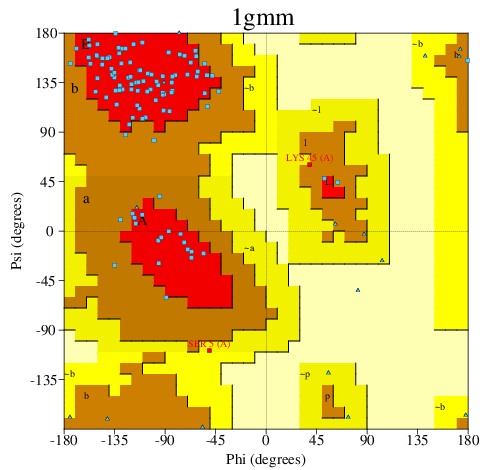
PROCHECK
|
|
|
|
|
|
Headers
|
|
|
|
References
|
|
|
|
|
|

|
|
O52780
(O52780_ACETH) -
endo-1,4-beta-xylanase from Acetivibrio thermocellus
|
|
|
|
Seq:
Struc:
|
|
|
|
683 a.a.
126 a.a.
|
|

|

|
|
|
|
|
|
|
|
|
|
|
|
Key: |
 |
PfamA domain |
|
|
 |
Secondary structure |
|
 |
CATH domain |
|
|
|
|
|
|
|
|
|
|
|
|
|
Enzyme class:
|
|
E.C.3.2.1.8
- endo-1,4-beta-xylanase.
|
|
|
|
|
|
|
Reaction:
|
|
Endohydrolysis of 1,4-beta-D-xylosidic linkages in xylans.
|
|
|
|
|
|
|
|
|
|
|
|
|
|
|
|
|
|
 |
|
|
|
|
|
|
| |
|
DOI no:
|
J Biol Chem
276:48580-48587
(2001)
|
|
PubMed id:
|
|
|
|
|
|
| |
|
The location of the ligand-binding site of carbohydrate-binding modules that have evolved from a common sequence is not conserved.
|
|
M.Czjzek,
D.N.Bolam,
A.Mosbah,
J.Allouch,
C.M.Fontes,
L.M.Ferreira,
O.Bornet,
V.Zamboni,
H.Darbon,
N.L.Smith,
G.W.Black,
B.Henrissat,
H.J.Gilbert.
|
|
|
|
|
| |
ABSTRACT
|
|
|
|
| |
|
|
Polysaccharide-degrading enzymes are generally modular proteins that contain
non-catalytic carbohydrate-binding modules (CBMs), which potentiate the activity
of the catalytic module. CBMs have been grouped into sequence-based families,
and three-dimensional structural data are available for half of these families.
Clostridium thermocellum xylanase 11A is a modular enzyme that contains a CBM
from family 6 (CBM6), for which no structural data are available. We have
determined the crystal structure of this module to a resolution of 2.1 A. The
protein is a beta-sandwich that contains two potential ligand-binding clefts
designated cleft A and B. The CBM interacts primarily with xylan, and NMR
spectroscopy coupled with site-directed mutagenesis identified cleft A,
containing Trp-92, Tyr-34, and Asn-120, as the ligand-binding site. The overall
fold of CBM6 is similar to proteins in CBM families 4 and 22, although
surprisingly the ligand-binding site in CBM4 and CBM22 is equivalent to cleft B
in CBM6. These structural data define a superfamily of CBMs, comprising CBM4,
CBM6, and CBM22, and demonstrate that, although CBMs have evolved from a
relatively small number of ancestors, the structural elements involved in ligand
recognition have been assembled at different locations on the ancestral scaffold.
|
|
|
|
|
|
| |
Selected figure(s)
|
|
|
|
| |
|
|

|
|

|
|
Figure 1.
Fig. 1. Electron density map at 2.1 Å and the final
structural model represented as sticks. a, final electron
density map, contoured at a 1  level, in
the region of Tyr-34 and Trp-92, also showing the putative
sodium ion. b, electron density map (1 level)
showing the presence of a structural calcium ion bridging the N-
and C-terminal ends. The figures were produced using the program
TURBO-FRODO (26). level, in
the region of Tyr-34 and Trp-92, also showing the putative
sodium ion. b, electron density map (1 level)
showing the presence of a structural calcium ion bridging the N-
and C-terminal ends. The figures were produced using the program
TURBO-FRODO (26).
|
|
Figure 2.
Fig. 2. Ribbon and surface representations of CBM6. a,
view showing the ligand-binding cleft (cleft A) formed by the
loops between the two  -sheets of
the sandwich fold. b, surface representation of CBM6 in the same
orientation as in a. The shallow binding cleft on top of the
globular molecule is formed by Tyr-34 and Trp-92. c, ribbon
representation of CBM6 in a perpendicular view with respect to
a, showing the second possible cleft (cleft B), which is
obstructed by a short loop in CBM6, situated on the concave face
of the -sheet
sandwich. a and c were produced with Molscript (45) and Raster3D
(46), whereas b was produced using GRASP (47). -sheets of
the sandwich fold. b, surface representation of CBM6 in the same
orientation as in a. The shallow binding cleft on top of the
globular molecule is formed by Tyr-34 and Trp-92. c, ribbon
representation of CBM6 in a perpendicular view with respect to
a, showing the second possible cleft (cleft B), which is
obstructed by a short loop in CBM6, situated on the concave face
of the -sheet
sandwich. a and c were produced with Molscript (45) and Raster3D
(46), whereas b was produced using GRASP (47).
|
|
|
|
|
|
| |
The above figures are
reprinted
by permission from the ASBMB:
J Biol Chem
(2001,
276,
48580-48587)
copyright 2001.
|
|
| |
Figures were
selected
by the author.
|
|
|
|
|
|
|
|
|
|
|
|
|
|
|
|
 |
 |
 |
|
Literature references that cite this PDB file's key reference
|
|
|
| |
PubMed id
|
|
Reference
|
|
|
|
|
|
A.P.Yeh,
P.Abdubek,
T.Astakhova,
H.L.Axelrod,
C.Bakolitsa,
X.Cai,
D.Carlton,
C.Chen,
H.J.Chiu,
M.Chiu,
T.Clayton,
D.Das,
M.C.Deller,
L.Duan,
K.Ellrott,
C.L.Farr,
J.Feuerhelm,
J.C.Grant,
A.Grzechnik,
G.W.Han,
L.Jaroszewski,
K.K.Jin,
H.E.Klock,
M.W.Knuth,
P.Kozbial,
S.S.Krishna,
A.Kumar,
W.W.Lam,
D.Marciano,
D.McMullan,
M.D.Miller,
A.T.Morse,
E.Nigoghossian,
A.Nopakun,
L.Okach,
C.Puckett,
R.Reyes,
H.J.Tien,
C.B.Trame,
H.van den Bedem,
D.Weekes,
T.Wooten,
Q.Xu,
K.O.Hodgson,
J.Wooley,
M.A.Elsliger,
A.M.Deacon,
A.Godzik,
S.A.Lesley,
and
I.A.Wilson
(2010).
Structure of Bacteroides thetaiotaomicron BT2081 at 2.05 Å resolution: the first structural representative of a new protein family that may play a role in carbohydrate metabolism.
|
| |
Acta Crystallogr Sect F Struct Biol Cryst Commun,
66,
1287-1296.
|
|
|
PDB code:
|
|
|
|
|
|
|
|
S.Yoshida,
R.I.Mackie,
and
I.K.Cann
(2010).
Biochemical and domain analyses of FSUAxe6B, a modular acetyl xylan esterase, identify a unique carbohydrate binding module in Fibrobacter succinogenes S85.
|
| |
J Bacteriol,
192,
483-493.
|
|
|
|
|
|
|
C.Montanier,
A.L.van Bueren,
C.Dumon,
J.E.Flint,
M.A.Correia,
J.A.Prates,
S.J.Firbank,
R.J.Lewis,
G.G.Grondin,
M.G.Ghinet,
T.M.Gloster,
C.Herve,
J.P.Knox,
B.G.Talbot,
J.P.Turkenburg,
J.Kerovuo,
R.Brzezinski,
C.M.Fontes,
G.J.Davies,
A.B.Boraston,
and
H.J.Gilbert
(2009).
Evidence that family 35 carbohydrate binding modules display conserved specificity but divergent function.
|
| |
Proc Natl Acad Sci U S A,
106,
3065-3070.
|
|
|
PDB codes:
|
|
|
|
|
|
|
|
E.Ficko-Blean,
and
A.B.Boraston
(2009).
N-acetylglucosamine recognition by a family 32 carbohydrate-binding module from Clostridium perfringens NagH.
|
| |
J Mol Biol,
390,
208-220.
|
|
|
PDB codes:
|
|
|
|
|
|
|
|
R.M.Weiner,
L.E.Taylor,
B.Henrissat,
L.Hauser,
M.Land,
P.M.Coutinho,
C.Rancurel,
E.H.Saunders,
A.G.Longmire,
H.Zhang,
E.A.Bayer,
H.J.Gilbert,
F.Larimer,
I.B.Zhulin,
N.A.Ekborg,
R.Lamed,
P.M.Richardson,
I.Borovok,
and
S.Hutcheson
(2008).
Complete genome sequence of the complex carbohydrate-degrading marine bacterium, Saccharophagus degradans strain 2-40 T.
|
| |
PLoS Genet,
4,
e1000087.
|
|
|
|
|
|
|
E.Vandermarliere,
T.M.Bourgois,
S.Van Campenhout,
S.V.Strelkov,
G.Volckaert,
J.A.Delcour,
C.M.Courtin,
and
A.Rabijns
(2007).
Crystallization and preliminary X-ray analysis of an arabinoxylan arabinofuranohydrolase from Bacillus subtilis.
|
| |
Acta Crystallogr Sect F Struct Biol Cryst Commun,
63,
692-694.
|
|
|
|
|
|
|
N.Palackal,
C.S.Lyon,
S.Zaidi,
P.Luginbühl,
P.Dupree,
F.Goubet,
J.L.Macomber,
J.M.Short,
G.P.Hazlewood,
D.E.Robertson,
and
B.A.Steer
(2007).
A multifunctional hybrid glycosyl hydrolase discovered in an uncultured microbial consortium from ruminant gut.
|
| |
Appl Microbiol Biotechnol,
74,
113-124.
|
|
|
|
|
|
|
L.McCartney,
A.W.Blake,
J.Flint,
D.N.Bolam,
A.B.Boraston,
H.J.Gilbert,
and
J.P.Knox
(2006).
Differential recognition of plant cell walls by microbial xylan-specific carbohydrate-binding modules.
|
| |
Proc Natl Acad Sci U S A,
103,
4765-4770.
|
|
|
|
|
|
|
P.Boonserm,
M.Mo,
C.Angsuthanasombat,
and
J.Lescar
(2006).
Structure of the functional form of the mosquito larvicidal Cry4Aa toxin from Bacillus thuringiensis at a 2.8-angstrom resolution.
|
| |
J Bacteriol,
188,
3391-3401.
|
|
|
PDB code:
|
|
|
|
|
|
|
|
D.K.Kam,
H.S.Jun,
J.K.Ha,
G.D.Inglis,
and
C.W.Forsberg
(2005).
Characteristics of adjacent family 6 acetylxylan esterases from Fibrobacter succinogenes and the interaction with the Xyn10E xylanase in hydrolysis of acetylated xylan.
|
| |
Can J Microbiol,
51,
821-832.
|
|
|
|
|
|
|
S.Jamal-Talabani,
A.B.Boraston,
J.P.Turkenburg,
N.Tarbouriech,
V.M.Ducros,
and
G.J.Davies
(2004).
Ab initio structure determination and functional characterization of CBM36; a new family of calcium-dependent carbohydrate binding modules.
|
| |
Structure,
12,
1177-1187.
|
|
|
PDB codes:
|
|
|
|
|
|
|
|
D.J.Rigden,
and
M.J.Jedrzejas
(2003).
Genome-based identification of a carbohydrate binding module in Streptococcus pneumoniae hyaluronate lyase.
|
| |
Proteins,
52,
203-211.
|
|
|
|
|
|
|
D.Shallom,
and
Y.Shoham
(2003).
Microbial hemicellulases.
|
| |
Curr Opin Microbiol,
6,
219-228.
|
|
|
|
|
|
|
K.Sakka,
M.Nakanishi,
M.Sogabe,
T.Arai,
H.Ohara,
A.Tanaka,
T.Kimura,
and
K.Ohmiya
(2003).
Isothermal titration calorimetric studies on the binding of a family 6 carbohydrate-binding module of Clostridium thermocellum xynA with xlylooligosaccharides.
|
| |
Biosci Biotechnol Biochem,
67,
406-409.
|
|
|
|
|
|
|
S.J.Charnock,
D.N.Bolam,
D.Nurizzo,
L.Szabó,
V.A.McKie,
H.J.Gilbert,
and
G.J.Davies
(2002).
Promiscuity in ligand-binding: The three-dimensional structure of a Piromyces carbohydrate-binding module, CBM29-2, in complex with cello- and mannohexaose.
|
| |
Proc Natl Acad Sci U S A,
99,
14077-14082.
|
|
|
PDB codes:
|
|
|
|
|
|
|
The most recent references are shown first.
Citation data come partly from CiteXplore and partly
from an automated harvesting procedure. Note that this is likely to be
only a partial list as not all journals are covered by
either method. However, we are continually building up the citation data
so more and more references will be included with time.
Where a reference describes a PDB structure, the PDB
code is
shown on the right.
|
|


 Links
Links



