|
|
|
|
|
 |
Contents |
 |
|
|
|
|
|
|
|
|
|
|
|
|
|
|
* Residue conservation analysis
|
|
|
|
|
|
|
|
|
|
Enzyme class:
|
|
Chains A, B:
E.C.3.1.4.11
- phosphoinositide phospholipase C.
|
|
|
|
|
|
|
Pathway:
|
|
myo-Inositol Phosphate Metabolism
|
|
|
|
|
|
Reaction:
|
|
a 1,2-diacyl-sn-glycero-3-phospho-(1D-myo-inositol-4,5-bisphosphate) + H2O = 1D-myo-inositol 1,4,5-trisphosphate + a 1,2-diacyl-sn-glycerol + H+
|
|
|
|
|
|
1,2-diacyl-sn-glycero-3-phospho-(1D-myo-inositol-4,5-bisphosphate)
|
+
|
H2O
|
=
|
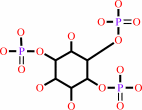 1D-myo-inositol 1,4,5-trisphosphate
|
+
|
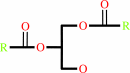 1,2-diacyl-sn-glycerol
|
+
|
H(+)
|
|
|
|
|
|
|
|
|
|
|
|
|
Molecule diagrams generated from .mol files obtained from the
KEGG ftp site
|
|
|
|
|
|
|
|
|
|
|
|
|
|
 |
|
|
|
|
|
|
| |
|
|
| |
|
DOI no:
|
Biochemistry
36:2753-2762
(1997)
|
|
PubMed id:
|
|
|
|
|
|
| |
|
A ternary metal binding site in the C2 domain of phosphoinositide-specific phospholipase C-delta1.
|
|
L.O.Essen,
O.Perisic,
D.E.Lynch,
M.Katan,
R.L.Williams.
|
|
|
|
|
| |
ABSTRACT
|
|
|
|
| |
|
|
We have determined the crystal structures of complexes of
phosphoinositide-specific phospholipase C-delta1 from rat with calcium, barium,
and lanthanum at 2.5-2.6 A resolution. Binding of these metal ions is observed
in the active site of the catalytic TIM barrel and in the calcium binding region
(CBR) of the C2 domain. The C2 domain of PLC-delta1 is a circularly permuted
topological variant (P-variant) of the synaptotagmin I C2A domain (S-variant).
On the basis of sequence analysis, we propose that both the S-variant and
P-variant topologies are present among other C2 domains. Multiple adjacent
binding sites in the C2 domain were observed for calcium and the other
metal/enzyme complexes. The maximum number of binding sites observed was for the
calcium analogue lanthanum. This complex shows an array-like binding of three
lanthanum ions (sites I-III) in a crevice on one end of the C2 beta-sandwich.
Residues involved in metal binding are contained in three loops, CBR1, CBR2, and
CBR3. Sites I and II are maintained in the calcium and barium complexes, whereas
sites II and III coincide with a binary calcium binding site in the C2A domain
of synaptotagmin I. Several conformers for CBR1 are observed. The conformation
of CBR1 does not appear to be strictly dependent on metal binding; however,
metal binding may stabilize certain conformers. No significant structural
changes are observed for CBR2 or CBR3. The surface of this ternary binding site
provides a cluster of freely accessible liganding positions for putative
phospholipid ligands of the C2 domain. It may be that the ternary metal binding
site is also a feature of calcium-dependent phospholipid binding in solution. A
ternary metal binding site might be a conserved feature among C2 domains that
contain the critical calcium ligands in their CBR's. The high cooperativity of
calcium-mediated lipid binding by C2 domains described previously is explained
by this novel type of calcium binding site.
|
|
|
|
|
|
|
|
|
|
|
|
|
|
|
|
|
|
 |
 |
 |
|
Literature references that cite this PDB file's key reference
|
|
|
| |
PubMed id
|
|
Reference
|
|
|
|
|
|
T.K.Harden,
S.N.Hicks,
and
J.Sondek
(2009).
Phospholipase C isozymes as effectors of Ras superfamily GTPases.
|
| |
J Lipid Res,
50,
S243-S248.
|
|
|
|
|
|
|
S.N.Hicks,
M.R.Jezyk,
S.Gershburg,
J.P.Seifert,
T.K.Harden,
and
J.Sondek
(2008).
General and versatile autoinhibition of PLC isozymes.
|
| |
Mol Cell,
31,
383-394.
|
|
|
PDB code:
|
|
|
|
|
|
|
|
Z.Shmelzer,
M.Karter,
M.Eisenstein,
T.L.Leto,
N.Hadad,
D.Ben-Menahem,
D.Gitler,
S.Banani,
B.Wolach,
M.Rotem,
and
R.Levy
(2008).
Cytosolic Phospholipase A2{alpha} Is Targeted to the p47phox-PX Domain of the Assembled NADPH Oxidase via a Novel Binding Site in Its C2 Domain.
|
| |
J Biol Chem,
283,
31898-31908.
|
|
|
|
|
|
|
A.Abyzov,
and
V.A.Ilyin
(2007).
A comprehensive analysis of non-sequential alignments between all protein structures.
|
| |
BMC Struct Biol,
7,
78.
|
|
|
|
|
|
|
G.Drin,
and
S.Scarlata
(2007).
Stimulation of phospholipase Cbeta by membrane interactions, interdomain movement, and G protein binding--how many ways can you activate an enzyme?
|
| |
Cell Signal,
19,
1383-1392.
|
|
|
|
|
|
|
J.L.Jiménez,
and
B.Davletov
(2007).
Beta-strand recombination in tricalbin evolution and the origin of synaptotagmin-like C2 domains.
|
| |
Proteins,
68,
770-778.
|
|
|
|
|
|
|
S.Varma,
and
E.Jakobsson
(2007).
The cPLA2 C2alpha domain in solution: structure and dynamics of its Ca2+-activated and cation-free states.
|
| |
Biophys J,
92,
966-976.
|
|
|
|
|
|
|
C.Malcuit,
M.Kurokawa,
and
R.A.Fissore
(2006).
Calcium oscillations and mammalian egg activation.
|
| |
J Cell Physiol,
206,
565-573.
|
|
|
|
|
|
|
J.H.Hurley
(2006).
Membrane binding domains.
|
| |
Biochim Biophys Acta,
1761,
805-811.
|
|
|
|
|
|
|
T.K.Harden,
and
J.Sondek
(2006).
Regulation of phospholipase C isozymes by ras superfamily GTPases.
|
| |
Annu Rev Pharmacol Toxicol,
46,
355-379.
|
|
|
|
|
|
|
I.Voskoboinik,
M.C.Thia,
J.Fletcher,
A.Ciccone,
K.Browne,
M.J.Smyth,
and
J.A.Trapani
(2005).
Calcium-dependent plasma membrane binding and cell lysis by perforin are mediated through its C2 domain: A critical role for aspartate residues 429, 435, 483, and 485 but not 491.
|
| |
J Biol Chem,
280,
8426-8434.
|
|
|
|
|
|
|
O.H.Shin,
W.Han,
Y.Wang,
and
T.C.Südhof
(2005).
Evolutionarily conserved multiple C2 domain proteins with two transmembrane regions (MCTPs) and unusual Ca2+ binding properties.
|
| |
J Biol Chem,
280,
1641-1651.
|
|
|
|
|
|
|
S.Málková,
F.Long,
R.V.Stahelin,
S.V.Pingali,
D.Murray,
W.Cho,
and
M.L.Schlossman
(2005).
X-ray reflectivity studies of cPLA2{alpha}-C2 domains adsorbed onto Langmuir monolayers of SOPC.
|
| |
Biophys J,
89,
1861-1873.
|
|
|
|
|
|
|
W.Cho,
and
R.V.Stahelin
(2005).
Membrane-protein interactions in cell signaling and membrane trafficking.
|
| |
Annu Rev Biophys Biomol Struct,
34,
119-151.
|
|
|
|
|
|
|
B.Davletov,
and
J.L.Jiménez
(2004).
Sculpting a domain by splicing.
|
| |
Nat Struct Mol Biol,
11,
4-5.
|
|
|
|
|
|
|
J.Garcia,
S.H.Gerber,
S.Sugita,
T.C.Südhof,
and
J.Rizo
(2004).
A conformational switch in the Piccolo C2A domain regulated by alternative splicing.
|
| |
Nat Struct Mol Biol,
11,
45-53.
|
|
|
PDB code:
|
|
|
|
|
|
|
|
S.Djordjevic,
and
P.C.Driscoll
(2002).
Structural insight into substrate specificity and regulatory mechanisms of phosphoinositide 3-kinases.
|
| |
Trends Biochem Sci,
27,
426-432.
|
|
|
|
|
|
|
T.Sklyarova,
V.De Corte,
K.Meerschaert,
L.Devriendt,
B.Vanloo,
J.Bailey,
L.J.Cook,
M.Goethals,
J.Van Damme,
M.Puype,
J.Vandekerckhove,
and
J.Gettemans
(2002).
Fragmin60 encodes an actin-binding protein with a C2 domain and controls actin Thr-203 phosphorylation in Physarum plasmodia and sclerotia.
|
| |
J Biol Chem,
277,
39840-39849.
|
|
|
|
|
|
|
B.Vanhaesebroeck,
S.J.Leevers,
K.Ahmadi,
J.Timms,
R.Katso,
P.C.Driscoll,
R.Woscholski,
P.J.Parker,
and
M.D.Waterfield
(2001).
Synthesis and function of 3-phosphorylated inositol lipids.
|
| |
Annu Rev Biochem,
70,
535-602.
|
|
|
|
|
|
|
S.G.Rhee
(2001).
Regulation of phosphoinositide-specific phospholipase C.
|
| |
Annu Rev Biochem,
70,
281-312.
|
|
|
|
|
|
|
S.H.Gerber,
J.Garcia,
J.Rizo,
and
T.C.Südhof
(2001).
An unusual C(2)-domain in the active-zone protein piccolo: implications for Ca(2+) regulation of neurotransmitter release.
|
| |
EMBO J,
20,
1605-1619.
|
|
|
|
|
|
|
A.G.Buckland,
and
D.C.Wilton
(2000).
Anionic phospholipids, interfacial binding and the regulation of cell functions.
|
| |
Biochim Biophys Acta,
1483,
199-216.
|
|
|
|
|
|
|
J.H.Hurley,
and
S.Misra
(2000).
Signaling and subcellular targeting by membrane-binding domains.
|
| |
Annu Rev Biophys Biomol Struct,
29,
49-79.
|
|
|
|
|
|
|
R.A.García,
C.E.Forde,
and
H.A.Godwin
(2000).
Calcium triggers an intramolecular association of the C2 domains in synaptotagmin.
|
| |
Proc Natl Acad Sci U S A,
97,
5883-5888.
|
|
|
|
|
|
|
J.O.Lee,
H.Yang,
M.M.Georgescu,
A.Di Cristofano,
T.Maehama,
Y.Shi,
J.E.Dixon,
P.Pandolfi,
and
N.P.Pavletich
(1999).
Crystal structure of the PTEN tumor suppressor: implications for its phosphoinositide phosphatase activity and membrane association.
|
| |
Cell,
99,
323-334.
|
|
|
PDB code:
|
|
|
|
|
|
|
|
J.W.Lomasney,
H.F.Cheng,
S.R.Roffler,
and
K.King
(1999).
Activation of phospholipase C delta1 through C2 domain by a Ca(2+)-enzyme-phosphatidylserine ternary complex.
|
| |
J Biol Chem,
274,
21995-22001.
|
|
|
|
|
|
|
M.Yamaga,
M.Fujii,
H.Kamata,
H.Hirata,
and
H.Yagisawa
(1999).
Phospholipase C-delta1 contains a functional nuclear export signal sequence.
|
| |
J Biol Chem,
274,
28537-28541.
|
|
|
|
|
|
|
N.Verdaguer,
S.Corbalan-Garcia,
W.F.Ochoa,
I.Fita,
and
J.C.Gómez-Fernández
(1999).
Ca(2+) bridges the C2 membrane-binding domain of protein kinase Calpha directly to phosphatidylserine.
|
| |
EMBO J,
18,
6329-6338.
|
|
|
PDB code:
|
|
|
|
|
|
|
|
O.Perisic,
H.F.Paterson,
G.Mosedale,
S.Lara-González,
and
R.L.Williams
(1999).
Mapping the phospholipid-binding surface and translocation determinants of the C2 domain from cytosolic phospholipase A2.
|
| |
J Biol Chem,
274,
14979-14987.
|
|
|
|
|
|
|
R.B.Sutton,
J.A.Ernst,
and
A.T.Brunger
(1999).
Crystal structure of the cytosolic C2A-C2B domains of synaptotagmin III. Implications for Ca(+2)-independent snare complex interaction.
|
| |
J Cell Biol,
147,
589-598.
|
|
|
PDB code:
|
|
|
|
|
|
|
|
S.J.Slater,
S.K.Milano,
B.A.Stagliano,
K.J.Gergich,
C.Ho,
A.Mazurek,
F.J.Taddeo,
M.B.Kelly,
M.D.Yeager,
and
C.D.Stubbs
(1999).
Synergistic activation of protein kinase Calpha, -betaI, and -gamma isoforms induced by diacylglycerol and phorbol ester: roles of membrane association and activating conformational changes.
|
| |
Biochemistry,
38,
3804-3815.
|
|
|
|
|
|
|
T.Pawelczyk,
and
A.Matecki
(1999).
Phospholipase C-delta3 binds with high specificity to phosphatidylinositol 4,5-bisphosphate and phosphatidic acid in bilayer membranes.
|
| |
Eur J Biochem,
262,
291-298.
|
|
|
|
|
|
|
A.Arcaro,
S.Volinia,
M.J.Zvelebil,
R.Stein,
S.J.Watton,
M.J.Layton,
I.Gout,
K.Ahmadi,
J.Downward,
and
M.D.Waterfield
(1998).
Human phosphoinositide 3-kinase C2beta, the role of calcium and the C2 domain in enzyme activity.
|
| |
J Biol Chem,
273,
33082-33090.
|
|
|
|
|
|
|
B.Davletov,
O.Perisic,
and
R.L.Williams
(1998).
Calcium-dependent membrane penetration is a hallmark of the C2 domain of cytosolic phospholipase A2 whereas the C2A domain of synaptotagmin binds membranes electrostatically.
|
| |
J Biol Chem,
273,
19093-19096.
|
|
|
|
|
|
|
C.E.Naylor,
J.T.Eaton,
A.Howells,
N.Justin,
D.S.Moss,
R.W.Titball,
and
A.K.Basak
(1998).
Structure of the key toxin in gas gangrene.
|
| |
Nat Struct Biol,
5,
738-746.
|
|
|
PDB code:
|
|
|
|
|
|
|
|
E.A.Nalefski,
and
J.J.Falke
(1998).
Location of the membrane-docking face on the Ca2+-activated C2 domain of cytosolic phospholipase A2.
|
| |
Biochemistry,
37,
17642-17650.
|
|
|
|
|
|
|
E.R.Chapman,
and
A.F.Davis
(1998).
Direct interaction of a Ca2+-binding loop of synaptotagmin with lipid bilayers.
|
| |
J Biol Chem,
273,
13995-14001.
|
|
|
|
|
|
|
H.Pappa,
J.Murray-Rust,
L.V.Dekker,
P.J.Parker,
and
N.Q.McDonald
(1998).
Crystal structure of the C2 domain from protein kinase C-delta.
|
| |
Structure,
6,
885-894.
|
|
|
PDB code:
|
|
|
|
|
|
|
|
J.A.Grobler,
and
J.H.Hurley
(1998).
Catalysis by phospholipase C delta1 requires that Ca2+ bind to the catalytic domain, but not the C2 domain.
|
| |
Biochemistry,
37,
5020-5028.
|
|
|
|
|
|
|
J.Rizo,
and
T.C.Südhof
(1998).
C2-domains, structure and function of a universal Ca2+-binding domain.
|
| |
J Biol Chem,
273,
15879-15882.
|
|
|
|
|
|
|
J.Ubach,
X.Zhang,
X.Shao,
T.C.Südhof,
and
J.Rizo
(1998).
Ca2+ binding to synaptotagmin: how many Ca2+ ions bind to the tip of a C2-domain?
|
| |
EMBO J,
17,
3921-3930.
|
|
|
|
|
|
|
M.Katan
(1998).
Families of phosphoinositide-specific phospholipase C: structure and function.
|
| |
Biochim Biophys Acta,
1436,
5.
|
|
|
|
|
|
|
O.Perisic,
S.Fong,
D.E.Lynch,
M.Bycroft,
and
R.L.Williams
(1998).
Crystal structure of a calcium-phospholipid binding domain from cytosolic phospholipase A2.
|
| |
J Biol Chem,
273,
1596-1604.
|
|
|
PDB code:
|
|
|
|
|
|
|
|
R.B.Sutton,
and
S.R.Sprang
(1998).
Structure of the protein kinase Cbeta phospholipid-binding C2 domain complexed with Ca2+.
|
| |
Structure,
6,
1395-1405.
|
|
|
PDB code:
|
|
|
|
|
|
|
|
S.Hayashizaki,
Y.Iino,
and
M.Yamamoto
(1998).
Characterization of the C. elegans gap-2 gene encoding a novel Ras-GTPase activating protein and its possible role in larval development.
|
| |
Genes Cells,
3,
189-202.
|
|
|
|
|
|
|
X.Shao,
I.Fernandez,
T.C.Südhof,
and
J.Rizo
(1998).
Solution structures of the Ca2+-free and Ca2+-bound C2A domain of synaptotagmin I: does Ca2+ induce a conformational change?
|
| |
Biochemistry,
37,
16106-16115.
|
|
|
PDB code:
|
|
|
|
|
|
|
|
X.Zhang,
J.Rizo,
and
T.C.Südhof
(1998).
Mechanism of phospholipid binding by the C2A-domain of synaptotagmin I.
|
| |
Biochemistry,
37,
12395-12403.
|
|
|
|
|
|
|
Y.K.Chae,
F.Abildgaard,
E.R.Chapman,
and
J.L.Markley
(1998).
Lipid binding ridge on loops 2 and 3 of the C2A domain of synaptotagmin I as revealed by NMR spectroscopy.
|
| |
J Biol Chem,
273,
25659-25663.
|
|
|
|
|
|
|
E.A.Nalefski,
M.M.Slazas,
and
J.J.Falke
(1997).
Ca2+-signaling cycle of a membrane-docking C2 domain.
|
| |
Biochemistry,
36,
12011-12018.
|
|
|
|
|
|
|
M.Mosior,
and
R.M.Epand
(1997).
Protein kinase C: an example of a calcium-regulated protein binding to membranes (review).
|
| |
Mol Membr Biol,
14,
65-70.
|
|
|
|
|
|
|
R.Uellner,
M.J.Zvelebil,
J.Hopkins,
J.Jones,
L.K.MacDougall,
B.P.Morgan,
E.Podack,
M.D.Waterfield,
and
G.M.Griffiths
(1997).
Perforin is activated by a proteolytic cleavage during biosynthesis which reveals a phospholipid-binding C2 domain.
|
| |
EMBO J,
16,
7287-7296.
|
|
|
|
|
|
The most recent references are shown first.
Citation data come partly from CiteXplore and partly
from an automated harvesting procedure. Note that this is likely to be
only a partial list as not all journals are covered by
either method. However, we are continually building up the citation data
so more and more references will be included with time.
Where a reference describes a PDB structure, the PDB
code is
shown on the right.
|
 |


 Links
Links