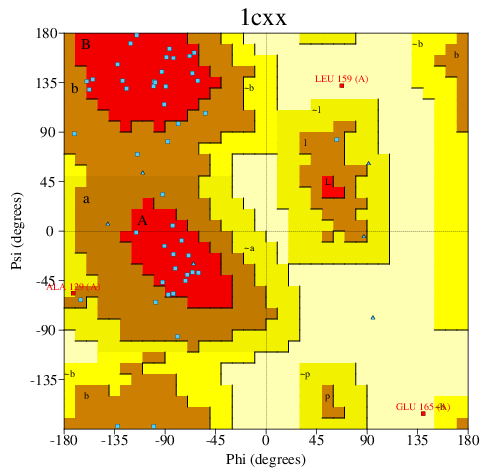
|
PDBsum entry 1cxx

|
|
|
|
|
|

|
|

|
|

|
|

|
|

|
|
|
 |

|

|
|
|
|
|
|
|
|
|
|
|
|
|
|
|
|
|
|
|
|
|
|
|
|
|
|
|
|
|
|
Signaling protein
|
PDB id
|
|
|
|
1cxx
|
|
|
|
|
|
|
|
|
|
|
|
|
|
|

|

|

|
|
|
|
|
|
|
|
 |
Contents |
 |
|
|
|
|
|
|
|
|
|
|
* Residue conservation analysis
|
|
|
|
|
References listed in PDB file
|
|
|
Key reference
|
|
|
Title
|
|
Mutational analysis and nmr spectroscopy of quail cysteine and glycine-Rich protein crp2 reveal an intrinsic segmental flexibility of lim domains.
|
|
|
Authors
|
|
K.Kloiber,
R.Weiskirchen,
B.Kräutler,
K.Bister,
R.Konrat.
|
|
|
Ref.
|
|
J Mol Biol, 1999,
292,
893-908.
[DOI no: ]
|
|
|
PubMed id
|
|
|
|
|
|
Abstract
|
|
|
The LIM domain is a conserved cysteine and histidine-containing structural
module of two tandemly arranged zinc fingers. It has been identified in single
or multiple copies in a variety of regulatory proteins, either in combination
with defined functional domains, like homeodomains, or alone, like in the CRP
family of LIM proteins. Structural studies of CRP proteins have allowed a
detailed evaluation of interactions in LIM-domains at the molecular level. The
packing interactions in the hydrophobic core have been identified as a
significant contribution to the LIM domain fold, whereas hydrogen bonding within
each single zinc binding site stabilizes zinc finger geometry in a so-called
"outer" or "indirect" coordination sphere. Here we report
the solution structure of a point-mutant of the carboxyl-terminal LIM domain of
quail cysteine and glycine-rich protein CRP2, CRP2(LIM2)R122A, and discuss the
structural consequences of the disruption of the hydrogen bond formed between
the guanidinium side-chain of Arg122 and the zinc-coordinating cysteine thiolate
group in the CCHC rubredoxin-knuckle. The structural analysis revealed that the
three-dimensional structure of the CCHC zinc binding site in CRP2(LIM2)R122A is
adapted as a consequence of the modified hydrogen bonding pattern. Additionally,
as a result of the conformational rearrangement of the zinc binding site, the
packing interactions in the hydrophobic core region are altered, leading to a
change in the relative orientation of the two zinc fingers with a concomitant
change in the solvent accessibilities of hydrophobic residues located at the
interface of the two modules. The backbone dynamics of residues located in the
folded part of CRP2(LIM2)R122A have been characterized by proton-detected(15)N
NMR spectroscopy. Analysis of the R2/R1ratios revealed a rotational correlation
time of approximately 6.2 ns and tumbling with an axially symmetric diffusion
tensor (D parallel/D perpendicular=1.43). The relaxation data were also analyzed
using a reduced spectral density mapping approach. As in wild-type CRP2(LIM2),
significant mobility on a picosecond/nanosecond time-scale was detected, and
conformational exchange on a microsecond time-scale was identified for residues
located in loop regions between secondary structure elements. In summary, the
relative orientation of the two zinc binding sites and the accessibility of
hydrophobic residues is not only determined by hydrophobic interactions, but can
also be modified by the formation and/or breakage of hydrogen bonds. This may be
important for the molecular interactions of an adaptor-type LIM domain protein
in macromolecular complexes, particularly for the modulation of protein-protein
interactions.
|
|
|
|

|
|

|
|
Figure 4.
Figure 4. Solution structure of CRP2(LIM2)R122A. Ribbon
diagram (left) of a selected representative structure from the
calculated set for CRP2(LIM2)R122A (residues 118 to 174).
Separate matches for each of the two zinc binding sites
encompassing residues 120 to 145 (middle) or residues 146 to 173
(right), respectively, indicate residual mobility between the
two zinc finger subdomains. The diagrams were produced using the
program MOLMOL [Koradi et al 1996].
|
|
Figure 9.
Figure 9. Schematic representation showing the change in
the relative orientation of the two CCHC and CCCC zinc-binding
sites in CRP2(LIM2)R122A introduced by the point mutation at
residue position 122. (a) Ribbon drawing showing the
superposition of a representative structure taken from the
ensemble of 11 energy-minimized NMR structures of
CRP2(LIM2)R122A (yellow) and the wild-type CRP2(LIM2) structure
with the lowest residual restraint violations [Konrat et al
1997] (blue). Backbone atoms of the N-terminal CCHC zinc finger
encompassing residues Cys120-Cys144 were matched. (b) Orthogonal
view displaying only the C-terminal CCCC zinc binding site of
mutant CRP2(LIM2)R122A (yellow) and wild-type protein (blue).
The pictures were produced with the program MOLMOL [Koradi et al
1996].
|
|
|
|
|
|
The above figures are
reprinted
by permission from Elsevier:
J Mol Biol
(1999,
292,
893-908)
copyright 1999.
|
|
|
|
|
|
|