 |
PDBsum entry 1cm8

|
|
|
|
|
 |
Contents |
 |
|
|
|
|
|
|
|
|
|
|
|
|
|
|
* Residue conservation analysis
|
|
|
|
|
|
|
|
|
|
|
Enzyme class:
|
|
E.C.2.7.11.24
- mitogen-activated protein kinase.
|
|
|
|
|
|
|
Reaction:
|
|
|
1.
|
L-seryl-[protein] + ATP = O-phospho-L-seryl-[protein] + ADP + H+
|
|
2.
|
L-threonyl-[protein] + ATP = O-phospho-L-threonyl-[protein] + ADP + H+
|
|
|
|
|
|
|
L-seryl-[protein]
|
+
|
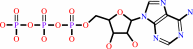 ATP
ATP
|
=
|
O-phospho-L-seryl-[protein]
Bound ligand (Het Group name = )
matches with 81.25% similarity
|
+
|
 ADP
ADP
|
+
|
H(+)
|
|
|
|
|
|
|
L-threonyl-[protein]
|
+
|
ATP
|
=
|
O-phospho-L-threonyl-[protein]
Bound ligand (Het Group name = )
matches with 81.25% similarity
|
+
|
ADP
|
+
|
H(+)
|
|
|
|
|
|
|
|
|
|
|
|
|
Molecule diagrams generated from .mol files obtained from the
KEGG ftp site
|
|
|
|
|
|
|
|
|
|
|
|
|
|
 |
|
|
|
|
|
|
| |
|
|
| |
|
DOI no:
|
Structure Fold Des
7:1057-1065
(1999)
|
|
PubMed id:
|
|
|
|
|
|
| |
|
The structure of phosphorylated p38gamma is monomeric and reveals a conserved activation-loop conformation.
|
|
S.Bellon,
M.J.Fitzgibbon,
T.Fox,
H.M.Hsiao,
K.P.Wilson.
|
|
|
|
|
| |
ABSTRACT
|
|
|
|
| |
|
|
BACKGROUND: Mitogen-activated protein (MAP) kinases mediate the cellular
response to stimuli such as pro-inflammatory cytokines and environmental stress.
P38gamma is a new member of the MAP kinase family, and is expressed at its
highest levels in skeletal muscle. P38gamma is 63% identical in sequence to
P38alpha. The structure of P38alpha MAP kinase has been determined in the apo,
unphosphorylated, inactive form. The structures of apo unphosphorylated ERK2, a
related MAP kinase, and apo phosphorylated ERK2 have also been determined.
RESULTS: We have determined the structure of doubly phosphorylated P38gamma in
complex with an ATP analog by X-ray crystallography. This is the first report of
a structure of an activated kinase in the P38 subfamily, and the first bound to
a nucleotide. P38gamma residue phosphoryl-Thr183 forms hydrogen bonds with five
basic amino acids, and these interactions induce an interdomain rotation. The
conformation of the activation loop of P38gamma is almost identical to that
observed in the structure of activated ERK2. However, unlike ERK2, the crystal
structure and solution studies indicate that activated P38gamma exists as a
monomer. CONCLUSIONS: Interactions mediated by phosphoryl-Thr183 induce
structural changes that direct the domains and active-site residues of P38gamma
into a conformation consistent with catalytic activity. The conformation of the
phosphorylation loop is likely to be similar in all activated MAP kinases, but
not all activated MAP kinases form dimers.
|
|
|
|
|
|
| |
Selected figure(s)
|
|
|
|
| |
|
|

|
|
Figure 4.
Figure 4. Stereoview of AMP-PNP. All major interactions
with protein sidechains are indicated by dashed gray lines. The
bound Mg2+ ions are indicated by black spheres. The phosphate
atoms are shown in purple. Met109 can be seen behind the adenine
base, blocking the hydrophobic pocket. Water molecules have been
removed for clarity.
|
|
|
|
|
|
| |
The above figure is
reprinted
by permission from Cell Press:
Structure Fold Des
(1999,
7,
1057-1065)
copyright 1999.
|
|
| |
Figure was
selected
by an automated process.
|
|
|
|
|
|
|
|
|
|
|
|
|
|
|
|
 |
 |
 |
|
Literature references that cite this PDB file's key reference
|
|
|
| |
PubMed id
|
|
Reference
|
|
|
|
|
|
S.Y.Lu,
Y.J.Jiang,
J.W.Zou,
and
T.X.Wu
(2011).
Dissection of the difference between the group I metal ions in inhibiting GSK3β: a computational study.
|
| |
Phys Chem Chem Phys,
13,
7014-7023.
|
|
|
|
|
|
|
A.Cuadrado,
and
A.R.Nebreda
(2010).
Mechanisms and functions of p38 MAPK signalling.
|
| |
Biochem J,
429,
403-417.
|
|
|
|
|
|
|
R.Akella,
X.Min,
Q.Wu,
K.H.Gardner,
and
E.J.Goldsmith
(2010).
The third conformation of p38α MAP kinase observed in phosphorylated p38α and in solution.
|
| |
Structure,
18,
1571-1578.
|
|
|
PDB code:
|
|
|
|
|
|
|
|
Y.W.Ng,
D.Raghunathan,
P.M.Chan,
Y.Baskaran,
D.J.Smith,
C.H.Lee,
C.Verma,
and
E.Manser
(2010).
Why an A-loop phospho-mimetic fails to activate PAK1: understanding an inaccessible kinase state by molecular dynamics simulations.
|
| |
Structure,
18,
879-890.
|
|
|
|
|
|
|
A.A.Santos,
C.M.Carvalho,
L.H.Florentino,
H.J.Ramos,
and
E.P.Fontes
(2009).
Conserved threonine residues within the A-loop of the receptor NIK differentially regulate the kinase function required for antiviral signaling.
|
| |
PLoS One,
4,
e5781.
|
|
|
|
|
|
|
A.G.Turjanski,
G.Hummer,
and
J.S.Gutkind
(2009).
How mitogen-activated protein kinases recognize and phosphorylate their targets: A QM/MM study.
|
| |
J Am Chem Soc,
131,
6141-6148.
|
|
|
|
|
|
|
P.R.Mittelstadt,
H.Yamaguchi,
E.Appella,
and
J.D.Ashwell
(2009).
T cell receptor-mediated activation of p38{alpha} by mono-phosphorylation of the activation loop results in altered substrate specificity.
|
| |
J Biol Chem,
284,
15469-15474.
|
|
|
|
|
|
|
R.Scholz,
M.Suter,
T.Weimann,
C.Polge,
P.V.Konarev,
R.F.Thali,
R.D.Tuerk,
B.Viollet,
T.Wallimann,
U.Schlattner,
and
D.Neumann
(2009).
Homo-oligomerization and activation of AMP-activated protein kinase are mediated by the kinase domain alphaG-helix.
|
| |
J Biol Chem,
284,
27425-27437.
|
|
|
|
|
|
|
S.B.Patel,
P.M.Cameron,
S.J.O'Keefe,
B.Frantz-Wattley,
J.Thompson,
E.A.O'Neill,
T.Tennis,
L.Liu,
J.W.Becker,
and
G.Scapin
(2009).
The three-dimensional structure of MAP kinase p38beta: different features of the ATP-binding site in p38beta compared with p38alpha.
|
| |
Acta Crystallogr D Biol Crystallogr,
65,
777-785.
|
|
|
PDB codes:
|
|
|
|
|
|
|
|
X.Min,
R.Akella,
H.He,
J.M.Humphreys,
S.E.Tsutakawa,
S.J.Lee,
J.A.Tainer,
M.H.Cobb,
and
E.J.Goldsmith
(2009).
The structure of the MAP2K MEK6 reveals an autoinhibitory dimer.
|
| |
Structure,
17,
96.
|
|
|
PDB code:
|
|
|
|
|
|
|
|
D.Muyllaert,
A.Kremer,
T.Jaworski,
P.Borghgraef,
H.Devijver,
S.Croes,
I.Dewachter,
and
F.Van Leuven
(2008).
Glycogen synthase kinase-3beta, or a link between amyloid and tau pathology?
|
| |
Genes Brain Behav,
7,
57-66.
|
|
|
|
|
|
|
K.M.Sours,
S.C.Kwok,
T.Rachidi,
T.Lee,
A.Ring,
A.N.Hoofnagle,
K.A.Resing,
and
N.G.Ahn
(2008).
Hydrogen-exchange mass spectrometry reveals activation-induced changes in the conformational mobility of p38alpha MAP kinase.
|
| |
J Mol Biol,
379,
1075-1093.
|
|
|
|
|
|
|
Y.Murakami,
K.Tatebayashi,
and
H.Saito
(2008).
Two adjacent docking sites in the yeast Hog1 mitogen-activated protein (MAP) kinase differentially interact with the Pbs2 MAP kinase kinase and the Ptp2 protein tyrosine phosphatase.
|
| |
Mol Cell Biol,
28,
2481-2494.
|
|
|
|
|
|
|
D.Kuhn,
N.Weskamp,
E.Hüllermeier,
and
G.Klebe
(2007).
Functional Classification of Protein Kinase Binding Sites Using Cavbase.
|
| |
ChemMedChem,
2,
1432-1447.
|
|
|
|
|
|
|
J.D.Knight,
B.Qian,
D.Baker,
and
R.Kothary
(2007).
Conservation, variability and the modeling of active protein kinases.
|
| |
PLoS ONE,
2,
e982.
|
|
|
|
|
|
|
M.Avitzour,
R.Diskin,
B.Raboy,
N.Askari,
D.Engelberg,
and
O.Livnah
(2007).
Intrinsically active variants of all human p38 isoforms.
|
| |
FEBS J,
274,
963-975.
|
|
|
|
|
|
|
Y.Zhu,
H.Li,
C.Long,
L.Hu,
H.Xu,
L.Liu,
S.Chen,
D.C.Wang,
and
F.Shao
(2007).
Structural insights into the enzymatic mechanism of the pathogenic MAPK phosphothreonine lyase.
|
| |
Mol Cell,
28,
899-913.
|
|
|
PDB codes:
|
|
|
|
|
|
|
|
Z.Miyake,
M.Takekawa,
Q.Ge,
and
H.Saito
(2007).
Activation of MTK1/MEKK4 by GADD45 through induced N-C dissociation and dimerization-mediated trans autophosphorylation of the MTK1 kinase domain.
|
| |
Mol Cell Biol,
27,
2765-2776.
|
|
|
|
|
|
|
E.S.Groban,
A.Narayanan,
and
M.P.Jacobson
(2006).
Conformational changes in protein loops and helices induced by post-translational phosphorylation.
|
| |
PLoS Comput Biol,
2,
e32.
|
|
|
|
|
|
|
J.D.Ashwell
(2006).
The many paths to p38 mitogen-activated protein kinase activation in the immune system.
|
| |
Nat Rev Immunol,
6,
532-540.
|
|
|
|
|
|
|
C.Tárrega,
P.Ríos,
R.Cejudo-Marín,
C.Blanco-Aparicio,
L.van den Berk,
J.Schepens,
W.Hendriks,
L.Tabernero,
and
R.Pulido
(2005).
ERK2 shows a restrictive and locally selective mechanism of recognition by its tyrosine phosphatase inactivators not shared by its activator MEK1.
|
| |
J Biol Chem,
280,
37885-37894.
|
|
|
|
|
|
|
J.M.Salvador,
P.R.Mittelstadt,
T.Guszczynski,
T.D.Copeland,
H.Yamaguchi,
E.Appella,
A.J.Fornace,
and
J.D.Ashwell
(2005).
Alternative p38 activation pathway mediated by T cell receptor-proximal tyrosine kinases.
|
| |
Nat Immunol,
6,
390-395.
|
|
|
|
|
|
|
S.H.Millson,
A.W.Truman,
V.King,
C.Prodromou,
L.H.Pearl,
and
P.W.Piper
(2005).
A two-hybrid screen of the yeast proteome for Hsp90 interactors uncovers a novel Hsp90 chaperone requirement in the activity of a stress-activated mitogen-activated protein kinase, Slt2p (Mpk1p).
|
| |
Eukaryot Cell,
4,
849-860.
|
|
|
|
|
|
|
N.J.Dibb,
S.M.Dilworth,
and
C.D.Mol
(2004).
Switching on kinases: oncogenic activation of BRAF and the PDGFR family.
|
| |
Nat Rev Cancer,
4,
718-727.
|
|
|
|
|
|
|
R.Diskin,
N.Askari,
R.Capone,
D.Engelberg,
and
O.Livnah
(2004).
Active mutants of the human p38alpha mitogen-activated protein kinase.
|
| |
J Biol Chem,
279,
47040-47049.
|
|
|
|
|
|
|
T.Lee,
A.N.Hoofnagle,
Y.Kabuyama,
J.Stroud,
X.Min,
E.J.Goldsmith,
L.Chen,
K.A.Resing,
and
N.G.Ahn
(2004).
Docking motif interactions in MAP kinases revealed by hydrogen exchange mass spectrometry.
|
| |
Mol Cell,
14,
43-55.
|
|
|
|
|
|
|
B.W.Doble,
and
J.R.Woodgett
(2003).
GSK-3: tricks of the trade for a multi-tasking kinase.
|
| |
J Cell Sci,
116,
1175-1186.
|
|
|
|
|
|
|
F.L.Chou,
J.M.Hill,
J.C.Hsieh,
J.Pouyssegur,
A.Brunet,
A.Glading,
F.Uberall,
J.W.Ramos,
M.H.Werner,
and
M.H.Ginsberg
(2003).
PEA-15 binding to ERK1/2 MAPKs is required for its modulation of integrin activation.
|
| |
J Biol Chem,
278,
52587-52597.
|
|
|
|
|
|
|
M.Bell,
and
D.Engelberg
(2003).
Phosphorylation of Tyr-176 of the yeast MAPK Hog1/p38 is not vital for Hog1 biological activity.
|
| |
J Biol Chem,
278,
14603-14606.
|
|
|
|
|
|
|
R.A.Engh,
and
D.Bossemeyer
(2002).
Structural aspects of protein kinase control-role of conformational flexibility.
|
| |
Pharmacol Ther,
93,
99.
|
|
|
|
|
|
The most recent references are shown first.
Citation data come partly from CiteXplore and partly
from an automated harvesting procedure. Note that this is likely to be
only a partial list as not all journals are covered by
either method. However, we are continually building up the citation data
so more and more references will be included with time.
Where a reference describes a PDB structure, the PDB
code is
shown on the right.
|
|


 Links
Links


