
|
|
|
|
|
 |
Contents |
 |
|
|
|
|
|
|
|
|
|
|
* Residue conservation analysis
|
|
|
|
|
|
|
|
|
|
Enzyme class 1:
|
|
Chains A, B:
E.C.2.7.7.-
- ?????
|
|
|
|
|
|
|
Enzyme class 2:
|
|
Chains A, B:
E.C.2.7.7.49
- RNA-directed Dna polymerase.
|
|
|
|
|
|
|
Reaction:
|
|
DNA(n) + a 2'-deoxyribonucleoside 5'-triphosphate = DNA(n+1) + diphosphate
|
|
|
|
|
|
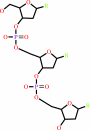 DNA(n)
|
+
|
2'-deoxyribonucleoside 5'-triphosphate
|
=
|
DNA(n+1)
|
+
|
 diphosphate
|
|
|
|
|
|
|
|
|
|
Enzyme class 3:
|
|
Chains A, B:
E.C.2.7.7.7
- DNA-directed Dna polymerase.
|
|
|
|
|
|
|
Reaction:
|
|
DNA(n) + a 2'-deoxyribonucleoside 5'-triphosphate = DNA(n+1) + diphosphate
|
|
|
|
|
|
DNA(n)
|
+
|
2'-deoxyribonucleoside 5'-triphosphate
|
=
|
DNA(n+1)
|
+
|
diphosphate
|
|
|
|
|
|
|
|
|
|
Enzyme class 4:
|
|
Chains A, B:
E.C.3.1.-.-
|
|
|
|
|
|
|
Enzyme class 5:
|
|
Chains A, B:
E.C.3.1.13.2
- exoribonuclease H.
|
|
|
|
|
|
|
Reaction:
|
|
Exonucleolytic cleavage to 5'-phosphomonoester oligonucleotides in both 5'- to 3'- and 3'- to 5'-directions.
|
|
|
|
|
|
Enzyme class 6:
|
|
Chains A, B:
E.C.3.1.26.13
- retroviral ribonuclease H.
|
|
|
|
|
|
|
Enzyme class 7:
|
|
Chains A, B:
E.C.3.4.23.16
- HIV-1 retropepsin.
|
|
|
|
|
|
|
Reaction:
|
|
Specific for a P1 residue that is hydrophobic, and P1' variable, but often Pro.
|
|
|
|
|
|
|
|
|
Note, where more than one E.C. class is given (as above), each may
correspond to a different protein domain or, in the case of polyprotein
precursors, to a different mature protein.
|
|
|
|
Molecule diagrams generated from .mol files obtained from the
KEGG ftp site
|
|
|
|
|
|
|
|
|
|
|
|
|
|
 |
|
|
|
|
|
|
| |
|
|
| |
|
DOI no:
|
J Mol Biol
284:313-323
(1998)
|
|
PubMed id:
|
|
|
|
|
|
| |
|
Structures of Tyr188Leu mutant and wild-type HIV-1 reverse transcriptase complexed with the non-nucleoside inhibitor HBY 097: inhibitor flexibility is a useful design feature for reducing drug resistance.
|
|
Y.Hsiou,
K.Das,
J.Ding,
A.D.Clark,
J.P.Kleim,
M.Rösner,
I.Winkler,
G.Riess,
S.H.Hughes,
E.Arnold.
|
|
|
|
|
| |
ABSTRACT
|
|
|
|
| |
|
|
The second generation Hoechst-Bayer non-nucleoside inhibitor, HBY 097
(S-4-isopropoxycarbonyl-6-methoxy-3-(methylthiomethyl)-3, 4-dihydroqui
noxalin-2(1H)-thione), is an extremely potent inhibitor of HIV-1 reverse
transcriptase (RT) and of HIV-1 infection in cell culture. HBY 097 selects for
unusual drug-resistance mutations in HIV-1 RT (e.g. Gly190Glu) when compared
with other non-nucleoside RT inhibitors (NNRTIs), such as nevirapine, alpha-APA
and TIBO. We have determined the structure of HBY 097 complexed with wild-type
HIV-1 RT at 3.1 A resolution. The HIV-1 RT/HBY 097 structure reveals an overall
inhibitor geometry and binding mode differing significantly from RT/NNRTI
structures reported earlier, in that HBY 097 does not adopt the usual
butterfly-like shape. We have determined the structure of the Tyr188Leu HIV-1 RT
drug-resistant mutant in complex with HBY 097 at 3.3 A resolution. HBY 097 binds
to the mutant RT in a manner similar to that seen in the wild-type RT/HBY 097
complex, although there are some repositioning and conformational alterations of
the inhibitor. Conformational changes of the structural elements forming the
inhibitor-binding pocket, including the orientation of some side-chains, are
observed. Reduction in the size of the 188 side-chain and repositioning of the
Phe227 side-chain increases the volume of the binding cavity in the Tyr188Leu
HIV-1 RT/HBY 097 complex. Loss of important protein-inhibitor interactions may
account for the reduced potency of HBY 097 against the Tyr188Leu HIV-1 RT
mutant. The loss of binding energy may be partially offset by additional
contacts resulting from conformational changes of the inhibitor and nearby amino
acid residues. This would suggest that inhibitor flexibility can help to
minimize drug resistance.
|
|
|
|
|
|
| |
Selected figure(s)
|
|
|
|
| |
|
|

|
|

|
|
Figure 1.
Figure 1. Diagram of HBY 097 (a quinoxaline derivative)
contacts with protein residues around the NNIBP in both (a)
wild-type HIV-1 RT/HBY 097 and (b) Tyr188Leu mutant HIV-1 RT/HBY
097 complexes. Distances (  slant
3.6 Å) between protein and inhibitor atoms are indicated. slant
3.6 Å) between protein and inhibitor atoms are indicated.
|
|
Figure 4.
Figure 4. (a) Stereoview of a difference Fourier m(F[obs] -
F[calc]) map showing the electron density of HBY 097 in the
wild-type HIV-1 RT/HBY 097 complex. The map is calculated at 3.1
Å resolution with 2s contours (in magenta). The phases
were computed from the protein model prior to inclusion of the
inhibitor. The green density corresponds to the difference
Fourier map (3.7 Å resolution) between HBY 097 and S-0483
complexed with wild-type HIV-1 RT (bromine in S-0483 replaces
the methoxy group of HBY 097), contoured at the 5s level,
showing the position of the bromine atom and confirming the
orientation and placement of the inhibitor. Difference Fourier
2mF[obs] - F[calc] map at 3.3 Å resolution, contoured at
1.2s, (b) of the Tyr188Leu mutant HIV-1 RT/HBY 097 complex at
the NNIBP region in p66 showing the absence of any density for
the side-chain of Leu188; clear density for HBY 097 is seen in
the binding pocket; and of a (c) similar region in the p51
subunit, showing clear electron density for the side-chain at
Leu188.
|
|
|
|
|
|
| |
The above figures are
reprinted
by permission from Elsevier:
J Mol Biol
(1998,
284,
313-323)
copyright 1998.
|
|
| |
Figures were
selected
by an automated process.
|
|
|
|
|
|
|
|
|
|
|
|
|
|
|
|
 |
 |
 |
|
Literature references that cite this PDB file's key reference
|
|
|
| |
PubMed id
|
|
Reference
|
|
|
|
|
|
Z.Li,
H.Zhang,
Y.Li,
J.Zhang,
and
H.F.Chen
(2011).
Drug resistant mechanism of diaryltriazine analog inhibitors of HIV-1 reverse transcriptase using molecular dynamics simulation and 3D-QSAR.
|
| |
Chem Biol Drug Des,
77,
63-74.
|
|
|
|
|
|
|
K.A.Delviks-Frankenberry,
G.N.Nikolenko,
and
V.K.Pathak
(2010).
The "Connection" Between HIV Drug Resistance and RNase H.
|
| |
Viruses,
2,
1476-1503.
|
|
|
|
|
|
|
K.Singh,
B.Marchand,
K.A.Kirby,
E.Michailidis,
and
S.G.Sarafianos
(2010).
Structural Aspects of Drug Resistance and Inhibition of HIV-1 Reverse Transcriptase.
|
| |
Viruses,
2,
606-638.
|
|
|
|
|
|
|
A.Ivetac,
and
J.A.McCammon
(2009).
Elucidating the inhibition mechanism of HIV-1 non-nucleoside reverse transcriptase inhibitors through multicopy molecular dynamics simulations.
|
| |
J Mol Biol,
388,
644-658.
|
|
|
|
|
|
|
S.G.Sarafianos,
B.Marchand,
K.Das,
D.M.Himmel,
M.A.Parniak,
S.H.Hughes,
and
E.Arnold
(2009).
Structure and function of HIV-1 reverse transcriptase: molecular mechanisms of polymerization and inhibition.
|
| |
J Mol Biol,
385,
693-713.
|
|
|
|
|
|
|
D.T.Manallack
(2008).
The use of local surface properties for molecular superimposition.
|
| |
J Mol Model,
14,
797-805.
|
|
|
|
|
|
|
M.B.Smith,
L.H.Rader,
A.M.Franklin,
E.V.Taylor,
K.D.Smith,
R.H.Smith,
J.Tirado-Rives,
and
W.L.Jorgensen
(2008).
Energetic effects for observed and unobserved HIV-1 reverse transcriptase mutations of residues L100, V106, and Y181 in the presence of nevirapine and efavirenz.
|
| |
Bioorg Med Chem Lett,
18,
969-972.
|
|
|
|
|
|
|
P.Srivab,
and
S.Hannongbua
(2008).
A study of the binding energies of efavirenz to wild-type and K103N/Y181C HIV-1 reverse transcriptase based on the ONIOM method.
|
| |
ChemMedChem,
3,
803-811.
|
|
|
|
|
|
|
G.Barreiro,
C.R.Guimarães,
I.Tubert-Brohman,
T.M.Lyons,
J.Tirado-Rives,
and
W.L.Jorgensen
(2007).
Search for non-nucleoside inhibitors of HIV-1 reverse transcriptase using chemical similarity, molecular docking, and MM-GB/SA scoring.
|
| |
J Chem Inf Model,
47,
2416-2428.
|
|
|
|
|
|
|
J.Ren,
C.E.Nichols,
A.Stamp,
P.P.Chamberlain,
R.Ferris,
K.L.Weaver,
S.A.Short,
and
D.K.Stammers
(2006).
Structural insights into mechanisms of non-nucleoside drug resistance for HIV-1 reverse transcriptases mutated at codons 101 or 138.
|
| |
FEBS J,
273,
3850-3860.
|
|
|
PDB codes:
|
|
|
|
|
|
|
|
T.Maruyama,
S.Kozai,
Y.Demizu,
M.Witvrouw,
C.Pannecouque,
J.Balzarini,
R.Snoecks,
G.Andrei,
and
E.De Clercq
(2006).
Synthesis and anti-HIV-1 and anti-HCMV activity of 1-substituted 3-(3,5-dimethylbenzyl)uracil derivatives.
|
| |
Chem Pharm Bull (Tokyo),
54,
325-333.
|
|
|
|
|
|
|
J.L.Medina-Franco,
A.Golbraikh,
S.Oloff,
R.Castillo,
and
A.Tropsha
(2005).
Quantitative structure-activity relationship analysis of pyridinone HIV-1 reverse transcriptase inhibitors using the k nearest neighbor method and QSAR-based database mining.
|
| |
J Comput Aided Mol Des,
19,
229-242.
|
|
|
|
|
|
|
S.Saen-oon,
M.Kuno,
and
S.Hannongbua
(2005).
Binding energy analysis for wild-type and Y181C mutant HIV-1 RT/8-Cl TIBO complex structures: quantum chemical calculations based on the ONIOM method.
|
| |
Proteins,
61,
859-869.
|
|
|
|
|
|
|
E.N.Peletskaya,
A.A.Kogon,
S.Tuske,
E.Arnold,
and
S.H.Hughes
(2004).
Nonnucleoside inhibitor binding affects the interactions of the fingers subdomain of human immunodeficiency virus type 1 reverse transcriptase with DNA.
|
| |
J Virol,
78,
3387-3397.
|
|
|
PDB code:
|
|
|
|
|
|
|
|
F.Daeyaert,
M.de Jonge,
J.Heeres,
L.Koymans,
P.Lewi,
M.H.Vinkers,
and
P.A.Janssen
(2004).
A pharmacophore docking algorithm and its application to the cross-docking of 18 HIV-NNRTI's in their binding pockets.
|
| |
Proteins,
54,
526-533.
|
|
|
|
|
|
|
G.Tachedjian,
and
A.Mijch
(2004).
Virological significance, prevalence and genetic basis of hypersusceptibility to nonnucleoside reverse transcriptase inhibitors.
|
| |
Sex Health,
1,
81-89.
|
|
|
|
|
|
|
J.D.Pata,
W.G.Stirtan,
S.W.Goldstein,
and
T.A.Steitz
(2004).
Structure of HIV-1 reverse transcriptase bound to an inhibitor active against mutant reverse transcriptases resistant to other nonnucleoside inhibitors.
|
| |
Proc Natl Acad Sci U S A,
101,
10548-10553.
|
|
|
PDB code:
|
|
|
|
|
|
|
|
N.Sluis-Cremer,
N.A.Temiz,
and
I.Bahar
(2004).
Conformational changes in HIV-1 reverse transcriptase induced by nonnucleoside reverse transcriptase inhibitor binding.
|
| |
Curr HIV Res,
2,
323-332.
|
|
|
|
|
|
|
O.J.D'Cruz,
P.Samuel,
and
F.M.Uckun
(2004).
PHI-443: a novel noncontraceptive broad-spectrum anti-human immunodeficiency virus microbicide.
|
| |
Biol Reprod,
71,
2037-2047.
|
|
|
|
|
|
|
Z.Ambrose,
V.Boltz,
S.Palmer,
J.M.Coffin,
S.H.Hughes,
and
V.N.Kewalramani
(2004).
In vitro characterization of a simian immunodeficiency virus-human immunodeficiency virus (HIV) chimera expressing HIV type 1 reverse transcriptase to study antiviral resistance in pigtail macaques.
|
| |
J Virol,
78,
13553-13561.
|
|
|
|
|
|
|
L.Shen,
J.Shen,
X.Luo,
F.Cheng,
Y.Xu,
K.Chen,
E.Arnold,
J.Ding,
and
H.Jiang
(2003).
Steered molecular dynamics simulation on the binding of NNRTI to HIV-1 RT.
|
| |
Biophys J,
84,
3547-3563.
|
|
|
|
|
|
|
J.Lindberg,
S.Sigurdsson,
S.Löwgren,
H.O.Andersson,
C.Sahlberg,
R.Noréen,
K.Fridborg,
H.Zhang,
and
T.Unge
(2002).
Structural basis for the inhibitory efficacy of efavirenz (DMP-266), MSC194 and PNU142721 towards the HIV-1 RT K103N mutant.
|
| |
Eur J Biochem,
269,
1670-1677.
|
|
|
PDB codes:
|
|
|
|
|
|
|
|
J.Ren,
L.E.Bird,
P.P.Chamberlain,
G.B.Stewart-Jones,
D.I.Stuart,
and
D.K.Stammers
(2002).
Structure of HIV-2 reverse transcriptase at 2.35-A resolution and the mechanism of resistance to non-nucleoside inhibitors.
|
| |
Proc Natl Acad Sci U S A,
99,
14410-14415.
|
|
|
PDB code:
|
|
|
|
|
|
|
|
E.N.Peletskaya,
P.L.Boyer,
A.A.Kogon,
P.Clark,
H.Kroth,
J.M.Sayer,
D.M.Jerina,
and
S.H.Hughes
(2001).
Cross-linking of the fingers subdomain of human immunodeficiency virus type 1 reverse transcriptase to template-primer.
|
| |
J Virol,
75,
9435-9445.
|
|
|
|
|
|
|
K.Van Laethem,
M.Witvrouw,
C.Pannecouque,
B.Van Remoortel,
J.C.Schmit,
R.Esnouf,
J.P.Kleim,
J.Balzarini,
J.Desmyter,
E.De Clercq,
and
A.M.Vandamme
(2001).
Mutations in the non-nucleoside binding-pocket interfere with the multi-nucleoside resistance phenotype.
|
| |
AIDS,
15,
553-561.
|
|
|
|
|
|
|
S.H.Hughes
(2001).
Molecular matchmaking: NNRTIs can enhance the dimerization of HIV type 1 reverse transcriptase.
|
| |
Proc Natl Acad Sci U S A,
98,
6991-6992.
|
|
|
|
|
|
|
A.J.Brown,
H.M.Precious,
J.M.Whitcomb,
J.K.Wong,
M.Quigg,
W.Huang,
E.S.Daar,
R.T.D'Aquila,
P.H.Keiser,
E.Connick,
N.S.Hellmann,
C.J.Petropoulos,
D.D.Richman,
and
S.J.Little
(2000).
Reduced susceptibility of human immunodeficiency virus type 1 (HIV-1) from patients with primary HIV infection to nonnucleoside reverse transcriptase inhibitors is associated with variation at novel amino acid sites.
|
| |
J Virol,
74,
10269-10273.
|
|
|
|
|
|
|
A.Velazquez-Campoy,
M.J.Todd,
and
E.Freire
(2000).
HIV-1 protease inhibitors: enthalpic versus entropic optimization of the binding affinity.
|
| |
Biochemistry,
39,
2201-2207.
|
|
|
|
|
|
|
E.De Clercq
(2000).
Novel compounds in preclinical/early clinical development for the treatment of HIV infections.
|
| |
Rev Med Virol,
10,
255-277.
|
|
|
|
|
|
|
H.Jonckheere,
J.Anné,
and
E.De Clercq
(2000).
The HIV-1 reverse transcription (RT) process as target for RT inhibitors.
|
| |
Med Res Rev,
20,
129-154.
|
|
|
|
|
|
The most recent references are shown first.
Citation data come partly from CiteXplore and partly
from an automated harvesting procedure. Note that this is likely to be
only a partial list as not all journals are covered by
either method. However, we are continually building up the citation data
so more and more references will be included with time.
Where a reference describes a PDB structure, the PDB
codes are
shown on the right.
|
 |


 Links
Links


