 |
PDBsum entry 1blj

|
|
|
|
|
|

|

|

|

|
|

|
|

|
|

|
|
|
 |

|

|
|
|
|
|
|
|
|
|
|
|
|
|
|
|
|
|
|
|
|
|
|
|
|
|
|
|
|
|
|
|
|
Phosphorylation
|
PDB id
|
|
|
|
1blj
|
|
|
|
|
|
|
|
|
|
|
|
|
|
|

|

|

|
|
|
|
|
|
|
|
 |
Contents |
 |
|
|
|
|
|
|
|
|
* Residue conservation analysis
|
|
|
|
|
|
|
|
|
|
|
Enzyme class:
|
|
E.C.2.7.10.2
- non-specific protein-tyrosine kinase.
|
|
|
|
|
|
|
Reaction:
|
|
L-tyrosyl-[protein] + ATP = O-phospho-L-tyrosyl-[protein] + ADP + H+
|
|
|
|
|
|
L-tyrosyl-[protein]
|
+
|
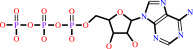 ATP
ATP
|
=
|
O-phospho-L-tyrosyl-[protein]
|
+
|
 ADP
ADP
|
+
|
H(+)
|
|
|
|
|
|
|
|
|
|
|
|
|
Molecule diagrams generated from .mol files obtained from the
KEGG ftp site
|
|
|
|
|
|
|
|
|
|
|
|
|
|
 |
|
|
|
|
|
|
| |
|
|
| |
|
DOI no:
|
Biochemistry
35:6201-6211
(1996)
|
|
PubMed id:
|
|
|
|
|
|
| |
|
The three-dimensional solution structure of the SH2 domain from p55blk kinase.
|
|
W.J.Metzler,
B.Leiting,
K.Pryor,
L.Mueller,
B.T.Farmer.
|
|
|
|
|
| |
ABSTRACT
|
|
|
|
| |
|
|
Signal transduction in B cells is mediated, in part, by the interaction of the
cytoplasmic components of the antigen receptor complex and various members of
the src family tyrosine kinases. Key to this process appears to be the
interaction of the tyrosine kinase SH2 domains with the tyrosine-phosphorylated
cytoplasmic domain of Ig-alpha, a disulfide-bonded heterodimeric (with Ig-beta
or Ig-gamma) transmembrane protein that noncovalently associates with the
antigen receptor immunoglobin chains. In addition to binding to the
phosphorylated cytoplasmic domains of Ig-alpha and Ig-beta, blk and fyn(T), two
members of the src family kinases, have been shown to bind overlapping but
distinct sets of phosphoproteins [Malek & Desiderio (1993) J. Biol. Chem.
268. 22557-22565]. A comparison of their three-dimensional structures may
elucidate the apparently subtle differences required for phosphoprotein
discrimination. To begin characterizing the blk/fyn/phosphosphoprotein
interactions, we have determined the three-dimensional solution structure of the
SH2 domain of blk kinase by nuclear magnetic resonance (NMR) spectroscopy. 1H,
13C, and 15N resonances of the SH2 domain of blk kinase were assigned by
analysis of multidimensional, double- and triple-resonance NMR experiments.
Twenty structures of the blk SH2 domain were refined with the program X-PLOR
using a total of 2080 experimentally derived conformational restraints. The
structures converged to a root-mean-squared (rms) distance deviation of 0.51 and
0.95 A for the backbone atoms and for the non-hydrogen atoms, respectively. The
blk SH2 domain adopts the prototypical SH2 fold. Structurally, blk SH2 is most
similar to the crystal structure of the v-src SH2 domain [Waksman et al. (1993)
Nature 358.646-653] and superimposes on the crystal structure with an rmsd of
1.52 A for the backbone atoms. The largest deviations occur in the four loops
interconnecting beta-strands A-E, which are the least well-defined regions in
the NMR structure. Exclusion of these loops lowers this rmsd to 0.82 A. The
conformation of the BC loop in the blk SH2 domain is similar to the open
conformation in the apo lck SH2 domain, suggesting that, like the lck SH2
domain, the blk SH2 domain may have a gated phosphopeptide binding site.
Finally, it is proposed that the amino acid substitution of Lys 88 (blk) for Glu
[fyn(T)] is important for the observed differences in specificity between blk
and fyn(T) SH2 domains.
|
|
|
|
|
|
|
|
|
|
|
|
|
|
|
|
|
|
 |
 |
 |
|
Literature references that cite this PDB file's key reference
|
|
|
| |
PubMed id
|
|
Reference
|
|
|
|
|
|
L.Wang,
H.R.Eghbalnia,
and
J.L.Markley
(2006).
Probabilistic approach to determining unbiased random-coil carbon-13 chemical shift values from the protein chemical shift database.
|
| |
J Biomol NMR,
35,
155-165.
|
|
|
|
|
|
|
M.Iwadate,
E.Nagao,
M.P.Williamson,
M.Ueki,
and
T.Asakura
(2000).
Structure determination of [Arg8]vasopressin methylenedithioether in dimethylsulfoxide using NMR.
|
| |
Eur J Biochem,
267,
4504-4510.
|
|
|
|
|
|
|
K.H.Gardner,
and
L.E.Kay
(1998).
The use of 2H, 13C, 15N multidimensional NMR to study the structure and dynamics of proteins.
|
| |
Annu Rev Biophys Biomol Struct,
27,
357-406.
|
|
|
|
|
|
|
L.Oligino,
F.D.Lung,
L.Sastry,
J.Bigelow,
T.Cao,
M.Curran,
T.R.Burke,
S.Wang,
D.Krag,
P.P.Roller,
and
C.R.King
(1997).
Nonphosphorylated peptide ligands for the Grb2 Src homology 2 domain.
|
| |
J Biol Chem,
272,
29046-29052.
|
|
|
|
|
|
|
T.D.Mulhern,
G.L.Shaw,
C.J.Morton,
A.J.Day,
and
I.D.Campbell
(1997).
The SH2 domain from the tyrosine kinase Fyn in complex with a phosphotyrosyl peptide reveals insights into domain stability and binding specificity.
|
| |
Structure,
5,
1313-1323.
|
|
|
PDB codes:
|
|
|
|
|
|
|
The most recent references are shown first.
Citation data come partly from CiteXplore and partly
from an automated harvesting procedure. Note that this is likely to be
only a partial list as not all journals are covered by
either method. However, we are continually building up the citation data
so more and more references will be included with time.
Where a reference describes a PDB structure, the PDB
codes are
shown on the right.
|
|


 Links
Links


