
|
|
|
|
|
 |
Contents |
 |
|
|
|
|
|
|
|
|
|
|
|
|
* Residue conservation analysis
|
|
|
|
|
|
|
|
|
|
Enzyme class 2:
|
|
Chain A:
E.C.?
|
|
|
|
|
|
|
Enzyme class 3:
|
|
Chain B:
E.C.2.7.7.7
- DNA-directed Dna polymerase.
|
|
|
|
|
|
|
Reaction:
|
|
DNA(n) + a 2'-deoxyribonucleoside 5'-triphosphate = DNA(n+1) + diphosphate
|
|
|
|
|
|
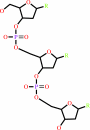 DNA(n)
|
+
|
2'-deoxyribonucleoside 5'-triphosphate
|
=
|
DNA(n+1)
|
+
|
 diphosphate
|
|
|
|
|
|
|
|
|
|
|
|
|
Note, where more than one E.C. class is given (as above), each may
correspond to a different protein domain or, in the case of polyprotein
precursors, to a different mature protein.
|
|
|
|
Molecule diagrams generated from .mol files obtained from the
KEGG ftp site
|
|
|
|
|
|
|
|
|
|
|
|
|
|
 |
|
|
|
|
|
|
| |
|
|
| |
|
DOI no:
|
J Biol Chem
281:5224-5232
(2006)
|
|
PubMed id:
|
|
|
|
|
|
| |
|
Crystal structure of the cytomegalovirus DNA polymerase subunit UL44 in complex with the C terminus from the catalytic subunit. Differences in structure and function relative to unliganded UL44.
|
|
B.A.Appleton,
J.Brooks,
A.Loregian,
D.J.Filman,
D.M.Coen,
J.M.Hogle.
|
|
|
|
|
| |
ABSTRACT
|
|
|
|
| |
|
|
The human cytomegalovirus DNA polymerase is composed of a catalytic subunit,
UL54, and an accessory protein, UL44, which has a structural fold similar to
that of other processivity factors, including herpes simplex virus UL42 and
homotrimeric sliding clamps such as proliferating cell nuclear antigen. Several
specific residues in the C-terminal region of UL54 and in the "connector
loop" of UL44 are required for the association of these proteins. Here, we
describe the crystal structure of residues 1-290 of UL44 in complex with a
peptide from the extreme C terminus of UL54, which explains this interaction at
a molecular level. The UL54 peptide binds to structural elements similar to
those used by UL42 and the sliding clamps to associate with their respective
binding partners. However, the details of the interaction differ from those of
other processivity factor-peptide complexes. Crucial residues include a
three-residue hydrophobic "plug" from the UL54 peptide and Ile(135) of
UL44, which forms a critical intramolecular hydrophobic anchor for interactions
between the connector loop and the peptide. As was the case for the unliganded
UL44 structure, the UL44-peptide complex forms a head-to-head dimer that could
potentially form a C-shaped clamp on DNA. However, the peptide-bound structure
displays subtle differences in the relative orientation of the two subdomains of
the protein, resulting in a more open clamp, which we predicted would affect its
association with DNA. Indeed, filter binding assays revealed that peptide-bound
UL44 binds DNA with higher affinity. Thus, interaction with the catalytic
subunit appears to affect both the structure and function of UL44.
|
|
|
|
|
|
| |
Selected figure(s)
|
|
|
|
| |
|
|

|
|

|
|
Figure 2.
FIGURE 2. Molecular details of the UL44-UL54 interface. A,
the connector loop of UL44 (white) and the UL54 peptide (brown)
are joined by an extensive network of hydrogen bonds (green
dots). Four intermolecular hydrogen bonds are formed between
main chain atoms of the connector loop (residues 133-137) and
the peptide (residues 1234-1238). Additional hydrogen bonds are
observed between the side chain of Gln^133 (yellow) of UL44 and
the main chain of the peptide and between the side chains of
Gln^51 and Lys^60 (light blue) of UL44 and the main chain of the
connector loop. Ile^135 (yellow) of UL44 forms a critical
hydrophobic anchor below the hydrogen-bonding network. For
clarity, only the side chains of Gln^51, Lys^60, Gln^133, and
Ile^135 are shown. B, Leu^1227, Phe^1231, and Tyr^1234 (magenta)
are part of a hydrophobic plug that packs against a hydrophobic
crevice composed of Val^136 (yellow) from the connector loop
(cyan) as well as hydrophobic and aliphatic side chains (green)
from the central  -sheet of UL44. C, the
molecular surface of UL44 reveals pockets that accommodate the
three-residue hydrophobic plug of UL54. -sheet of UL44. C, the
molecular surface of UL44 reveals pockets that accommodate the
three-residue hydrophobic plug of UL54.
|
|
Figure 3.
FIGURE 3. Comparison of the processivity factor-peptide
structures of HSV UL42, HCMV UL44, and human PCNA. A, the
association of HSV UL42 (Protein Data Bank code 1DML) with the
UL30 peptide (orange) is primarily stabilized by interactions
between the C-terminal helix of the peptide and a groove on the
left side of the connector loop (red in each panel). His^1228
and Arg^1229 from the C-terminal helix of the peptide are
hydrogenbonded to Arg^64 and Gln^171, respectively, of UL42. B,
in contrast, the HCMV UL54 peptide (blue) makes significant
interactions with UL44 on the right side of the connector loop.
This interaction depends largely on three hydrophobic residues
from the peptide that bind to a hydrophobic crevice on UL44. The
side chains of Leu^1227 and Phe^1231 of UL54 are required for
the association with UL44. Although the HSV UL30 peptide has an
aromatic residue (Phe^1211) that packs into an analogous crevice
on UL42 (see inset in A), this interaction is not essential. C,
like UL44, PCNA (Protein Data Bank code 1AXC [PDB]
) contains a hydrophobic crevice on the right side of the
connector loop that binds to a peptide from its respective
binding partner, p21^WAF1/CIP1 (green). Similar to the UL54
peptide, the p21^WAF1/CIP1 peptide buries three hydrophobic
residues in the crevice. The connector loop from each
processivity factor forms an antiparallel -sheet with its
respective peptide. In each inset, the processivity factor is
gray; the connector loop is red; and the peptide backbone is tan.
|
|
|
|
|
|
| |
The above figures are
reprinted
by permission from the ASBMB:
J Biol Chem
(2006,
281,
5224-5232)
copyright 2006.
|
|
| |
Figures were
selected
by an automated process.
|
|
|
|
|
|
|
|
|
|
|
|
|
|
|
|
 |
 |
 |
|
Literature references that cite this PDB file's key reference
|
|
|
| |
PubMed id
|
|
Reference
|
|
|
|
|
|
B.L.Strang,
A.P.Geballe,
and
D.M.Coen
(2010).
Association of human cytomegalovirus proteins IRS1 and TRS1 with the viral DNA polymerase accessory subunit UL44.
|
| |
J Gen Virol,
91,
2167-2175.
|
|
|
|
|
|
|
B.L.Strang,
and
D.M.Coen
(2010).
Interaction of the human cytomegalovirus uracil DNA glycosylase UL114 with the viral DNA polymerase catalytic subunit UL54.
|
| |
J Gen Virol,
91,
2029-2033.
|
|
|
|
|
|
|
B.L.Strang,
S.Boulant,
and
D.M.Coen
(2010).
Nucleolin associates with the human cytomegalovirus DNA polymerase accessory subunit UL44 and is necessary for efficient viral replication.
|
| |
J Virol,
84,
1771-1784.
|
|
|
|
|
|
|
Z.Zhuang,
and
Y.Ai
(2010).
Processivity factor of DNA polymerase and its expanding role in normal and translesion DNA synthesis.
|
| |
Biochim Biophys Acta,
1804,
1081-1093.
|
|
|
|
|
|
|
B.L.Strang,
E.Sinigalia,
L.A.Silva,
D.M.Coen,
and
A.Loregian
(2009).
Analysis of the association of the human cytomegalovirus DNA polymerase subunit UL44 with the viral DNA replication factor UL84.
|
| |
J Virol,
83,
7581-7589.
|
|
|
|
|
|
|
G.Alvisi,
D.M.Roth,
D.Camozzi,
G.S.Pari,
A.Loregian,
A.Ripalti,
and
D.A.Jans
(2009).
The flexible loop of the human cytomegalovirus DNA polymerase processivity factor ppUL44 is required for efficient DNA binding and replication in cells.
|
| |
J Virol,
83,
9567-9576.
|
|
|
|
|
|
|
J.L.Baltz,
D.J.Filman,
M.Ciustea,
J.E.Silverman,
C.L.Lautenschlager,
D.M.Coen,
R.P.Ricciardi,
and
J.M.Hogle
(2009).
The crystal structure of PF-8, the DNA polymerase accessory subunit from Kaposi's sarcoma-associated herpesvirus.
|
| |
J Virol,
83,
12215-12228.
|
|
|
PDB codes:
|
|
|
|
|
|
|
|
K.Murayama,
S.Nakayama,
M.Kato-Murayama,
R.Akasaka,
N.Ohbayashi,
Y.Kamewari-Hayami,
T.Terada,
M.Shirouzu,
T.Tsurumi,
and
S.Yokoyama
(2009).
Crystal structure of epstein-barr virus DNA polymerase processivity factor BMRF1.
|
| |
J Biol Chem,
284,
35896-35905.
|
|
|
PDB code:
|
|
|
|
|
|
|
|
B.Mercorelli,
E.Sinigalia,
A.Loregian,
and
G.Palù
(2008).
Human cytomegalovirus DNA replication: antiviral targets and drugs.
|
| |
Rev Med Virol,
18,
177-210.
|
|
|
|
|
|
|
G.Komazin-Meredith,
R.J.Petrella,
W.L.Santos,
D.J.Filman,
J.M.Hogle,
G.L.Verdine,
M.Karplus,
and
D.M.Coen
(2008).
The human cytomegalovirus UL44 C clamp wraps around DNA.
|
| |
Structure,
16,
1214-1225.
|
|
|
|
|
|
|
G.Komazin-Meredith,
W.L.Santos,
D.J.Filman,
J.M.Hogle,
G.L.Verdine,
and
D.M.Coen
(2008).
The positively charged surface of herpes simplex virus UL42 mediates DNA binding.
|
| |
J Biol Chem,
283,
6154-6161.
|
|
|
|
|
|
|
H.G.Woon,
G.M.Scott,
K.L.Yiu,
D.H.Miles,
and
W.D.Rawlinson
(2008).
Identification of putative functional motifs in viral proteins essential for human cytomegalovirus DNA replication.
|
| |
Virus Genes,
37,
193-202.
|
|
|
|
|
|
|
A.Loregian,
E.Sinigalia,
B.Mercorelli,
G.Palù,
and
D.M.Coen
(2007).
Binding parameters and thermodynamics of the interaction of the human cytomegalovirus DNA polymerase accessory protein, UL44, with DNA: implications for the processivity mechanism.
|
| |
Nucleic Acids Res,
35,
4779-4791.
|
|
|
|
|
|
|
G.Alvisi,
A.Ripalti,
A.Ngankeu,
M.Giannandrea,
S.G.Caraffi,
M.M.Dias,
and
D.A.Jans
(2006).
Human cytomegalovirus DNA polymerase catalytic subunit pUL54 possesses independently acting nuclear localization and ppUL44 binding motifs.
|
| |
Traffic,
7,
1322-1332.
|
|
|
|
|
|
|
J.R.Mesters,
J.Tan,
and
R.Hilgenfeld
(2006).
Viral enzymes.
|
| |
Curr Opin Struct Biol,
16,
776-786.
|
|
|
|
|
|
The most recent references are shown first.
Citation data come partly from CiteXplore and partly
from an automated harvesting procedure. Note that this is likely to be
only a partial list as not all journals are covered by
either method. However, we are continually building up the citation data
so more and more references will be included with time.
Where a reference describes a PDB structure, the PDB
codes are
shown on the right.
|
 |


 Links
Links


