 |
PDBsum entry 1xwl

|
|
|
|
|
|

|

|

|

|
|

|
|

|
|

|
|

|
|
|
 |

|

|
|
|
|
|
|
|
|
|
|
|
|
|
|
|
|
|
|
|
|
|
|
|
|
|
|
|
|
|
|
|
|
|
DNA replication
|
PDB id
|
|
|
|
1xwl
|
|
|
|
|
|
|
|
|
|
|
|
|
|
|

|

|

|
|
|
|
|
|
|
|
 |
Contents |
 |
|
|
|
|
|
|
|
|
|
|
|
|
* Residue conservation analysis
|
|
|
|
|
|
|
|
|
|
|
Enzyme class:
|
|
E.C.2.7.7.7
- DNA-directed Dna polymerase.
|
|
|
|
|
|
|
Reaction:
|
|
DNA(n) + a 2'-deoxyribonucleoside 5'-triphosphate = DNA(n+1) + diphosphate
|
|
|
|
|
|
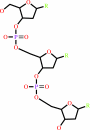 DNA(n)
|
+
|
2'-deoxyribonucleoside 5'-triphosphate
|
=
|
DNA(n+1)
|
+
|
 diphosphate
|
|
|
|
|
|
|
|
|
|
|
|
|
Molecule diagrams generated from .mol files obtained from the
KEGG ftp site
|
|
|
|
|
|
|
|
|
|
|
|
|
|
 |
|
|
|
|
|
|
| |
|
|
| |
|
DOI no:
|
Structure
5:95
(1997)
|
|
PubMed id:
|
|
|
|
|
|
| |
|
Crystal structure of a thermostable Bacillus DNA polymerase I large fragment at 2.1 A resolution.
|
|
J.R.Kiefer,
C.Mao,
C.J.Hansen,
S.L.Basehore,
H.H.Hogrefe,
J.C.Braman,
L.S.Beese.
|
|
|
|
|
| |
ABSTRACT
|
|
|
|
| |
|
|
BACKGROUND: The study of DNA polymerases in the Pol l family is central to the
understanding of DNA replication and repair. DNA polymerases are used in many
molecular biology techniques, including PCR, which require a thermostable
polymerase. In order to learn about Pol I function and the basis of
thermostability, we undertook structural studies of a new thermostable DNA
polymerase. RESULTS: A DNA polymerase large, Klenow-like, fragment from a
recently identified thermostable strain of Bacillus stearothermophilus (BF) was
cloned, sequenced, overexpressed and characterized. Its crystal structure was
determined to 2.1 A resolution by the method of multiple isomorphous
replacement. CONCLUSIONS: This structure represents the highest resolution view
of a Pol I enzyme obtained to date. Comparison of the three Pol I structures
reveals no compelling evidence for many of the specific interactions that have
been proposed to induce thermostability, but suggests that thermostability
arises from innumerable small changes distributed throughout the protein
structure. The polymerase domain is highly conserved in all three proteins. The
N-terminal domains are highly divergent in sequence, but retain a common fold.
When present, the 3'-5' proofreading exonuclease activity is associated with
this domain. Its absence is associated with changes in catalytic residues that
coordinate the divalent ions required for activity and in loops connecting
homologous secondary structural elements. In BF, these changes result in a
blockage of the DNA-binding cleft.
|
|
|
|
|
|
| |
Selected figure(s)
|
|
|
|
| |
|
|

|
|
Figure 3.
Figure 3. Comparison of 3'-5' exonuclease active sites.
Stereo diagram of the BF polymerase vestigial exonuclease active
site (red) with the position of a portion of the structure of
the KF active site (gold) [4] superimposed. The KF Ca backbone
schematic is accompanied by is two bound zinc atoms (green), and
three nucleotides (black) from the KF editing complex [11]. The
KF residues shown (yellow) are the four residues that bind the
two metal ions essential for catalysis. These essential KF
sidechains Asp355, Glu357, Asp424, and Asp501 correspond to BF
residues Val319, Glu321, Ala376, and Lys450, respectively (shown
in blue). Also shown in blue are two BF proline residues (438
and 441) that may be responsible for the collapse of a loop
between helices E[1] and F (dotted line) into the exonuclease
cleft not observed in KF. (Drawn with RIBBONS [71].)
|
|
|
|
|
|
| |
The above figure is
reprinted
by permission from Cell Press:
Structure
(1997,
5,
95-0)
copyright 1997.
|
|
| |
Figure was
selected
by an automated process.
|
|
|
|
|
|
|
|
|
|
|
|
|
|
|
|
 |
 |
 |
|
Literature references that cite this PDB file's key reference
|
|
|
| |
PubMed id
|
|
Reference
|
|
|
|
|
|
A.A.Golosov,
J.J.Warren,
L.S.Beese,
and
M.Karplus
(2010).
The mechanism of the translocation step in DNA replication by DNA polymerase I: a computer simulation analysis.
|
| |
Structure,
18,
83-93.
|
|
|
PDB codes:
|
|
|
|
|
|
|
|
M.Münzel,
L.Lercher,
M.Müller,
and
T.Carell
(2010).
Chemical discrimination between dC and 5MedC via their hydroxylamine adducts.
|
| |
Nucleic Acids Res,
38,
e192.
|
|
|
PDB code:
|
|
|
|
|
|
|
|
V.B.Chen,
W.B.Arendall,
J.J.Headd,
D.A.Keedy,
R.M.Immormino,
G.J.Kapral,
L.W.Murray,
J.S.Richardson,
and
D.C.Richardson
(2010).
MolProbity: all-atom structure validation for macromolecular crystallography.
|
| |
Acta Crystallogr D Biol Crystallogr,
66,
12-21.
|
|
|
|
|
|
|
Y.Santoso,
C.M.Joyce,
O.Potapova,
L.Le Reste,
J.Hohlbein,
J.P.Torella,
N.D.Grindley,
and
A.N.Kapanidis
(2010).
Conformational transitions in DNA polymerase I revealed by single-molecule FRET.
|
| |
Proc Natl Acad Sci U S A,
107,
715-720.
|
|
|
|
|
|
|
Y.Santoso,
J.P.Torella,
and
A.N.Kapanidis
(2010).
Characterizing single-molecule FRET dynamics with probability distribution analysis.
|
| |
Chemphyschem,
11,
2209-2219.
|
|
|
|
|
|
|
M.Horiuchi,
K.Takeuchi,
N.Noda,
N.Muroya,
T.Suzuki,
T.Nakamura,
J.Kawamura-Tsuzuku,
K.Takahasi,
T.Yamamoto,
and
F.Inagaki
(2009).
Structural Basis for the Antiproliferative Activity of the Tob-hCaf1 Complex.
|
| |
J Biol Chem,
284,
13244-13255.
|
|
|
PDB code:
|
|
|
|
|
|
|
|
M.Trostler,
A.Delier,
J.Beckman,
M.Urban,
J.N.Patro,
T.E.Spratt,
L.S.Beese,
and
R.D.Kuchta
(2009).
Discrimination between right and wrong purine dNTPs by DNA polymerase I from Bacillus stearothermophilus.
|
| |
Biochemistry,
48,
4633-4641.
|
|
|
|
|
|
|
P.Xu,
L.Oum,
Y.C.Lee,
N.E.Geacintov,
and
S.Broyde
(2009).
Visualizing sequence-governed nucleotide selectivities and mutagenic consequences through a replicative cycle: processing of a bulky carcinogen N2-dG lesion in a Y-family DNA polymerase.
|
| |
Biochemistry,
48,
4677-4690.
|
|
|
|
|
|
|
A.M.Leconte,
G.T.Hwang,
S.Matsuda,
P.Capek,
Y.Hari,
and
F.E.Romesberg
(2008).
Discovery, characterization, and optimization of an unnatural base pair for expansion of the genetic alphabet.
|
| |
J Am Chem Soc,
130,
2336-2343.
|
|
|
|
|
|
|
R.Venkatramani,
and
R.Radhakrishnan
(2008).
Effect of oxidatively damaged DNA on the active site preorganization during nucleotide incorporation in a high fidelity polymerase from Bacillus stearothermophilus.
|
| |
Proteins,
71,
1360-1372.
|
|
|
|
|
|
|
S.Broyde,
L.Wang,
O.Rechkoblit,
N.E.Geacintov,
and
D.J.Patel
(2008).
Lesion processing: high-fidelity versus lesion-bypass DNA polymerases.
|
| |
Trends Biochem Sci,
33,
209-219.
|
|
|
|
|
|
|
M.E.Arana,
K.Takata,
M.Garcia-Diaz,
R.D.Wood,
and
T.A.Kunkel
(2007).
A unique error signature for human DNA polymerase nu.
|
| |
DNA Repair (Amst),
6,
213-223.
|
|
|
|
|
|
|
M.Garcia-Diaz,
and
K.Bebenek
(2007).
Multiple functions of DNA polymerases.
|
| |
CRC Crit Rev Plant Sci,
26,
105-122.
|
|
|
|
|
|
|
M.Khalaj-Kondori,
M.Sadeghizadeh,
K.Khajeh,
H.Naderi-Manesh,
A.M.Ahadi,
and
A.Emamzadeh
(2007).
Cloning, sequence analysis and three-dimensional structure prediction of DNA pol I from thermophilic Geobacillus sp. MKK isolated from an Iranian hot spring.
|
| |
Appl Biochem Biotechnol,
142,
200-208.
|
|
|
|
|
|
|
P.Xu,
L.Oum,
L.S.Beese,
N.E.Geacintov,
and
S.Broyde
(2007).
Following an environmental carcinogen N2-dG adduct through replication: elucidating blockage and bypass in a high-fidelity DNA polymerase.
|
| |
Nucleic Acids Res,
35,
4275-4288.
|
|
|
|
|
|
|
S.Duigou,
S.D.Ehrlich,
P.Noirot,
and
M.F.Noirot-Gros
(2005).
DNA polymerase I acts in translesion synthesis mediated by the Y-polymerases in Bacillus subtilis.
|
| |
Mol Microbiol,
57,
678-690.
|
|
|
|
|
|
|
G.W.Hsu,
M.Ober,
T.Carell,
and
L.S.Beese
(2004).
Error-prone replication of oxidatively damaged DNA by a high-fidelity DNA polymerase.
|
| |
Nature,
431,
217-221.
|
|
|
PDB codes:
|
|
|
|
|
|
|
|
L.L.Videau,
W.B.Arendall,
and
J.S.Richardson
(2004).
The cis-Pro touch-turn: a rare motif preferred at functional sites.
|
| |
Proteins,
56,
298-309.
|
|
|
|
|
|
|
S.J.Johnson,
and
L.S.Beese
(2004).
Structures of mismatch replication errors observed in a DNA polymerase.
|
| |
Cell,
116,
803-816.
|
|
|
PDB codes:
|
|
|
|
|
|
|
|
Y.Shen,
X.F.Tang,
H.Yokoyama,
E.Matsui,
and
I.Matsui
(2004).
A 21-amino acid peptide from the cysteine cluster II of the family D DNA polymerase from Pyrococcus horikoshii stimulates its nuclease activity which is Mre11-like and prefers manganese ion as the cofactor.
|
| |
Nucleic Acids Res,
32,
158-168.
|
|
|
|
|
|
|
K.Singh,
and
M.J.Modak
(2003).
Presence of 18-A long hydrogen bond track in the active site of Escherichia coli DNA polymerase I (Klenow fragment). Its requirement in the stabilization of enzyme-template-primer complex.
|
| |
J Biol Chem,
278,
11289-11302.
|
|
|
|
|
|
|
S.J.Johnson,
J.S.Taylor,
and
L.S.Beese
(2003).
Processive DNA synthesis observed in a polymerase crystal suggests a mechanism for the prevention of frameshift mutations.
|
| |
Proc Natl Acad Sci U S A,
100,
3895-3900.
|
|
|
PDB codes:
|
|
|
|
|
|
|
|
R.Eisenbrandt,
J.M.Lázaro,
M.Salas,
and
M.de Vega
(2002).
Phi29 DNA polymerase residues Tyr59, His61 and Phe69 of the highly conserved ExoII motif are essential for interaction with the terminal protein.
|
| |
Nucleic Acids Res,
30,
1379-1386.
|
|
|
|
|
|
|
S.W.Yang,
M.Astatke,
J.Potter,
and
D.K.Chatterjee
(2002).
Mutant Thermotoga neapolitana DNA polymerase I: altered catalytic properties for non-templated nucleotide addition and incorporation of correct nucleotides.
|
| |
Nucleic Acids Res,
30,
4314-4320.
|
|
|
|
|
|
|
H.Liu,
J.H.Naismith,
and
R.T.Hay
(2000).
Identification of conserved residues contributing to the activities of adenovirus DNA polymerase.
|
| |
J Virol,
74,
11681-11689.
|
|
|
|
|
|
|
K.Chowdhury,
S.Tabor,
and
C.C.Richardson
(2000).
A unique loop in the DNA-binding crevice of bacteriophage T7 DNA polymerase influences primer utilization.
|
| |
Proc Natl Acad Sci U S A,
97,
12469-12474.
|
|
|
|
|
|
|
K.Vastmans,
S.Pochet,
A.Peys,
L.Kerremans,
A.Van Aerschot,
C.Hendrix,
P.Marlière,
and
P.Herdewijn
(2000).
Enzymatic incorporation in DNA of 1,5-anhydrohexitol nucleotides.
|
| |
Biochemistry,
39,
12757-12765.
|
|
|
|
|
|
|
S.J.Evans,
M.J.Fogg,
A.Mamone,
M.Davis,
L.H.Pearl,
and
B.A.Connolly
(2000).
Improving dideoxynucleotide-triphosphate utilisation by the hyper-thermophilic DNA polymerase from the archaeon Pyrococcus furiosus.
|
| |
Nucleic Acids Res,
28,
1059-1066.
|
|
|
|
|
|
|
T.A.Kunkel,
and
K.Bebenek
(2000).
DNA replication fidelity.
|
| |
Annu Rev Biochem,
69,
497-529.
|
|
|
|
|
|
|
G.Martin,
P.Jenö,
and
W.Keller
(1999).
Mapping of ATP binding regions in poly(A) polymerases by photoaffinity labeling and by mutational analysis identifies a domain conserved in many nucleotidyltransferases.
|
| |
Protein Sci,
8,
2380-2391.
|
|
|
|
|
|
|
J.Jäger,
and
J.D.Pata
(1999).
Getting a grip: polymerases and their substrate complexes.
|
| |
Curr Opin Struct Biol,
9,
21-28.
|
|
|
|
|
|
|
K.P.Hopfner,
A.Eichinger,
R.A.Engh,
F.Laue,
W.Ankenbauer,
R.Huber,
and
B.Angerer
(1999).
Crystal structure of a thermostable type B DNA polymerase from Thermococcus gorgonarius.
|
| |
Proc Natl Acad Sci U S A,
96,
3600-3605.
|
|
|
PDB code:
|
|
|
|
|
|
|
|
S.Doublié,
M.R.Sawaya,
and
T.Ellenberger
(1999).
An open and closed case for all polymerases.
|
| |
Structure,
7,
R31-R35.
|
|
|
|
|
|
|
Y.Zhao,
D.Jeruzalmi,
I.Moarefi,
L.Leighton,
R.Lasken,
and
J.Kuriyan
(1999).
Crystal structure of an archaebacterial DNA polymerase.
|
| |
Structure,
7,
1189-1199.
|
|
|
PDB codes:
|
|
|
|
|
|
|
|
C.A.Brautigam,
and
T.A.Steitz
(1998).
Structural and functional insights provided by crystal structures of DNA polymerases and their substrate complexes.
|
| |
Curr Opin Struct Biol,
8,
54-63.
|
|
|
|
|
|
|
I.K.Cann,
K.Komori,
H.Toh,
S.Kanai,
and
Y.Ishino
(1998).
A heterodimeric DNA polymerase: evidence that members of Euryarchaeota possess a distinct DNA polymerase.
|
| |
Proc Natl Acad Sci U S A,
95,
14250-14255.
|
|
|
|
|
|
|
J.Sanz-Aparicio,
J.A.Hermoso,
M.Martínez-Ripoll,
B.González,
C.López-Camacho,
and
J.Polaina
(1998).
Structural basis of increased resistance to thermal denaturation induced by single amino acid substitution in the sequence of beta-glucosidase A from Bacillus polymyxa.
|
| |
Proteins,
33,
567-576.
|
|
|
PDB code:
|
|
|
|
|
|
|
|
M.de Vega,
L.Blanco,
and
M.Salas
(1998).
phi29 DNA polymerase residue Ser122, a single-stranded DNA ligand for 3'-5' exonucleolysis, is required to interact with the terminal protein.
|
| |
J Biol Chem,
273,
28966-28977.
|
|
|
|
|
|
|
S.Doublié,
and
T.Ellenberger
(1998).
The mechanism of action of T7 DNA polymerase.
|
| |
Curr Opin Struct Biol,
8,
704-712.
|
|
|
|
|
|
|
T.A.Kunkel,
and
S.H.Wilson
(1998).
DNA polymerases on the move.
|
| |
Nat Struct Biol,
5,
95-99.
|
|
|
|
|
|
|
W.S.Furey,
C.M.Joyce,
M.A.Osborne,
D.Klenerman,
J.A.Peliska,
and
S.Balasubramanian
(1998).
Use of fluorescence resonance energy transfer to investigate the conformation of DNA substrates bound to the Klenow fragment.
|
| |
Biochemistry,
37,
2979-2990.
|
|
|
|
|
|
|
Y.Ishino,
and
I.K.Cann
(1998).
The euryarchaeotes, a subdomain of Archaea, survive on a single DNA polymerase: fact or farce?
|
| |
Genes Genet Syst,
73,
323-336.
|
|
|
|
|
|
|
J.Wang,
A.K.Sattar,
C.C.Wang,
J.D.Karam,
W.H.Konigsberg,
and
T.A.Steitz
(1997).
Crystal structure of a pol alpha family replication DNA polymerase from bacteriophage RB69.
|
| |
Cell,
89,
1087-1099.
|
|
|
PDB codes:
|
|
|
|
|
|
|
|
M.Oliveros,
R.J.Yáñez,
M.L.Salas,
J.Salas,
E.Viñuela,
and
L.Blanco
(1997).
Characterization of an African swine fever virus 20-kDa DNA polymerase involved in DNA repair.
|
| |
J Biol Chem,
272,
30899-30910.
|
|
|
|
|
|
The most recent references are shown first.
Citation data come partly from CiteXplore and partly
from an automated harvesting procedure. Note that this is likely to be
only a partial list as not all journals are covered by
either method. However, we are continually building up the citation data
so more and more references will be included with time.
Where a reference describes a PDB structure, the PDB
codes are
shown on the right.
|
|


 Links
Links


