 |
PDBsum entry 1ua0

|
|
|
|
|
|

|

|

|

|
|

|
|

|
|

|
|

|
|

|
|
|
 |

|

|
|
|
|
|
|
|
|
|
|
|
|
|
|
|
|
|
|
|
|
|
|
|
|
|
|
|
|
|
|
|
|
|
|
Transferase/DNA
|
PDB id
|
|
|
|
1ua0
|
|
|
|
|
|
|
|
|
|
|
|
|
|
|

|

|

|
|
|
|
|
|
|
|
 |
Contents |
 |
|
|
|
|
|
|
|
|
|
|
|
|
|
|
* Residue conservation analysis
|
|
|
|
|
|
|
|
|
|
|
Enzyme class:
|
|
E.C.2.7.7.7
- DNA-directed Dna polymerase.
|
|
|
|
|
|
|
Reaction:
|
|
DNA(n) + a 2'-deoxyribonucleoside 5'-triphosphate = DNA(n+1) + diphosphate
|
|
|
|
|
|
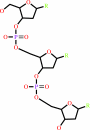 DNA(n)
|
+
|
2'-deoxyribonucleoside 5'-triphosphate
|
=
|
DNA(n+1)
|
+
|
 diphosphate
|
|
|
|
|
|
|
|
|
|
|
|
|
Molecule diagrams generated from .mol files obtained from the
KEGG ftp site
|
|
|
|
|
|
|
|
|
|
|
|
|
|
 |
|
|
|
|
|
|
| |
|
|
| |
|
DOI no:
|
J Biol Chem
279:50280-50285
(2004)
|
|
PubMed id:
|
|
|
|
|
|
| |
|
Observing translesion synthesis of an aromatic amine DNA adduct by a high-fidelity DNA polymerase.
|
|
G.W.Hsu,
J.R.Kiefer,
D.Burnouf,
O.J.Becherel,
R.P.Fuchs,
L.S.Beese.
|
|
|
|
|
| |
ABSTRACT
|
|
|
|
| |
|
|
Aromatic amines have been studied for more than a half-century as model
carcinogens representing a class of chemicals that form bulky adducts to the C8
position of guanine in DNA. Among these guanine adducts, the
N-(2'-deoxyguanosin-8-yl)-aminofluorene (G-AF) and
N-2-(2'-deoxyguanosin-8-yl)-acetylaminofluorene (G-AAF) derivatives are the best
studied. Although G-AF and G-AAF differ by only an acetyl group, they exert
different effects on DNA replication by replicative and high-fidelity DNA
polymerases. Translesion synthesis of G-AF is achieved with high-fidelity
polymerases, whereas replication of G-AAF requires specialized bypass
polymerases. Here we have presented structures of G-AF as it undergoes one round
of accurate replication by a high-fidelity DNA polymerase. Nucleotide
incorporation opposite G-AF is achieved in solution and in the crystal,
revealing how the polymerase accommodates and replicates past G-AF, but not
G-AAF. Like an unmodified guanine, G-AF adopts a conformation that allows it to
form Watson-Crick hydrogen bonds with an opposing cytosine that results in
protrusion of the bulky fluorene moiety into the major groove. Although
incorporation opposite G-AF is observed, the C:G-AF base pair induces
distortions to the polymerase active site that slow translesion synthesis.
|
|
|
|
|
|
| |
Selected figure(s)
|
|
|
|
| |
|
|

|
|

|
|
Figure 1.
FIG. 1. A, chemical structures of G-AF and G-AAF. dR,
deoxyribose ring. The proton and the N-acetyl group that
differentiate G-AF from G-AAF are shown in orange. B, schematic
of the polymerase active site. Sites through which the template
base (red) traverses during replication are shown (see the
Introduction for description).
|
|
Figure 4.
FIG. 4. Structure of BF with G-AF at the postinsertion
site. A, structure of BF bound to G-AF at the postinsertion site
(blue) superimposed with a structure of BF bound to an
unmodified base at the postinsertion site (gray). G-AF (red)
adopts an anti conformation and obstructs the n+1 template base
from occupying the preinsertion site that is itself disordered.
B, C:G-AF base pair surrounded by electron density contoured at
3.5  and calculated using
Fourier coefficients (F[obs] - F[calc]) and calculated using
Fourier coefficients (F[obs] - F[calc])  [calc] with C:G-AF
omitted from the final model. Hydrogen bonds (dashed lines) are
shown accompanied with bond lengths. [calc] with C:G-AF
omitted from the final model. Hydrogen bonds (dashed lines) are
shown accompanied with bond lengths.
|
|
|
|
|
|
| |
The above figures are
reprinted
by permission from the ASBMB:
J Biol Chem
(2004,
279,
50280-50285)
copyright 2004.
|
|
| |
Figures were
selected
by an automated process.
|
|
|
|
|
|
|
|
|
|
|
|
|
|
|
|
 |
 |
 |
|
Literature references that cite this PDB file's key reference
|
|
|
| |
PubMed id
|
|
Reference
|
|
|
|
|
|
F.Liang,
and
B.P.Cho
(2010).
Enthalpy-entropy contribution to carcinogen-induced DNA conformational heterogeneity.
|
| |
Biochemistry,
49,
259-266.
|
|
|
|
|
|
|
O.Rechkoblit,
A.Kolbanovskiy,
L.Malinina,
N.E.Geacintov,
S.Broyde,
and
D.J.Patel
(2010).
Mechanism of error-free and semitargeted mutagenic bypass of an aromatic amine lesion by Y-family polymerase Dpo4.
|
| |
Nat Struct Mol Biol,
17,
379-388.
|
|
|
PDB codes:
|
|
|
|
|
|
|
|
R.G.Federley,
and
L.J.Romano
(2010).
DNA polymerase: structural homology, conformational dynamics, and the effects of carcinogenic DNA adducts.
|
| |
J Nucleic Acids,
2010,
0.
|
|
|
|
|
|
|
S.Schorr,
S.Schneider,
K.Lammens,
K.P.Hopfner,
and
T.Carell
(2010).
Mechanism of replication blocking and bypass of Y-family polymerase {eta} by bulky acetylaminofluorene DNA adducts.
|
| |
Proc Natl Acad Sci U S A,
107,
20720-20725.
|
|
|
PDB codes:
|
|
|
|
|
|
|
|
S.Schorr,
and
T.Carell
(2010).
Mechanism of acetylaminofluorene-dG induced frameshifting by polymerase η.
|
| |
Chembiochem,
11,
2534-2537.
|
|
|
|
|
|
|
M.Trostler,
A.Delier,
J.Beckman,
M.Urban,
J.N.Patro,
T.E.Spratt,
L.S.Beese,
and
R.D.Kuchta
(2009).
Discrimination between right and wrong purine dNTPs by DNA polymerase I from Bacillus stearothermophilus.
|
| |
Biochemistry,
48,
4633-4641.
|
|
|
|
|
|
|
P.Xu,
L.Oum,
Y.C.Lee,
N.E.Geacintov,
and
S.Broyde
(2009).
Visualizing sequence-governed nucleotide selectivities and mutagenic consequences through a replicative cycle: processing of a bulky carcinogen N2-dG lesion in a Y-family DNA polymerase.
|
| |
Biochemistry,
48,
4677-4690.
|
|
|
|
|
|
|
S.Schneider,
S.Schorr,
and
T.Carell
(2009).
Crystal structure analysis of DNA lesion repair and tolerance mechanisms.
|
| |
Curr Opin Struct Biol,
19,
87-95.
|
|
|
|
|
|
|
V.Vooradi,
and
L.J.Romano
(2009).
Effect of N-2-acetylaminofluorene and 2-aminofluorene adducts on DNA binding and synthesis by yeast DNA polymerase eta.
|
| |
Biochemistry,
48,
4209-4216.
|
|
|
|
|
|
|
N.Jain,
Y.K.Reshetnyak,
L.Gao,
M.P.Chiarelli,
and
B.P.Cho
(2008).
Fluorescence probing of aminofluorene-induced conformational heterogeneity in DNA duplexes.
|
| |
Chem Res Toxicol,
21,
445-452.
|
|
|
|
|
|
|
R.Venkatramani,
and
R.Radhakrishnan
(2008).
Effect of oxidatively damaged DNA on the active site preorganization during nucleotide incorporation in a high fidelity polymerase from Bacillus stearothermophilus.
|
| |
Proteins,
71,
1360-1372.
|
|
|
|
|
|
|
C.E.Elmquist,
F.Wang,
J.S.Stover,
M.P.Stone,
and
C.J.Rizzo
(2007).
Conformational differences of the C8-deoxyguanosine adduct of 2-amino-3-methylimidazo[4,5-f]quinoline (IQ) within the NarI recognition sequence.
|
| |
Chem Res Toxicol,
20,
445-454.
|
|
|
|
|
|
|
D.L.Watt,
C.D.Utzat,
P.Hilario,
and
A.K.Basu
(2007).
Mutagenicity of the 1-nitropyrene-DNA adduct N-(deoxyguanosin-8-yl)-1-aminopyrene in mammalian cells.
|
| |
Chem Res Toxicol,
20,
1658-1664.
|
|
|
|
|
|
|
P.Xu,
L.Oum,
L.S.Beese,
N.E.Geacintov,
and
S.Broyde
(2007).
Following an environmental carcinogen N2-dG adduct through replication: elucidating blockage and bypass in a high-fidelity DNA polymerase.
|
| |
Nucleic Acids Res,
35,
4275-4288.
|
|
|
|
|
|
|
S.Meneni,
F.Liang,
and
B.P.Cho
(2007).
Examination of the long-range effects of aminofluorene-induced conformational heterogeneity and its relevance to the mechanism of translesional DNA synthesis.
|
| |
J Mol Biol,
366,
1387-1400.
|
|
|
|
|
|
|
J.J.Warren,
L.J.Forsberg,
and
L.S.Beese
(2006).
The structural basis for the mutagenicity of O(6)-methyl-guanine lesions.
|
| |
Proc Natl Acad Sci U S A,
103,
19701-19706.
|
|
|
PDB codes:
|
|
|
|
|
|
|
|
L.Wang,
and
S.Broyde
(2006).
A new anti conformation for N-(deoxyguanosin-8-yl)-2-acetylaminofluorene (AAF-dG) allows Watson-Crick pairing in the Sulfolobus solfataricus P2 DNA polymerase IV (Dpo4).
|
| |
Nucleic Acids Res,
34,
785-795.
|
|
|
|
|
|
|
M.Garcia-Diaz,
and
T.A.Kunkel
(2006).
Mechanism of a genetic glissando: structural biology of indel mutations.
|
| |
Trends Biochem Sci,
31,
206-214.
|
|
|
|
|
|
|
S.R.Meneni,
R.D'Mello,
G.Norigian,
G.Baker,
L.Gao,
M.P.Chiarelli,
and
B.P.Cho
(2006).
Sequence effects of aminofluorene-modified DNA duplexes: thermodynamic and circular dichroism properties.
|
| |
Nucleic Acids Res,
34,
755-763.
|
|
|
|
|
|
The most recent references are shown first.
Citation data come partly from CiteXplore and partly
from an automated harvesting procedure. Note that this is likely to be
only a partial list as not all journals are covered by
either method. However, we are continually building up the citation data
so more and more references will be included with time.
Where a reference describes a PDB structure, the PDB
codes are
shown on the right.
|
|


 Links
Links


