
|
|
|
|
|
 |
Contents |
 |
|
|
|
|
|
|
|
|
|
|
|
|
|
|
|
|
* Residue conservation analysis
|
|
|
|
|
|
PDB id:
|
|
|
|
| Name: |
|
Transferase/electron transport/DNA
|
|
|
Title:
|
|
T7 DNA polymerase complexed to DNA primer/template and ddatp
|
|
Structure:
|
|
5'-d( Cp Gp Ap Ap Ap Ap Cp Gp Ap C Gp Gp Cp Cp Ap Gp Tp Gp Cp Cp Ap (2Da))-3'. Chain: p. Engineered: yes. Other_details: DNA primer. 5'-d( Cp Cp Cp Tp Tp Tp Gp Gp Cp Ap Cp Tp Gp Gp Cp Cp Gp Tp Cp Gp Tp Tp Tp Tp Cp G)-3'. Chain: t. Engineered: yes.
|
|
Source:
|
|
Synthetic: yes. Enterobacteria phage t7. Organism_taxid: 10760. Gene: 5. Expressed in: escherichia coli. Expression_system_taxid: 562. Escherichia coli. Organism_taxid: 562. Gene: trxa, tsnc, fipa, b3781, c4701, z5291, ecs4714, stm3915,
|
|
Biol. unit:
|
|
Tetramer (from
)
|
|
Resolution:
|
|
|
2.40Å
|
R-factor:
|
0.226
|
R-free:
|
0.270
|
|
|
Authors:
|
|
Y.Li,S.Dutta,S.Doublie,H.M.Bdour,J.S.Taylor,T.Ellenberger
|
Key ref:

|
|
Y.Li
et al.
(2004).
Nucleotide insertion opposite a cis-syn thymine dimer by a replicative DNA polymerase from bacteriophage T7.
Nat Struct Mol Biol,
11,
784-790.
PubMed id:
DOI:

|
|
|
Date:
|
|
|
05-Mar-04
|
Release date:
|
06-Jul-04
|
|
|
|
|
|
|
PROCHECK
|

|
|
|
|
|
Headers
|
|
|
|
References
|
|
|
|
|
|
|
|
|
|
|
|
Enzyme class 2:
|
|
Chain A:
E.C.2.7.7.7
- DNA-directed Dna polymerase.
|
|
|
|
|
|
|
Reaction:
|
|
DNA(n) + a 2'-deoxyribonucleoside 5'-triphosphate = DNA(n+1) + diphosphate
|
|
|
|
|
|
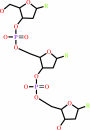 DNA(n)
|
+
|
2'-deoxyribonucleoside 5'-triphosphate
|
=
|
DNA(n+1)
|
+
|
 diphosphate
|
|
|
|
|
|
|
|
|
|
Enzyme class 3:
|
|
Chain A:
E.C.3.1.11.-
- ?????
|
|
|
|
|
|
|
Enzyme class 4:
|
|
Chain B:
E.C.?
|
|
|
|
|
|
|
|
|
|
Note, where more than one E.C. class is given (as above), each may
correspond to a different protein domain or, in the case of polyprotein
precursors, to a different mature protein.
|
|
|
|
Molecule diagrams generated from .mol files obtained from the
KEGG ftp site
|
|
|
|
|
|
|
|
|
|
|
|
|
|
 |
|
|
|
|
|
|
| |
|
|
| |
|
DOI no:
|
Nat Struct Mol Biol
11:784-790
(2004)
|
|
PubMed id:
|
|
|
|
|
|
| |
|
Nucleotide insertion opposite a cis-syn thymine dimer by a replicative DNA polymerase from bacteriophage T7.
|
|
Y.Li,
S.Dutta,
S.Doublié,
H.M.Bdour,
J.S.Taylor,
T.Ellenberger.
|
|
|
|
|
| |
ABSTRACT
|
|
|
|
| |
|
|
Ultraviolet-induced DNA damage poses a lethal block to replication. To
understand the structural basis for this, we determined crystal structures of a
replicative DNA polymerase from bacteriophage T7 in complex with nucleotide
substrates and a DNA template containing a cis-syn cyclobutane pyrimidine dimer
(CPD). When the 3' thymine is the templating base, the CPD is rotated out of the
polymerase active site and the fingers subdomain adopts an open orientation.
When the 5' thymine is the templating base, the CPD lies within the polymerase
active site where it base-pairs with the incoming nucleotide and the 3' base of
the primer, while the fingers are in a closed conformation. These structures
reveal the basis for the strong block of DNA replication that is caused by this
photolesion.
|
|
|
|
|
|
| |
Selected figure(s)
|
|
|
|
| |
|
|

|
|

|
|
Figure 1.
Figure 1. Positioning of the cis-syn thymine dimer in the T7 DNA
polymerase. (a) CPD-3'a complex, in which the CPD is rotated
by  90°
and lying outside of the polymerase active site. The fingers
domain is in an open conformation. (b) CPD-5'b complex, in which
the CPD is in the polymerase active site and it base-pairs with
the 3' base of the primer strand and the incoming nucleotide.
The fingers domain is in a closed conformation. (c) CPD-5'a
complex, in which the DNA slides back by one base pair and the
CPD curves back into the major grove of the duplex DNA. The
fingers domain is in an open conformation. The protein is shown
as surface representation. The DNA and nucleotide are
ball-and-stick models in which the backbone of the primer strand
is red and that of the template is light purple. The 5' base of
the cis-syn thymine dimer is magenta and the 3' base is light
magenta. The carbon atoms in the incoming nucleotide in b are
green and the Mg2+ ions are gold spheres. For clarity, the thumb
subdomain and the processivity factor E. coli thioredoxin were
removed from Figures 1,2,3. 90°
and lying outside of the polymerase active site. The fingers
domain is in an open conformation. (b) CPD-5'b complex, in which
the CPD is in the polymerase active site and it base-pairs with
the 3' base of the primer strand and the incoming nucleotide.
The fingers domain is in a closed conformation. (c) CPD-5'a
complex, in which the DNA slides back by one base pair and the
CPD curves back into the major grove of the duplex DNA. The
fingers domain is in an open conformation. The protein is shown
as surface representation. The DNA and nucleotide are
ball-and-stick models in which the backbone of the primer strand
is red and that of the template is light purple. The 5' base of
the cis-syn thymine dimer is magenta and the 3' base is light
magenta. The carbon atoms in the incoming nucleotide in b are
green and the Mg2+ ions are gold spheres. For clarity, the thumb
subdomain and the processivity factor E. coli thioredoxin were
removed from Figures 1,2,3.
|
|
Figure 4.
Figure 4. The cis-syn thymine dimer base pairs with ddATP in the
closed CPD-5'b complex. (a) View from the major groove side
of the duplex DNA. (b) The view in a has been rotated by 90°
along an axis (straight arrow). The 3' T of the CPD forms a
normal Watson-Crick base pair with the 3' base of the primer. A
twisted base pair is formed between the 5' T and the incoming
ddATP. The view in b shows the distorted stacking of the 5' T
base pair with that of the 3' T. The nucleic acids are in
ball-and-stick representation with the same color scheme used in
Figure 1.
|
|
|
|
|
|
| |
The above figures are
reprinted
by permission from Macmillan Publishers Ltd:
Nat Struct Mol Biol
(2004,
11,
784-790)
copyright 2004.
|
|
| |
Figures were
selected
by an automated process.
|
|
|
|
|
|
|
|
|
|
|
|
|
|
|
|
 |
 |
 |
|
Literature references that cite this PDB file's key reference
|
|
|
| |
PubMed id
|
|
Reference
|
|
|
|
|
|
N.Atanassova,
J.M.Fusté,
S.Wanrooij,
B.Macao,
S.Goffart,
S.Bäckström,
G.Farge,
I.Khvorostov,
N.G.Larsson,
J.N.Spelbrink,
and
M.Falkenberg
(2011).
Sequence-specific stalling of DNA polymerase γ and the effects of mutations causing progressive ophthalmoplegia.
|
| |
Hum Mol Genet,
20,
1212-1223.
|
|
|
|
|
|
|
R.Vasquez-Del Carpio,
T.D.Silverstein,
S.Lone,
R.E.Johnson,
L.Prakash,
S.Prakash,
and
A.K.Aggarwal
(2011).
Role of human DNA polymerase κ in extension opposite from a cis-syn thymine dimer.
|
| |
J Mol Biol,
408,
252-261.
|
|
|
PDB code:
|
|
|
|
|
|
|
|
C.Biertümpfel,
Y.Zhao,
Y.Kondo,
S.Ramón-Maiques,
M.Gregory,
J.Y.Lee,
C.Masutani,
A.R.Lehmann,
F.Hanaoka,
and
W.Yang
(2010).
Structure and mechanism of human DNA polymerase eta.
|
| |
Nature,
465,
1044-1048.
|
|
|
PDB codes:
|
|
|
|
|
|
|
|
M.T.Washington,
K.D.Carlson,
B.D.Freudenthal,
and
J.M.Pryor
(2010).
Variations on a theme: eukaryotic Y-family DNA polymerases.
|
| |
Biochim Biophys Acta,
1804,
1113-1123.
|
|
|
|
|
|
|
O.Ziv,
N.Geacintov,
S.Nakajima,
A.Yasui,
and
Z.Livneh
(2009).
DNA polymerase zeta cooperates with polymerases kappa and iota in translesion DNA synthesis across pyrimidine photodimers in cells from XPV patients.
|
| |
Proc Natl Acad Sci U S A,
106,
11552-11557.
|
|
|
|
|
|
|
W.A.Beard,
D.D.Shock,
V.K.Batra,
L.C.Pedersen,
and
S.H.Wilson
(2009).
DNA polymerase beta substrate specificity: side chain modulation of the "A-rule".
|
| |
J Biol Chem,
284,
31680-31689.
|
|
|
PDB codes:
|
|
|
|
|
|
|
|
J.C.Delaney,
and
J.M.Essigmann
(2008).
Biological properties of single chemical-DNA adducts: a twenty year perspective.
|
| |
Chem Res Toxicol,
21,
232-252.
|
|
|
|
|
|
|
V.K.Batra,
W.A.Beard,
D.D.Shock,
L.C.Pedersen,
and
S.H.Wilson
(2008).
Structures of DNA polymerase beta with active-site mismatches suggest a transient abasic site intermediate during misincorporation.
|
| |
Mol Cell,
30,
315-324.
|
|
|
PDB codes:
|
|
|
|
|
|
|
|
F.Brueckner,
U.Hennecke,
T.Carell,
and
P.Cramer
(2007).
CPD damage recognition by transcribing RNA polymerase II.
|
| |
Science,
315,
859-862.
|
|
|
PDB codes:
|
|
|
|
|
|
|
|
G.Luo,
M.Wang,
W.H.Konigsberg,
and
X.S.Xie
(2007).
Single-molecule and ensemble fluorescence assays for a functionally important conformational change in T7 DNA polymerase.
|
| |
Proc Natl Acad Sci U S A,
104,
12610-12615.
|
|
|
|
|
|
|
V.J.Cannistraro,
and
J.S.Taylor
(2007).
Ability of polymerase eta and T7 DNA polymerase to bypass bulge structures.
|
| |
J Biol Chem,
282,
11188-11196.
|
|
|
|
|
|
|
O.Rechkoblit,
L.Malinina,
Y.Cheng,
V.Kuryavyi,
S.Broyde,
N.E.Geacintov,
and
D.J.Patel
(2006).
Stepwise translocation of Dpo4 polymerase during error-free bypass of an oxoG lesion.
|
| |
PLoS Biol,
4,
e11.
|
|
|
PDB codes:
|
|
|
|
|
|
|
|
S.D.McCulloch,
and
T.A.Kunkel
(2006).
Multiple solutions to inefficient lesion bypass by T7 DNA polymerase.
|
| |
DNA Repair (Amst),
5,
1373-1383.
|
|
|
|
|
|
|
V.K.Batra,
D.D.Shock,
R.Prasad,
W.A.Beard,
E.W.Hou,
L.C.Pedersen,
J.M.Sayer,
H.Yagi,
S.Kumar,
D.M.Jerina,
and
S.H.Wilson
(2006).
Structure of DNA polymerase beta with a benzo[c]phenanthrene diol epoxide-adducted template exhibits mutagenic features.
|
| |
Proc Natl Acad Sci U S A,
103,
17231-17236.
|
|
|
PDB code:
|
|
|
|
|
|
|
|
W.Yang,
J.Y.Lee,
and
M.Nowotny
(2006).
Making and breaking nucleic acids: two-Mg2+-ion catalysis and substrate specificity.
|
| |
Mol Cell,
22,
5.
|
|
|
|
|
|
|
A.Vaisman,
H.Ling,
R.Woodgate,
and
W.Yang
(2005).
Fidelity of Dpo4: effect of metal ions, nucleotide selection and pyrophosphorolysis.
|
| |
EMBO J,
24,
2957-2967.
|
|
|
PDB codes:
|
|
|
|
|
|
|
|
L.G.Brieba,
R.J.Kokoska,
K.Bebenek,
T.A.Kunkel,
and
T.Ellenberger
(2005).
A lysine residue in the fingers subdomain of T7 DNA polymerase modulates the miscoding potential of 8-oxo-7,8-dihydroguanosine.
|
| |
Structure,
13,
1653-1659.
|
|
|
PDB code:
|
|
|
|
|
|
|
|
R.E.Johnson,
L.Prakash,
and
S.Prakash
(2005).
Distinct mechanisms of cis-syn thymine dimer bypass by Dpo4 and DNA polymerase eta.
|
| |
Proc Natl Acad Sci U S A,
102,
12359-12364.
|
|
|
|
|
|
|
S.Prakash,
R.E.Johnson,
and
L.Prakash
(2005).
Eukaryotic translesion synthesis DNA polymerases: specificity of structure and function.
|
| |
Annu Rev Biochem,
74,
317-353.
|
|
|
|
|
|
|
Z.M.Svedruzić,
C.Wang,
J.V.Kosmoski,
and
M.J.Smerdon
(2005).
Accommodation and repair of a UV photoproduct in DNA at different rotational settings on the nucleosome surface.
|
| |
J Biol Chem,
280,
40051-40057.
|
|
|
|
|
|
|
G.W.Hsu,
J.R.Kiefer,
D.Burnouf,
O.J.Becherel,
R.P.Fuchs,
and
L.S.Beese
(2004).
Observing translesion synthesis of an aromatic amine DNA adduct by a high-fidelity DNA polymerase.
|
| |
J Biol Chem,
279,
50280-50285.
|
|
|
PDB codes:
|
|
|
|
|
|
|
|
S.Dutta,
Y.Li,
D.Johnson,
L.Dzantiev,
C.C.Richardson,
L.J.Romano,
and
T.Ellenberger
(2004).
Crystal structures of 2-acetylaminofluorene and 2-aminofluorene in complex with T7 DNA polymerase reveal mechanisms of mutagenesis.
|
| |
Proc Natl Acad Sci U S A,
101,
16186-16191.
|
|
|
PDB codes:
|
|
|
|
|
|
|
The most recent references are shown first.
Citation data come partly from CiteXplore and partly
from an automated harvesting procedure. Note that this is likely to be
only a partial list as not all journals are covered by
either method. However, we are continually building up the citation data
so more and more references will be included with time.
Where a reference describes a PDB structure, the PDB
code is
shown on the right.
|
 |


 Links
Links


