 |
PDBsum entry 1s5j

|
|
|
|
|
 |
Contents |
 |
|
|
|
|
|
|
|
|
|
|
|
|
|
|
* Residue conservation analysis
|
|
|
|
|
|
PDB id:
|
|
|
|
| Name: |
|
Transferase
|
|
|
Title:
|
|
Insight in DNA replication: the crystal structure of DNA polymerase b1 from the archaeon sulfolobus solfataricus
|
|
Structure:
|
|
DNA polymerase i. Chain: a. Engineered: yes
|
|
Source:
|
|
Sulfolobus solfataricus. Organism_taxid: 2287. Strain: mt 4. Gene: dpo1, pols, sso0552. Expressed in: escherichia coli bl21(de3). Expression_system_taxid: 469008.
|
|
Resolution:
|
|
|
2.40Å
|
R-factor:
|
0.234
|
R-free:
|
0.272
|
|
|
Authors:
|
|
C.Savino,L.Federici,V.Nastopoulos,K.A.Johnson,F.M.Pisani,M.Rossi, D.Tsernoglou
|
Key ref:

|
|
C.Savino
et al.
(2004).
Insights into DNA replication: the crystal structure of DNA polymerase B1 from the archaeon Sulfolobus solfataricus.
Structure,
12,
2001-2008.
PubMed id:
DOI:

|
|
|
Date:
|
|
|
21-Jan-04
|
Release date:
|
09-Nov-04
|
|
|
|
|
|
|
PROCHECK
|

|
|
|
|
|
Headers
|
|
|
|
References
|
|
|
|
|
|

|
|
P26811
(DPOL1_SULSO) -
DNA polymerase 1 from Saccharolobus solfataricus (strain ATCC 35092 / DSM 1617 / JCM 11322 / P2)
|
|
|
|
Seq:
Struc:
|
|
|
|
882 a.a.
727 a.a.*
|
|

|

|

|
|
|
|
|
|
|
|
|
|
|
Key: |
|
 |
Secondary structure |
|
 |
CATH domain |
|
|
*
PDB and UniProt seqs differ
at 1 residue position (black
cross)
|
|
|
|
|
|
|
|
|
|
|
|
|
Enzyme class:
|
|
E.C.2.7.7.7
- DNA-directed Dna polymerase.
|
|
|
|
|
|
|
Reaction:
|
|
DNA(n) + a 2'-deoxyribonucleoside 5'-triphosphate = DNA(n+1) + diphosphate
|
|
|
|
|
|
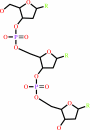 DNA(n)
|
+
|
2'-deoxyribonucleoside 5'-triphosphate
|
=
|
DNA(n+1)
|
+
|
 diphosphate
|
|
|
|
|
|
|
|
|
|
|
|
|
Molecule diagrams generated from .mol files obtained from the
KEGG ftp site
|
|
|
|
|
|
|
|
|
|
|
|
|
|
 |
|
|
|
|
|
|
| |
|
|
| |
|
DOI no:
|
Structure
12:2001-2008
(2004)
|
|
PubMed id:
|
|
|
|
|
|
| |
|
Insights into DNA replication: the crystal structure of DNA polymerase B1 from the archaeon Sulfolobus solfataricus.
|
|
C.Savino,
L.Federici,
K.A.Johnson,
B.Vallone,
V.Nastopoulos,
M.Rossi,
F.M.Pisani,
D.Tsernoglou.
|
|
|
|
|
| |
ABSTRACT
|
|
|
|
| |
|
|
To minimize the large number of mispairs during genome duplication owing to the
large amount of DNA to be synthesized, many replicative polymerases have
accessory domains with complementary functions. We describe the crystal
structure of replicative DNA polymerase B1 from the archaeon Sulfolobus
solfataricus. Comparison between other known structures indicates that although
the protein is folded into the typical N-terminal, editing 3'-5'exonuclease, and
C-terminal right-handed polymerase domains, it is characterized by the unusual
presence of two extra alpha helices in the N-terminal domain interacting with
the fingers helices to form an extended fingers subdomain, a structural feature
that can account for some functional features of the protein. We explore the
structural basis of specific lesion recognition, the initial step in DNA repair,
describing how the N-terminal subdomain pocket of archaeal DNA polymerases could
allow specific recognition of deaminated bases such as uracil and hypoxanthine
in addition to the typical DNA bases.
|
|
|
|
|
|
| |
Selected figure(s)
|
|
|
|
| |
|
|

|
|
Figure 4.
Figure 4. Modeling Deminated Bases into the Protein(A)
Uridine5'monophosphate (dUMP). It is possible to see the binding
between the R142 and the sulfate ion that mimics the phosphate
in the 5' position, the hydrogen bonds that fix the position of
R464 and N161 and would be expected to discriminate between
oxygen or amino group, i.e., uracil or cytosine base, and the
position of Y158, which could contribute to steric
discrimination against the thymine methyl group.(B)
Hypoxanthine. The oxygen in position 6 on hypoxanthine could be
recognized in same way as the oxygen in position 4 of uracil.
Only the hypoxanthine nucleoside is shown to highlight the
position of the sulfate ion. The dUMP and the hypoxanthine were
positioned manually to maximize hydrogen bonding and minimize
steric clashes.
|
|
|
|
|
|
| |
The above figure is
reprinted
by permission from Cell Press:
Structure
(2004,
12,
2001-2008)
copyright 2004.
|
|
| |
Figure was
selected
by an automated process.
|
|
|
|
|
|
|
|
|
|
|
|
|
|
|
|
 |
 |
 |
|
Literature references that cite this PDB file's key reference
|
|
|
| |
PubMed id
|
|
Reference
|
|
|
|
|
|
A.L.Mikheikin,
H.K.Lin,
P.Mehta,
L.Jen-Jacobson,
and
M.A.Trakselis
(2009).
A trimeric DNA polymerase complex increases the native replication processivity.
|
| |
Nucleic Acids Res,
37,
7194-7205.
|
|
|
|
|
|
|
I.B.Rogozin,
K.S.Makarova,
Y.I.Pavlov,
and
E.V.Koonin
(2008).
A highly conserved family of inactivated archaeal B family DNA polymerases.
|
| |
Biol Direct,
3,
32.
|
|
|
|
|
|
|
M.De Felice,
B.Medagli,
L.Esposito,
M.De Falco,
B.Pucci,
M.Rossi,
P.Grùz,
T.Nohmi,
and
F.M.Pisani
(2007).
Biochemical evidence of a physical interaction between Sulfolobus solfataricus B-family and Y-family DNA polymerases.
|
| |
Extremophiles,
11,
277-282.
|
|
|
|
|
|
|
M.Hogg,
P.Aller,
W.Konigsberg,
S.S.Wallace,
and
S.Doublié
(2007).
Structural and biochemical investigation of the role in proofreading of a beta hairpin loop found in the exonuclease domain of a replicative DNA polymerase of the B family.
|
| |
J Biol Chem,
282,
1432-1444.
|
|
|
PDB code:
|
|
|
|
|
|
|
|
G.Lipps
(2006).
Plasmids and viruses of the thermoacidophilic crenarchaeote Sulfolobus.
|
| |
Extremophiles,
10,
17-28.
|
|
|
|
|
|
|
I.G.Duggin,
and
S.D.Bell
(2006).
The chromosome replication machinery of the archaeon Sulfolobus solfataricus.
|
| |
J Biol Chem,
281,
15029-15032.
|
|
|
|
|
|
|
R.Shi,
A.Azzi,
C.Gilbert,
G.Boivin,
and
S.X.Lin
(2006).
Three-dimensional modeling of cytomegalovirus DNA polymerase and preliminary analysis of drug resistance.
|
| |
Proteins,
64,
301-307.
|
|
|
|
|
|
The most recent references are shown first.
Citation data come partly from CiteXplore and partly
from an automated harvesting procedure. Note that this is likely to be
only a partial list as not all journals are covered by
either method. However, we are continually building up the citation data
so more and more references will be included with time.
Where a reference describes a PDB structure, the PDB
code is
shown on the right.
|
|


 Links
Links


