
|
|
|
|
|
 |
Contents |
 |
|
|
|
|
|
|
|
|
|
|
|
|
* Residue conservation analysis
|
|
|
|
|
|
|
|
|
|
Enzyme class 1:
|
|
Chains A, B:
E.C.2.7.7.-
- ?????
|
|
|
|
|
|
|
Enzyme class 2:
|
|
Chains A, B:
E.C.2.7.7.49
- RNA-directed Dna polymerase.
|
|
|
|
|
|
|
Reaction:
|
|
DNA(n) + a 2'-deoxyribonucleoside 5'-triphosphate = DNA(n+1) + diphosphate
|
|
|
|
|
|
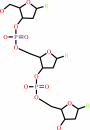 DNA(n)
|
+
|
2'-deoxyribonucleoside 5'-triphosphate
|
=
|
DNA(n+1)
Bound ligand (Het Group name = )
matches with 55.56% similarity
|
+
|
 diphosphate
|
|
|
|
|
|
|
|
|
|
Enzyme class 3:
|
|
Chains A, B:
E.C.2.7.7.7
- DNA-directed Dna polymerase.
|
|
|
|
|
|
|
Reaction:
|
|
DNA(n) + a 2'-deoxyribonucleoside 5'-triphosphate = DNA(n+1) + diphosphate
|
|
|
|
|
|
DNA(n)
|
+
|
2'-deoxyribonucleoside 5'-triphosphate
|
=
|
DNA(n+1)
Bound ligand (Het Group name = )
matches with 55.56% similarity
|
+
|
diphosphate
|
|
|
|
|
|
|
|
|
|
Enzyme class 4:
|
|
Chains A, B:
E.C.3.1.-.-
|
|
|
|
|
|
|
Enzyme class 5:
|
|
Chains A, B:
E.C.3.1.13.2
- exoribonuclease H.
|
|
|
|
|
|
|
Reaction:
|
|
Exonucleolytic cleavage to 5'-phosphomonoester oligonucleotides in both 5'- to 3'- and 3'- to 5'-directions.
|
|
|
|
|
|
Enzyme class 6:
|
|
Chains A, B:
E.C.3.1.26.13
- retroviral ribonuclease H.
|
|
|
|
|
|
|
Enzyme class 7:
|
|
Chains A, B:
E.C.3.4.23.16
- HIV-1 retropepsin.
|
|
|
|
|
|
|
Reaction:
|
|
Specific for a P1 residue that is hydrophobic, and P1' variable, but often Pro.
|
|
|
|
|
|
|
|
|
Note, where more than one E.C. class is given (as above), each may
correspond to a different protein domain or, in the case of polyprotein
precursors, to a different mature protein.
|
|
|
|
Molecule diagrams generated from .mol files obtained from the
KEGG ftp site
|
|
|
|
|
|
|
|
|
|
|
|
|
|
 |
|
|
|
|
|
|
| |
|
|
| |
|
DOI no:
|
J Mol Biol
336:569-578
(2004)
|
|
PubMed id:
|
|
|
|
|
|
| |
|
Crystal structures of HIV-1 reverse transcriptases mutated at codons 100, 106 and 108 and mechanisms of resistance to non-nucleoside inhibitors.
|
|
J.Ren,
C.E.Nichols,
P.P.Chamberlain,
K.L.Weaver,
S.A.Short,
D.K.Stammers.
|
|
|
|
|
| |
ABSTRACT
|
|
|
|
| |
|
|
Leu100Ile, Val106Ala and Val108Ile are mutations in HIV-1 reverse transcriptase
(RT) that are observed in the clinic and give rise to resistance to certain
non-nucleoside inhibitors (NNRTIs) including the first-generation drug
nevirapine. In order to investigate structural mechanisms of resistance for
different NNRTI classes we have determined six crystal structures of mutant
RT-inhibitor complexes. Val108 does not have direct contact with nevirapine in
wild-type RT and in the RT(Val108Ile) complex the biggest change observed is at
the distally positioned Tyr181 which is > 8 A from the mutation site. Thus in
contrast to most NNRTI resistance mutations RT(Val108Ile) appears to act via an
indirect mechanism which in this case is through alterations of the ring
stacking interactions of the drug particularly with Tyr181. Shifts in side-chain
and inhibitor positions compared to wild-type RT are observed in complexes of
nevirapine and the second-generation NNRTI UC-781 with RT(Leu100Ile) and
RT(Val106Ala), leading to perturbations in inhibitor contacts with Tyr181 and
Tyr188. Such perturbations are likely to be a factor contributing to the greater
loss of binding for nevirapine compared to UC-781 as, in the former case, a
larger proportion of binding energy is derived from aromatic ring stacking of
the inhibitor with the tyrosine side-chains. The differing resistance profiles
of first and second generation NNRTIs for other drug resistance mutations in RT
may also be in part due to this indirect mechanism.
|
|
|
|
|
|
| |
Selected figure(s)
|
|
|
|
| |
|
|

|
|

|
|
Figure 2.
Figure 2. Comparison of the NNRTI-binding sites of
wild-type and mutant HIV-1 RTs. a, Leu100Ile with nevirapine. b,
Leu100Ile with TNK-651. c, Leu100Ile and UC-781. The CA
backbones and side-chains are shown as thin and thick bonds,
coloured in orange and blue for wild-type and mutant RTs,
respectively. For clarity the inhibitors and the side-chains of
the corresponding mutation sites are coloured in red for
wild-type and cyan for mutant RTs.
|
|
Figure 3.
Figure 3. Comparison of the NNRTI-binding sites of
wild-type and mutant HIV-1 RTs with bound inhibitors. a,
Val106Ala with nevirapine; b, Val106Ala with UC-781; c,
Val108Ile with nevirapine. Colour coding is the same as for
Figure 2.
|
|
|
|
|
|
| |
The above figures are
reprinted
by permission from Elsevier:
J Mol Biol
(2004,
336,
569-578)
copyright 2004.
|
|
| |
Figures were
selected
by an automated process.
|
|
|
|
|
|
|
|
|
|
|
|
|
|
|
|
 |
 |
 |
|
Literature references that cite this PDB file's key reference
|
|
|
| |
PubMed id
|
|
Reference
|
|
|
|
|
|
A.Hachiya,
E.N.Kodama,
M.M.Schuckmann,
K.A.Kirby,
E.Michailidis,
Y.Sakagami,
S.Oka,
K.Singh,
and
S.G.Sarafianos
(2011).
K70Q adds high-level tenofovir resistance to "Q151M complex" HIV reverse transcriptase through the enhanced discrimination mechanism.
|
| |
PLoS One,
6,
e16242.
|
|
|
|
|
|
|
Z.Li,
H.Zhang,
Y.Li,
J.Zhang,
and
H.F.Chen
(2011).
Drug resistant mechanism of diaryltriazine analog inhibitors of HIV-1 reverse transcriptase using molecular dynamics simulation and 3D-QSAR.
|
| |
Chem Biol Drug Des,
77,
63-74.
|
|
|
|
|
|
|
K.Singh,
B.Marchand,
K.A.Kirby,
E.Michailidis,
and
S.G.Sarafianos
(2010).
Structural Aspects of Drug Resistance and Inhibition of HIV-1 Reverse Transcriptase.
|
| |
Viruses,
2,
606-638.
|
|
|
|
|
|
|
R.K.Raju,
N.A.Burton,
and
I.H.Hillier
(2010).
Modelling the binding of HIV-reverse transcriptase and nevirapine: an assessment of quantum mechanical and force field approaches and predictions of the effect of mutations on binding.
|
| |
Phys Chem Chem Phys,
12,
7117-7125.
|
|
|
|
|
|
|
S.G.Sarafianos,
B.Marchand,
K.Das,
D.M.Himmel,
M.A.Parniak,
S.H.Hughes,
and
E.Arnold
(2009).
Structure and function of HIV-1 reverse transcriptase: molecular mechanisms of polymerization and inhibition.
|
| |
J Mol Biol,
385,
693-713.
|
|
|
|
|
|
|
E.Magiorkinis,
D.Paraskevis,
H.Sambatakou,
P.Gargalianos,
C.Haida,
A.Vassilakis,
and
A.Hatzakis
(2008).
Emergence of an NNRTI resistance mutation Y181C in an HIV-infected NNRTI-naive patient.
|
| |
AIDS Res Hum Retroviruses,
24,
413-415.
|
|
|
|
|
|
|
K.Das,
J.D.Bauman,
A.D.Clark,
Y.V.Frenkel,
P.J.Lewi,
A.J.Shatkin,
S.H.Hughes,
and
E.Arnold
(2008).
High-resolution structures of HIV-1 reverse transcriptase/TMC278 complexes: strategic flexibility explains potency against resistance mutations.
|
| |
Proc Natl Acad Sci U S A,
105,
1466-1471.
|
|
|
PDB codes:
|
|
|
|
|
|
|
|
J.Ren,
C.E.Nichols,
A.Stamp,
P.P.Chamberlain,
R.Ferris,
K.L.Weaver,
S.A.Short,
and
D.K.Stammers
(2006).
Structural insights into mechanisms of non-nucleoside drug resistance for HIV-1 reverse transcriptases mutated at codons 101 or 138.
|
| |
FEBS J,
273,
3850-3860.
|
|
|
PDB codes:
|
|
|
|
|
|
|
|
Z.Zhang,
M.Walker,
W.Xu,
J.H.Shim,
J.L.Girardet,
R.K.Hamatake,
and
Z.Hong
(2006).
Novel nonnucleoside inhibitors that select nucleoside inhibitor resistance mutations in human immunodeficiency virus type 1 reverse transcriptase.
|
| |
Antimicrob Agents Chemother,
50,
2772-2781.
|
|
|
|
|
|
|
J.Ren,
and
D.K.Stammers
(2005).
HIV reverse transcriptase structures: designing new inhibitors and understanding mechanisms of drug resistance.
|
| |
Trends Pharmacol Sci,
26,
4-7.
|
|
|
|
|
|
The most recent references are shown first.
Citation data come partly from CiteXplore and partly
from an automated harvesting procedure. Note that this is likely to be
only a partial list as not all journals are covered by
either method. However, we are continually building up the citation data
so more and more references will be included with time.
Where a reference describes a PDB structure, the PDB
codes are
shown on the right.
|
 |


 Links
Links


