 |
PDBsum entry 1rdh

|
|
|
|
|
|

|

|

|

|
|

|
|
|
 |

|

|
|
|
|
|
|
|
|
|
|
|
|
|
|
|
|
|
|
|
|
|
|
|
|
|
|
|
|
|
|
Hydrolase(endoribonuclease)
|
PDB id
|
|
|
|
1rdh
|
|
|
|
|
|
|
|
|
|
|
|
|
|
|

|

|

|
|
|
|
|
|
|
|
 |
Contents |
 |
|
|
|
|
|
|
|
|
* Residue conservation analysis
|
|
* C-alpha coords only
|
|
|
|
|
|
|
|
|
|
|
Enzyme class 1:
|
|
E.C.2.7.7.-
- ?????
|
|
|
|
|
|
|
Enzyme class 2:
|
|
E.C.2.7.7.49
- RNA-directed Dna polymerase.
|
|
|
|
|
|
|
Reaction:
|
|
DNA(n) + a 2'-deoxyribonucleoside 5'-triphosphate = DNA(n+1) + diphosphate
|
|
|
|
|
|
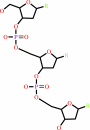 DNA(n)
|
+
|
2'-deoxyribonucleoside 5'-triphosphate
|
=
|
DNA(n+1)
|
+
|
 diphosphate
|
|
|
|
|
|
|
|
|
|
Enzyme class 3:
|
|
E.C.2.7.7.7
- DNA-directed Dna polymerase.
|
|
|
|
|
|
|
Reaction:
|
|
DNA(n) + a 2'-deoxyribonucleoside 5'-triphosphate = DNA(n+1) + diphosphate
|
|
|
|
|
|
DNA(n)
|
+
|
2'-deoxyribonucleoside 5'-triphosphate
|
=
|
DNA(n+1)
|
+
|
diphosphate
|
|
|
|
|
|
|
|
|
|
Enzyme class 4:
|
|
E.C.3.1.-.-
|
|
|
|
|
|
|
Enzyme class 5:
|
|
E.C.3.1.13.2
- exoribonuclease H.
|
|
|
|
|
|
|
Reaction:
|
|
Exonucleolytic cleavage to 5'-phosphomonoester oligonucleotides in both 5'- to 3'- and 3'- to 5'-directions.
|
|
|
|
|
|
Enzyme class 6:
|
|
E.C.3.1.26.13
- retroviral ribonuclease H.
|
|
|
|
|
|
|
Enzyme class 7:
|
|
E.C.3.4.23.16
- HIV-1 retropepsin.
|
|
|
|
|
|
|
Reaction:
|
|
Specific for a P1 residue that is hydrophobic, and P1' variable, but often Pro.
|
|
|
|
|
|
|
|
|
Note, where more than one E.C. class is given (as above), each may
correspond to a different protein domain or, in the case of polyprotein
precursors, to a different mature protein.
|
|
|
|
Molecule diagrams generated from .mol files obtained from the
KEGG ftp site
|
|
|
|
|
|
|
|
|
|
|
|
|
|
 |
|
|
|
|
|
|
| |
|
|
| |
|
DOI no:
|
Acta Crystallogr D Biol Crystallogr
49:423-427
(1993)
|
|
PubMed id:
|
|
|
|
|
|
| |
|
Crystallographic analyses of an active HIV-1 ribonuclease H domain show structural features that distinguish it from the inactive form.
|
|
D.Chattopadhyay,
B.C.Finzel,
S.H.Munson,
D.B.Evans,
S.K.Sharma,
N.A.Strakalaitus,
D.P.Brunner,
F.M.Eckenrode,
Z.Dauter,
C.Betzel,
H.M.Einspahr.
|
|
|
|
|
| |
ABSTRACT
|
|
|
|
| |
|
|
. An active recombinant preparation of the carboxy-terminal ribonuclease H
(RNase H) domain of HIV-I reverse transcriptase has produced crystals of several
different forms, including a trigonal prism form (P3(1); a = b = 52.03, c =
113.9 A with two molecules per asymmetric unit) and a hexagonal tablet form
(P6(2)22 or P6(4)22; a = b = 93.5, c = 74.1 A with one molecule per asymmetric
unit). The former appears to be isomorphous with crystals of a similar, but
inactive, version of the enzyme that was used for a prior crystal structure
determination [Davies, Hostomska, Hostomsky, Jordan & Matthews (1991).
Science, 252, 88-95]. We have also obtained a structure solution for this
crystal form and have refined it with 2.8 A resolution data (R = 0.216). We
report here details of our crystallization studies and some initial structural
results that verify that the preparation of active HIV-1 RNase H yields a
protein that is not just enzymatically, but also structurally, distinguishable
from the inactive form. Evidence suggests that region 538-542, which may be
involved in the catalytic site and which is disordered in both molecules in the
prior structure determination, is ordered in the crystal structure of the active
enzyme, although the ordering may include more than one conformation for this
loop. It should also be noted that, in the crystal structure of the trigonal
form, RNase H monomers associate to form noncrystallographic twofold-symmetric
dimers by fusing five-stranded mixed beta sheets into a single ten-stranded
dimerwide sheet, an assembly that was not remarked upon by previous
investigators.
|
|
|
|
|
|
| |
Selected figure(s)
|
|
|
|
| |
|
|

|
|
Figure 1.
Fig. 1. Stylized ribbon representations of the two HIV-1 RNase H domains found in the crystallographic asymmetric unit. The two dmains
are related by noncrystallographic twofold axis that is normal to the figure in view (a) and horizontal in the plane of the page in view
(b). The two monomers interact at the outermost strand (~3) of the five-stranded ~ sheet to form a single large sheet that spans both
domains. The position of His539 is indicated.
|
|
|
|
|
|
| |
The above figure is
reprinted
by permission from the IUCr:
Acta Crystallogr D Biol Crystallogr
(1993,
49,
423-427)
copyright 1993.
|
|
| |
Figure was
selected
by an automated process.
|
|
|
|
|
|
|
|
|
|
|
|
|
|
|
|
 |
 |
 |
|
Literature references that cite this PDB file's key reference
|
|
|
| |
PubMed id
|
|
Reference
|
|
|
|
|
|
K.E.Bushley,
and
B.G.Turgeon
(2010).
Phylogenomics reveals subfamilies of fungal nonribosomal peptide synthetases and their evolutionary relationships.
|
| |
BMC Evol Biol,
10,
26.
|
|
|
|
|
|
|
E.Arnold,
J.Ding,
S.H.Hughes,
and
Z.Hostomsky
(1995).
Structures of DNA and RNA polymerases and their interactions with nucleic acid substrates.
|
| |
Curr Opin Struct Biol,
5,
27-38.
|
|
|
|
|
|
|
J.Ding,
K.Das,
C.Tantillo,
W.Zhang,
A.D.Clark,
S.Jessen,
X.Lu,
Y.Hsiou,
A.Jacobo-Molina,
and
K.Andries
(1995).
Structure of HIV-1 reverse transcriptase in a complex with the non-nucleoside inhibitor alpha-APA R 95845 at 2.8 A resolution.
|
| |
Structure,
3,
365-379.
|
|
|
PDB code:
|
|
|
|
|
|
|
|
J.L.Keck,
and
S.Marqusee
(1995).
Substitution of a highly basic helix/loop sequence into the RNase H domain of human immunodeficiency virus reverse transcriptase restores its Mn(2+)-dependent RNase H activity.
|
| |
Proc Natl Acad Sci U S A,
92,
2740-2744.
|
|
|
|
|
|
|
A.G.Tomasselli,
J.L.Sarcich,
L.J.Barrett,
I.M.Reardon,
W.J.Howe,
D.B.Evans,
S.K.Sharma,
and
R.L.Heinrikson
(1993).
Human immunodeficiency virus type-1 reverse transcriptase and ribonuclease H as substrates of the viral protease.
|
| |
Protein Sci,
2,
2167-2176.
|
|
|
|
|
|
The most recent references are shown first.
Citation data come partly from CiteXplore and partly
from an automated harvesting procedure. Note that this is likely to be
only a partial list as not all journals are covered by
either method. However, we are continually building up the citation data
so more and more references will be included with time.
Where a reference describes a PDB structure, the PDB
code is
shown on the right.
|
|


 Links
Links


