
|
|
|
|
|
 |
Contents |
 |
|
|
|
|
|
|
|
|
|
|
* Residue conservation analysis
|
|
|
|
|
|
|
|
|
|
Enzyme class 1:
|
|
Chains A, B:
E.C.2.7.7.-
- ?????
|
|
|
|
|
|
|
Enzyme class 2:
|
|
Chains A, B:
E.C.2.7.7.49
- RNA-directed Dna polymerase.
|
|
|
|
|
|
|
Reaction:
|
|
DNA(n) + a 2'-deoxyribonucleoside 5'-triphosphate = DNA(n+1) + diphosphate
|
|
|
|
|
|
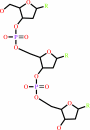 DNA(n)
|
+
|
2'-deoxyribonucleoside 5'-triphosphate
|
=
|
DNA(n+1)
|
+
|
 diphosphate
|
|
|
|
|
|
|
|
|
|
Enzyme class 3:
|
|
Chains A, B:
E.C.2.7.7.7
- DNA-directed Dna polymerase.
|
|
|
|
|
|
|
Reaction:
|
|
DNA(n) + a 2'-deoxyribonucleoside 5'-triphosphate = DNA(n+1) + diphosphate
|
|
|
|
|
|
DNA(n)
|
+
|
2'-deoxyribonucleoside 5'-triphosphate
|
=
|
DNA(n+1)
|
+
|
diphosphate
|
|
|
|
|
|
|
|
|
|
Enzyme class 4:
|
|
Chains A, B:
E.C.3.1.-.-
|
|
|
|
|
|
|
Enzyme class 5:
|
|
Chains A, B:
E.C.3.1.13.2
- exoribonuclease H.
|
|
|
|
|
|
|
Reaction:
|
|
Exonucleolytic cleavage to 5'-phosphomonoester oligonucleotides in both 5'- to 3'- and 3'- to 5'-directions.
|
|
|
|
|
|
Enzyme class 6:
|
|
Chains A, B:
E.C.3.1.26.13
- retroviral ribonuclease H.
|
|
|
|
|
|
|
Enzyme class 7:
|
|
Chains A, B:
E.C.3.4.23.16
- HIV-1 retropepsin.
|
|
|
|
|
|
|
Reaction:
|
|
Specific for a P1 residue that is hydrophobic, and P1' variable, but often Pro.
|
|
|
|
|
|
|
|
|
Note, where more than one E.C. class is given (as above), each may
correspond to a different protein domain or, in the case of polyprotein
precursors, to a different mature protein.
|
|
|
|
Molecule diagrams generated from .mol files obtained from the
KEGG ftp site
|
|
|
|
|
|
|
|
|
|
|
|
|
|
 |
|
|
|
|
|
|
| |
|
|
| |
|
DOI no:
|
Eur J Biochem
269:1670-1677
(2002)
|
|
PubMed id:
|
|
|
|
|
|
| |
|
Structural basis for the inhibitory efficacy of efavirenz (DMP-266), MSC194 and PNU142721 towards the HIV-1 RT K103N mutant.
|
|
J.Lindberg,
S.Sigurdsson,
S.Löwgren,
H.O.Andersson,
C.Sahlberg,
R.Noréen,
K.Fridborg,
H.Zhang,
T.Unge.
|
|
|
|
|
| |
ABSTRACT
|
|
|
|
| |
|
|
The K103N substitution is a frequently observed HIV-1 RT mutation in patients
who do not respond to combination-therapy. The drugs Efavirenz, MSC194 and
PNU142721 belong to the recent generation of NNRTIs characterized by an improved
resistance profile to the most common single point mutations within HIV-1 RT,
including the K103N mutation. In the present study we present structural
observations from Efavirenz in complex with wild-type protein and the K103N
mutant and PNU142721 and MSC194 in complex with the K103N mutant. The structures
unanimously indicate that the K103N substitution induces only minor positional
adjustments of the three inhibitors and the residues lining the binding pocket.
Thus, compared to the corresponding wild-type structures, these inhibitors bind
to the mutant in a conservative mode rather than through major rearrangements.
The structures implicate that the reduced inhibitory efficacy should be
attributed to the changes in the chemical environment in the vicinity of the
substituted N103 residue. This is supported by changes in hydrophobic and
electrostatic interactions to the inhibitors between wild-type and K103N mutant
complexes. These potent inhibitors accommodate to the K103N mutation by forming
new interactions to the N103 side chain. Our results are consistent with the
proposal by Hsiou et al. [Hsiou, Y., Ding, J., Das, K., Clark, A.D. Jr, Boyer,
P.L., Lewi, P., Janssen, P.A., Kleim, J.P., Rosner, M., Hughes, S.H. &
Arnold, E. (2001) J. Mol. Biol. 309, 437-445] that inhibitors with good activity
against the K103N mutant would be expected to have favorable interactions with
the mutant asparagines side chain, thereby compensating for resistance caused by
stabilization of the mutant enzyme due to a hydrogen-bond network involving the
N103 and Y188 side chains.
|
|
|
|
|
|
| |
Selected figure(s)
|
|
|
|
| |
|
|

|
|

|
|
Figure 1.
Fig. 1. Structures of NNRTIs. Chemical structure of the
NNRTIs (A) Efavirenz, (B) PNU142721, and (C) MSC194. Atom
numbering was included for clarification of Table 3 Go- . .
|
|
Figure 3.
Fig. 3. Superimposition of Efavirenz bound to wild-type
and K103N mutant RT NNIBPs. Stereoview of the superimposition of
Efavirenz bound to the NNIBP of wild-type RT and the K103N
mutant. Residue side chains characteristic of the NNIBP are
included from each inhibitor complex and colored green for
wild-type and maroon for the K103N mutant. The superimposition
was carried out using all atoms from the residues within 4.0
Å from the inhibitors (V189, K101, K103N, V179, Y181,
Y188, F227, W229, L234, H235, Y318 and E138).
|
|
|
|
|
|
| |
The above figures are
reprinted
by permission from the Federation of European Biochemical Societies:
Eur J Biochem
(2002,
269,
1670-1677)
copyright 2002.
|
|
| |
Figures were
selected
by an automated process.
|
|
|
|
|
|
|
|
|
|
|
|
|
|
|
|
 |
 |
 |
|
Literature references that cite this PDB file's key reference
|
|
|
| |
PubMed id
|
|
Reference
|
|
|
|
|
|
Z.Li,
H.Zhang,
Y.Li,
J.Zhang,
and
H.F.Chen
(2011).
Drug resistant mechanism of diaryltriazine analog inhibitors of HIV-1 reverse transcriptase using molecular dynamics simulation and 3D-QSAR.
|
| |
Chem Biol Drug Des,
77,
63-74.
|
|
|
|
|
|
|
A.G.Marcelin,
P.Flandre,
D.Descamps,
L.Morand-Joubert,
C.Charpentier,
J.Izopet,
M.A.Trabaud,
H.Saoudin,
C.Delaugerre,
C.Tamalet,
J.Cottalorda,
M.Bouvier-Alias,
D.Bettinger,
G.Dos Santos,
A.Ruffault,
C.Alloui,
C.Henquell,
S.Rogez,
F.Barin,
A.Signori-Schmuck,
S.Vallet,
B.Masquelier,
V.Calvez,
C.Alloui,
D.Bettinger,
G.Anies,
B.Masquelier,
S.Vallet,
C.Henquell,
M.Bouvier-Alias,
G.Dos Santos,
A.Signori-Schmuck,
S.Rogez,
P.Andre,
J.C.Tardy,
M.A.Trabaud,
C.Tamalet,
B.Montes,
J.Cottalorda,
D.Descamps,
F.Brun-Vézinet,
C.Charpentier,
M.L.Chaix,
S.Fourati,
A.G.Marcelin,
V.Calvez,
P.Flandre,
L.Morand-Joubert,
C.Delaugerre,
A.Ruffault,
A.Maillard,
T.Bourlet,
H.Saoudin,
J.Izopet,
F.Barin,
O.Bouchaud,
B.Hoen,
M.Dupon,
P.Morlat,
D.Neau,
M.Garré,
V.Bellein,
C.Jacomet,
Y.Lévy,
S.Dominguez,
A.Cabié,
P.Leclercq,
P.Weinbreck,
L.Cotte,
I.Poizot-Martin,
I.Ravaud,
J.Reynes,
P.Dellamonica,
P.Yeni,
R.Landman,
L.Weiss,
C.Piketty,
J.P.Viard,
C.Katlama,
A.Simon,
P.M.Girard,
J.L.Meynard,
J.M.Molina,
M.T.Goeger-Sow,
I.Lamaury,
C.Michelet,
F.Lucht,
B.Marchou,
P.Massip,
and
J.M.Besnier
(2010).
Factors associated with virological response to etravirine in nonnucleoside reverse transcriptase inhibitor-experienced HIV-1-infected patients.
|
| |
Antimicrob Agents Chemother,
54,
72-77.
|
|
|
|
|
|
|
A.J.Kandathil,
A.P.Joseph,
R.Kannangai,
N.Srinivasan,
O.C.Abraham,
S.A.Pulimood,
and
G.Sridharan
(2010).
HIV reverse transcriptase: Structural interpretation of drug resistant genetic variants from India.
|
| |
Bioinformation,
4,
36-45.
|
|
|
|
|
|
|
H.Gatanaga,
H.Ode,
A.Hachiya,
T.Hayashida,
H.Sato,
M.Takiguchi,
and
S.Oka
(2010).
Impact of human leukocyte antigen-B*51-restricted cytotoxic T-lymphocyte pressure on mutation patterns of nonnucleoside reverse transcriptase inhibitor resistance.
|
| |
AIDS,
24,
F15-F22.
|
|
|
|
|
|
|
H.Gatanaga,
H.Ode,
A.Hachiya,
T.Hayashida,
H.Sato,
and
S.Oka
(2010).
Combination of V106I and V179D polymorphic mutations in human immunodeficiency virus type 1 reverse transcriptase confers resistance to efavirenz and nevirapine but not etravirine.
|
| |
Antimicrob Agents Chemother,
54,
1596-1602.
|
|
|
|
|
|
|
H.P.Su,
Y.Yan,
G.S.Prasad,
R.F.Smith,
C.L.Daniels,
P.D.Abeywickrema,
J.C.Reid,
H.M.Loughran,
M.Kornienko,
S.Sharma,
J.A.Grobler,
B.Xu,
V.Sardana,
T.J.Allison,
P.D.Williams,
P.L.Darke,
D.J.Hazuda,
and
S.Munshi
(2010).
Structural basis for the inhibition of RNase H activity of HIV-1 reverse transcriptase by RNase H active site-directed inhibitors.
|
| |
J Virol,
84,
7625-7633.
|
|
|
PDB codes:
|
|
|
|
|
|
|
|
K.Singh,
B.Marchand,
K.A.Kirby,
E.Michailidis,
and
S.G.Sarafianos
(2010).
Structural Aspects of Drug Resistance and Inhibition of HIV-1 Reverse Transcriptase.
|
| |
Viruses,
2,
606-638.
|
|
|
|
|
|
|
V.A.Braz,
L.A.Holladay,
and
M.D.Barkley
(2010).
Efavirenz binding to HIV-1 reverse transcriptase monomers and dimers.
|
| |
Biochemistry,
49,
601-610.
|
|
|
|
|
|
|
S.E.Nichols,
R.A.Domaoal,
V.V.Thakur,
J.Tirado-Rives,
K.S.Anderson,
and
W.L.Jorgensen
(2009).
Discovery of wild-type and Y181C mutant non-nucleoside HIV-1 reverse transcriptase inhibitors using virtual screening with multiple protein structures.
|
| |
J Chem Inf Model,
49,
1272-1279.
|
|
|
|
|
|
|
Y.M.Loksha,
E.B.Pedersen,
R.Loddo,
and
P.La Colla
(2009).
Synthesis and anti-HIV-1 activity of 1-substiuted 6-(3-cyanobenzoyl) and [(3-cyanophenyl)fluoromethyl]-5-ethyl-uracils.
|
| |
Arch Pharm (Weinheim),
342,
501-506.
|
|
|
|
|
|
|
K.Das,
J.D.Bauman,
A.D.Clark,
Y.V.Frenkel,
P.J.Lewi,
A.J.Shatkin,
S.H.Hughes,
and
E.Arnold
(2008).
High-resolution structures of HIV-1 reverse transcriptase/TMC278 complexes: strategic flexibility explains potency against resistance mutations.
|
| |
Proc Natl Acad Sci U S A,
105,
1466-1471.
|
|
|
PDB codes:
|
|
|
|
|
|
|
|
M.Radi,
C.Falciani,
L.Contemori,
E.Petricci,
G.Maga,
A.Samuele,
S.Zanoli,
M.Terrazas,
M.Castria,
A.Togninelli,
J.A.Esté,
I.Clotet-Codina,
M.Armand-Ugón,
and
M.Botta
(2008).
A multidisciplinary approach for the identification of novel HIV-1 non-nucleoside reverse transcriptase inhibitors: S-DABOCs and DAVPs.
|
| |
ChemMedChem,
3,
573-593.
|
|
|
|
|
|
|
P.Srivab,
and
S.Hannongbua
(2008).
A study of the binding energies of efavirenz to wild-type and K103N/Y181C HIV-1 reverse transcriptase based on the ONIOM method.
|
| |
ChemMedChem,
3,
803-811.
|
|
|
|
|
|
|
J.Ren,
C.E.Nichols,
A.Stamp,
P.P.Chamberlain,
R.Ferris,
K.L.Weaver,
S.A.Short,
and
D.K.Stammers
(2006).
Structural insights into mechanisms of non-nucleoside drug resistance for HIV-1 reverse transcriptases mutated at codons 101 or 138.
|
| |
FEBS J,
273,
3850-3860.
|
|
|
PDB codes:
|
|
|
|
|
|
|
|
J.Ruan,
K.Chen,
J.A.Tuszynski,
and
L.A.Kurgan
(2006).
Quantitative analysis of the conservation of the tertiary structure of protein segments.
|
| |
Protein J,
25,
301-315.
|
|
|
|
|
|
|
Z.Zhang,
M.Zheng,
L.Du,
J.Shen,
X.Luo,
W.Zhu,
and
H.Jiang
(2006).
Towards discovering dual functional inhibitors against both wild type and K103N mutant HIV-1 reverse transcriptases: molecular docking and QSAR studies on 4,1-benzoxazepinone analogues.
|
| |
J Comput Aided Mol Des,
20,
281-293.
|
|
|
|
|
|
|
N.Sluis-Cremer,
N.A.Temiz,
and
I.Bahar
(2004).
Conformational changes in HIV-1 reverse transcriptase induced by nonnucleoside reverse transcriptase inhibitor binding.
|
| |
Curr HIV Res,
2,
323-332.
|
|
|
|
|
|
|
Y.Gao,
E.Paxinos,
J.Galovich,
R.Troyer,
H.Baird,
M.Abreha,
C.Kityo,
P.Mugyenyi,
C.Petropoulos,
and
E.J.Arts
(2004).
Characterization of a subtype D human immunodeficiency virus type 1 isolate that was obtained from an untreated individual and that is highly resistant to nonnucleoside reverse transcriptase inhibitors.
|
| |
J Virol,
78,
5390-5401.
|
|
|
|
|
|
|
A.Malmsten,
X.W.Shao,
K.Aperia,
G.E.Corrigan,
E.Sandström,
C.F.Källander,
T.Leitner,
and
J.S.Gronowitz
(2003).
HIV-1 viral load determination based on reverse transcriptase activity recovered from human plasma.
|
| |
J Med Virol,
71,
347-359.
|
|
|
|
|
|
|
L.Shen,
J.Shen,
X.Luo,
F.Cheng,
Y.Xu,
K.Chen,
E.Arnold,
J.Ding,
and
H.Jiang
(2003).
Steered molecular dynamics simulation on the binding of NNRTI to HIV-1 RT.
|
| |
Biophys J,
84,
3547-3563.
|
|
|
|
|
|
|
X.W.Shao,
A.Malmsten,
J.Lennerstrand,
A.Sönnerborg,
T.Unge,
J.S.Gronowitz,
and
C.F.Källander
(2003).
Use of HIV-1 reverse transcriptase recovered from human plasma for phenotypic drug susceptibility testing.
|
| |
AIDS,
17,
1463-1471.
|
|
|
|
|
|
The most recent references are shown first.
Citation data come partly from CiteXplore and partly
from an automated harvesting procedure. Note that this is likely to be
only a partial list as not all journals are covered by
either method. However, we are continually building up the citation data
so more and more references will be included with time.
Where a reference describes a PDB structure, the PDB
codes are
shown on the right.
|
 |


 Links
Links


