
|
|
|
|
|
 |
Contents |
 |
|
|
|
|
|
|
|
|
|
|
* Residue conservation analysis
|
|
|
|
|
|
|
|
|
|
Enzyme class 1:
|
|
Chains A, B:
E.C.2.7.7.-
- ?????
|
|
|
|
|
|
|
Enzyme class 2:
|
|
Chains A, B:
E.C.2.7.7.49
- RNA-directed Dna polymerase.
|
|
|
|
|
|
|
Reaction:
|
|
DNA(n) + a 2'-deoxyribonucleoside 5'-triphosphate = DNA(n+1) + diphosphate
|
|
|
|
|
|
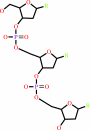 DNA(n)
|
+
|
2'-deoxyribonucleoside 5'-triphosphate
|
=
|
DNA(n+1)
|
+
|
 diphosphate
|
|
|
|
|
|
|
|
|
|
Enzyme class 3:
|
|
Chains A, B:
E.C.2.7.7.7
- DNA-directed Dna polymerase.
|
|
|
|
|
|
|
Reaction:
|
|
DNA(n) + a 2'-deoxyribonucleoside 5'-triphosphate = DNA(n+1) + diphosphate
|
|
|
|
|
|
DNA(n)
|
+
|
2'-deoxyribonucleoside 5'-triphosphate
|
=
|
DNA(n+1)
|
+
|
diphosphate
|
|
|
|
|
|
|
|
|
|
Enzyme class 4:
|
|
Chains A, B:
E.C.3.1.-.-
|
|
|
|
|
|
|
Enzyme class 5:
|
|
Chains A, B:
E.C.3.1.13.2
- exoribonuclease H.
|
|
|
|
|
|
|
Reaction:
|
|
Exonucleolytic cleavage to 5'-phosphomonoester oligonucleotides in both 5'- to 3'- and 3'- to 5'-directions.
|
|
|
|
|
|
Enzyme class 6:
|
|
Chains A, B:
E.C.3.1.26.13
- retroviral ribonuclease H.
|
|
|
|
|
|
|
Enzyme class 7:
|
|
Chains A, B:
E.C.3.4.23.16
- HIV-1 retropepsin.
|
|
|
|
|
|
|
Reaction:
|
|
Specific for a P1 residue that is hydrophobic, and P1' variable, but often Pro.
|
|
|
|
|
|
|
|
|
Note, where more than one E.C. class is given (as above), each may
correspond to a different protein domain or, in the case of polyprotein
precursors, to a different mature protein.
|
|
|
|
Molecule diagrams generated from .mol files obtained from the
KEGG ftp site
|
|
|
|
|
|
|
|
|
|
|
|
|
|
 |
|
|
|
|
|
|
| |
|
|
| |
|
DOI no:
|
J Mol Biol
309:437-445
(2001)
|
|
PubMed id:
|
|
|
|
|
|
| |
|
The Lys103Asn mutation of HIV-1 RT: a novel mechanism of drug resistance.
|
|
Y.Hsiou,
J.Ding,
K.Das,
A.D.Clark,
P.L.Boyer,
P.Lewi,
P.A.Janssen,
J.P.Kleim,
M.Rösner,
S.H.Hughes,
E.Arnold.
|
|
|
|
|
| |
ABSTRACT
|
|
|
|
| |
|
|
Inhibitors of human immunodeficiency virus (HIV) reverse transcriptase (RT) are
widely used in the treatment of HIV infection. Loviride (an alpha-APA
derivative) and HBY 097 (a quinoxaline derivative) are two potent non-nucleoside
RT inhibitors (NNRTIs) that have been used in human clinical trials. A major
problem for existing anti-retroviral therapy is the emergence of drug-resistant
mutants with reduced susceptibility to the inhibitors. Amino acid residue 103 in
the p66 subunit of HIV-1 RT is located near a putative entrance to a hydrophobic
pocket that binds NNRTIs. Substitution of asparagine for lysine at position 103
of HIV-1 RT is associated with the development of resistance to NNRTIs; this
mutation contributes to clinical failure of treatments employing NNRTIs. We have
determined the structures of the unliganded form of the Lys103Asn mutant HIV-1
RT and in complexes with loviride and HBY 097. The structures of wild-type and
Lys103Asn mutant HIV-1 RT in complexes with NNRTIs are quite similar overall as
well as in the vicinity of the bound NNRTIs. Comparison of unliganded wild-type
and Lys103Asn mutant HIV-1 RT structures reveals a network of hydrogen bonds in
the Lys103Asn mutant that is not present in the wild-type enzyme. Hydrogen bonds
in the unliganded Lys103Asn mutant but not in wild-type HIV-1 RT are observed
between (1) the side-chains of Asn103 and Tyr188 and (2) well-ordered water
molecules in the pocket and nearby pocket residues. The structural differences
between unliganded wild-type and Lys103Asn mutant HIV-1 RT may correspond to
stabilization of the closed-pocket form of the enzyme, which could interfere
with the ability of inhibitors to bind to the enzyme. These results are
consistent with kinetic data indicating that NNRTIs bind more slowly to
Lys103Asn mutant than to wild-type HIV-1 RT. This novel drug-resistance
mechanism explains the broad cross-resistance of Lys103Asn mutant HIV-1 RT to
different classes of NNRTIs. Design of NNRTIs that make favorable interactions
with the Asn103 side-chain should be relatively effective against the Lys103Asn
drug-resistant mutant.
|
|
|
|
|
|
| |
Selected figure(s)
|
|
|
|
| |
|
|

|
|

|
|
Figure 3.
Figure 3. Stereoview of a SIGMAA weighted 2mFo
-
DFc difference Fourier map showing the electron density in
the NNIBP region of p66 in the unliganded Lys103Asn mutant HIV-1 RT structure. The phases were computed from
the final model at 2.7 Å resolution and the map was contoured at 2s. Selected hydrogen-bonding interactions are
indicated with broken lines.
|
|
Figure 4.
Figure 4. Energy diagram for the binding of an
NNRTI to wild-type and Lys103Asn mutant RT. The
Lys103Asn mutant RT with the additional hydrogen
bonding network in the NNIBP region is assumed to be
more stable than wild-type HIV-1 RT. The relative stab-
ility of wild-type and Lys103Asn mutant HIV-1 RT com-
plexes with NNRTIs will depend on the inhibitor.
|
|
|
|
|
|
| |
The above figures are
reprinted
by permission from Elsevier:
J Mol Biol
(2001,
309,
437-445)
copyright 2001.
|
|
| |
Figures were
selected
by an automated process.
|
|
|
|
|
|
|
|
|
|
|
|
|
|
|
|
 |
 |
 |
|
Literature references that cite this PDB file's key reference
|
|
|
| |
PubMed id
|
|
Reference
|
|
|
|
|
|
P.Decha,
P.Intharathep,
T.Udommaneethanakit,
P.Sompornpisut,
S.Hannongbua,
P.Wolschann,
and
V.Parasuk
(2011).
Theoretical studies on the molecular basis of HIV-1RT/NNRTIs interactions.
|
| |
J Enzyme Inhib Med Chem,
26,
29-36.
|
|
|
|
|
|
|
S.Ibe,
and
W.Sugiura
(2011).
Clinical significance of HIV reverse-transcriptase inhibitor-resistance mutations.
|
| |
Future Microbiol,
6,
295-315.
|
|
|
|
|
|
|
A.Herschhorn,
and
A.Hizi
(2010).
Retroviral reverse transcriptases.
|
| |
Cell Mol Life Sci,
67,
2717-2747.
|
|
|
|
|
|
|
G.N.Nikolenko,
K.A.Delviks-Frankenberry,
and
V.K.Pathak
(2010).
A novel molecular mechanism of dual resistance to nucleoside and nonnucleoside reverse transcriptase inhibitors.
|
| |
J Virol,
84,
5238-5249.
|
|
|
|
|
|
|
H.T.Xu,
M.Oliveira,
Y.Quan,
T.Bar-Magen,
and
M.A.Wainberg
(2010).
Differential impact of the HIV-1 non-nucleoside reverse transcriptase inhibitor mutations K103N and M230L on viral replication and enzyme function.
|
| |
J Antimicrob Chemother,
65,
2291-2299.
|
|
|
|
|
|
|
J.Zhang,
T.Hou,
W.Wang,
and
J.S.Liu
(2010).
Detecting and understanding combinatorial mutation patterns responsible for HIV drug resistance.
|
| |
Proc Natl Acad Sci U S A,
107,
1321-1326.
|
|
|
|
|
|
|
K.A.Delviks-Frankenberry,
G.N.Nikolenko,
and
V.K.Pathak
(2010).
The "Connection" Between HIV Drug Resistance and RNase H.
|
| |
Viruses,
2,
1476-1503.
|
|
|
|
|
|
|
K.Singh,
B.Marchand,
K.A.Kirby,
E.Michailidis,
and
S.G.Sarafianos
(2010).
Structural Aspects of Drug Resistance and Inhibition of HIV-1 Reverse Transcriptase.
|
| |
Viruses,
2,
606-638.
|
|
|
|
|
|
|
R.K.Raju,
N.A.Burton,
and
I.H.Hillier
(2010).
Modelling the binding of HIV-reverse transcriptase and nevirapine: an assessment of quantum mechanical and force field approaches and predictions of the effect of mutations on binding.
|
| |
Phys Chem Chem Phys,
12,
7117-7125.
|
|
|
|
|
|
|
N.S.Sapre,
S.Gupta,
N.Pancholi,
and
N.Sapre
(2009).
A group center overlap based approach for "3D QSAR" studies on TIBO derivatives.
|
| |
J Comput Chem,
30,
922-933.
|
|
|
|
|
|
|
S.G.Sarafianos,
B.Marchand,
K.Das,
D.M.Himmel,
M.A.Parniak,
S.H.Hughes,
and
E.Arnold
(2009).
Structure and function of HIV-1 reverse transcriptase: molecular mechanisms of polymerization and inhibition.
|
| |
J Mol Biol,
385,
693-713.
|
|
|
|
|
|
|
M.Radi,
C.Falciani,
L.Contemori,
E.Petricci,
G.Maga,
A.Samuele,
S.Zanoli,
M.Terrazas,
M.Castria,
A.Togninelli,
J.A.Esté,
I.Clotet-Codina,
M.Armand-Ugón,
and
M.Botta
(2008).
A multidisciplinary approach for the identification of novel HIV-1 non-nucleoside reverse transcriptase inhibitors: S-DABOCs and DAVPs.
|
| |
ChemMedChem,
3,
573-593.
|
|
|
|
|
|
|
P.Srivab,
and
S.Hannongbua
(2008).
A study of the binding energies of efavirenz to wild-type and K103N/Y181C HIV-1 reverse transcriptase based on the ONIOM method.
|
| |
ChemMedChem,
3,
803-811.
|
|
|
|
|
|
|
F.Ceccherini-Silberstein,
V.Svicher,
T.Sing,
A.Artese,
M.M.Santoro,
F.Forbici,
A.Bertoli,
S.Alcaro,
G.Palamara,
A.d'Arminio Monforte,
J.Balzarini,
A.Antinori,
T.Lengauer,
and
C.F.Perno
(2007).
Characterization and structural analysis of novel mutations in human immunodeficiency virus type 1 reverse transcriptase involved in the regulation of resistance to nonnucleoside inhibitors.
|
| |
J Virol,
81,
11507-11519.
|
|
|
|
|
|
|
R.K.Gupta,
and
D.Pillay
(2007).
HIV resistance and the developing world.
|
| |
Int J Antimicrob Agents,
29,
510-517.
|
|
|
|
|
|
|
S.Sungkanuparph,
W.Manosuthi,
S.Kiertiburanakul,
B.Piyavong,
N.Chumpathat,
and
W.Chantratita
(2007).
Options for a second-line antiretroviral regimen for HIV type 1-infected patients whose initial regimen of a fixed-dose combination of stavudine, lamivudine, and nevirapine fails.
|
| |
Clin Infect Dis,
44,
447-452.
|
|
|
|
|
|
|
Y.El Safadi,
V.Vivet-Boudou,
and
R.Marquet
(2007).
HIV-1 reverse transcriptase inhibitors.
|
| |
Appl Microbiol Biotechnol,
75,
723-737.
|
|
|
|
|
|
|
A.Figueiredo,
K.L.Moore,
J.Mak,
N.Sluis-Cremer,
M.P.de Bethune,
and
G.Tachedjian
(2006).
Potent nonnucleoside reverse transcriptase inhibitors target HIV-1 Gag-Pol.
|
| |
PLoS Pathog,
2,
e119.
|
|
|
|
|
|
|
E.P.Tchesnokov,
C.Gilbert,
G.Boivin,
and
M.Götte
(2006).
Role of helix P of the human cytomegalovirus DNA polymerase in resistance and hypersusceptibility to the antiviral drug foscarnet.
|
| |
J Virol,
80,
1440-1450.
|
|
|
|
|
|
|
J.Ren,
C.E.Nichols,
A.Stamp,
P.P.Chamberlain,
R.Ferris,
K.L.Weaver,
S.A.Short,
and
D.K.Stammers
(2006).
Structural insights into mechanisms of non-nucleoside drug resistance for HIV-1 reverse transcriptases mutated at codons 101 or 138.
|
| |
FEBS J,
273,
3850-3860.
|
|
|
PDB codes:
|
|
|
|
|
|
|
|
R.Di Santo,
R.Costi,
M.Artico,
G.Miele,
A.Lavecchia,
E.Novellino,
A.Bergamini,
R.Cancio,
and
G.Maga
(2006).
Arylthiopyrrole (AThP) derivatives as non-nucleoside HIV-1 reverse transcriptase inhibitors: synthesis, structure-activity relationships, and docking studies (part 1).
|
| |
ChemMedChem,
1,
1367-1378.
|
|
|
|
|
|
|
J.Ren,
and
D.K.Stammers
(2005).
HIV reverse transcriptase structures: designing new inhibitors and understanding mechanisms of drug resistance.
|
| |
Trends Pharmacol Sci,
26,
4-7.
|
|
|
|
|
|
|
S.Saen-oon,
M.Kuno,
and
S.Hannongbua
(2005).
Binding energy analysis for wild-type and Y181C mutant HIV-1 RT/8-Cl TIBO complex structures: quantum chemical calculations based on the ONIOM method.
|
| |
Proteins,
61,
859-869.
|
|
|
|
|
|
|
Y.Mei,
X.He,
Y.Xiang,
D.W.Zhang,
and
J.Z.Zhang
(2005).
Quantum study of mutational effect in binding of efavirenz to HIV-1 RT.
|
| |
Proteins,
59,
489-495.
|
|
|
|
|
|
|
G.Tachedjian,
and
A.Mijch
(2004).
Virological significance, prevalence and genetic basis of hypersusceptibility to nonnucleoside reverse transcriptase inhibitors.
|
| |
Sex Health,
1,
81-89.
|
|
|
|
|
|
|
J.D.Pata,
W.G.Stirtan,
S.W.Goldstein,
and
T.A.Steitz
(2004).
Structure of HIV-1 reverse transcriptase bound to an inhibitor active against mutant reverse transcriptases resistant to other nonnucleoside inhibitors.
|
| |
Proc Natl Acad Sci U S A,
101,
10548-10553.
|
|
|
PDB code:
|
|
|
|
|
|
|
|
M.C.St-Louis,
M.Cojocariu,
and
D.Archambault
(2004).
The molecular biology of bovine immunodeficiency virus: a comparison with other lentiviruses.
|
| |
Anim Health Res Rev,
5,
125-143.
|
|
|
|
|
|
|
M.D.Miller,
and
D.J.Hazuda
(2004).
HIV resistance to the fusion inhibitor enfuvirtide: mechanisms and clinical implications.
|
| |
Drug Resist Updat,
7,
89-95.
|
|
|
|
|
|
|
M.Götte
(2004).
Inhibition of HIV-1 reverse transcription: basic principles of drug action and resistance.
|
| |
Expert Rev Anti Infect Ther,
2,
707-716.
|
|
|
|
|
|
|
N.Sluis-Cremer,
N.A.Temiz,
and
I.Bahar
(2004).
Conformational changes in HIV-1 reverse transcriptase induced by nonnucleoside reverse transcriptase inhibitor binding.
|
| |
Curr HIV Res,
2,
323-332.
|
|
|
|
|
|
|
J.L.Jeffrey,
J.Y.Feng,
C.C.Qi,
K.S.Anderson,
and
P.A.Furman
(2003).
Dioxolane guanosine 5'-triphosphate, an alternative substrate inhibitor of wild-type and mutant HIV-1 reverse transcriptase. Steady state and pre-steady state kinetic analyses.
|
| |
J Biol Chem,
278,
18971-18979.
|
|
|
|
|
|
|
L.Shen,
J.Shen,
X.Luo,
F.Cheng,
Y.Xu,
K.Chen,
E.Arnold,
J.Ding,
and
H.Jiang
(2003).
Steered molecular dynamics simulation on the binding of NNRTI to HIV-1 RT.
|
| |
Biophys J,
84,
3547-3563.
|
|
|
|
|
|
|
M.S.Hirsch,
F.Brun-Vézinet,
B.Clotet,
B.Conway,
D.R.Kuritzkes,
R.T.D'Aquila,
L.M.Demeter,
S.M.Hammer,
V.A.Johnson,
C.Loveday,
J.W.Mellors,
D.M.Jacobsen,
and
D.D.Richman
(2003).
Antiretroviral drug resistance testing in adults infected with human immunodeficiency virus type 1: 2003 recommendations of an International AIDS Society-USA Panel.
|
| |
Clin Infect Dis,
37,
113-128.
|
|
|
|
|
|
|
J.Lindberg,
S.Sigurdsson,
S.Löwgren,
H.O.Andersson,
C.Sahlberg,
R.Noréen,
K.Fridborg,
H.Zhang,
and
T.Unge
(2002).
Structural basis for the inhibitory efficacy of efavirenz (DMP-266), MSC194 and PNU142721 towards the HIV-1 RT K103N mutant.
|
| |
Eur J Biochem,
269,
1670-1677.
|
|
|
PDB codes:
|
|
|
|
|
|
|
|
N.A.Temiz,
and
I.Bahar
(2002).
Inhibitor binding alters the directions of domain motions in HIV-1 reverse transcriptase.
|
| |
Proteins,
49,
61-70.
|
|
|
|
|
|
|
R.W.Shafer
(2002).
Genotypic testing for human immunodeficiency virus type 1 drug resistance.
|
| |
Clin Microbiol Rev,
15,
247-277.
|
|
|
|
|
|
The most recent references are shown first.
Citation data come partly from CiteXplore and partly
from an automated harvesting procedure. Note that this is likely to be
only a partial list as not all journals are covered by
either method. However, we are continually building up the citation data
so more and more references will be included with time.
Where a reference describes a PDB structure, the PDB
codes are
shown on the right.
|
 |


 Links
Links


