 |
PDBsum entry 1har

|
|
|
|
|
|

|

|

|

|
|

|
|

|
|
|
 |

|

|
|
|
|
|
|
|
|
|
|
|
|
|
|
|
|
|
|
|
|
|
|
|
|
|
|
|
|
|
|
|
Viral protein, transferase
|
PDB id
|
|
|
|
1har
|
|
|
|
|
|
|
|
|
|
|
|
|
|
|

|

|

|
|
|
|
|
|
|
|
 |
Contents |
 |
|
|
|
|
|
|
|
|
|
|
* Residue conservation analysis
|
|
|
|
|
|
|
|
|
|
|
Enzyme class 1:
|
|
E.C.2.7.7.-
- ?????
|
|
|
|
|
|
|
Enzyme class 2:
|
|
E.C.2.7.7.49
- RNA-directed Dna polymerase.
|
|
|
|
|
|
|
Reaction:
|
|
DNA(n) + a 2'-deoxyribonucleoside 5'-triphosphate = DNA(n+1) + diphosphate
|
|
|
|
|
|
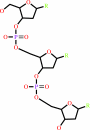 DNA(n)
|
+
|
2'-deoxyribonucleoside 5'-triphosphate
|
=
|
DNA(n+1)
|
+
|
 diphosphate
|
|
|
|
|
|
|
|
|
|
Enzyme class 3:
|
|
E.C.2.7.7.7
- DNA-directed Dna polymerase.
|
|
|
|
|
|
|
Reaction:
|
|
DNA(n) + a 2'-deoxyribonucleoside 5'-triphosphate = DNA(n+1) + diphosphate
|
|
|
|
|
|
DNA(n)
|
+
|
2'-deoxyribonucleoside 5'-triphosphate
|
=
|
DNA(n+1)
|
+
|
diphosphate
|
|
|
|
|
|
|
|
|
|
Enzyme class 4:
|
|
E.C.3.1.-.-
|
|
|
|
|
|
|
Enzyme class 5:
|
|
E.C.3.1.13.2
- exoribonuclease H.
|
|
|
|
|
|
|
Reaction:
|
|
Exonucleolytic cleavage to 5'-phosphomonoester oligonucleotides in both 5'- to 3'- and 3'- to 5'-directions.
|
|
|
|
|
|
Enzyme class 6:
|
|
E.C.3.1.26.13
- retroviral ribonuclease H.
|
|
|
|
|
|
|
Enzyme class 7:
|
|
E.C.3.4.23.16
- HIV-1 retropepsin.
|
|
|
|
|
|
|
Reaction:
|
|
Specific for a P1 residue that is hydrophobic, and P1' variable, but often Pro.
|
|
|
|
|
|
|
|
|
Note, where more than one E.C. class is given (as above), each may
correspond to a different protein domain or, in the case of polyprotein
precursors, to a different mature protein.
|
|
|
|
Molecule diagrams generated from .mol files obtained from the
KEGG ftp site
|
|
|
|
|
|
|
|
|
|
|
|
|
|
 |
|
|
|
|
|
|
| |
|
|
| |
|
DOI no:
|
Structure
2:953-961
(1994)
|
|
PubMed id:
|
|
|
|
|
|
| |
|
2.2 A resolution structure of the amino-terminal half of HIV-1 reverse transcriptase (fingers and palm subdomains).
|
|
T.Unge,
S.Knight,
R.Bhikhabhai,
S.Lövgren,
Z.Dauter,
K.Wilson,
B.Strandberg.
|
|
|
|
|
| |
ABSTRACT
|
|
|
|
| |
|
|
BACKGROUND: HIV-1 reverse transcriptase (RT) catalyzes the transformation of
single-stranded viral RNA into double-stranded DNA, which is integrated into
host cell chromosomes. The molecule is a heterodimer of two subunits, p51 and
p66. The amino acid sequence of p51 is identical to the sequence of the
amino-terminal subdomains of p66. Earlier crystallographic studies indicate that
the RT molecule is flexible, which may explain the difficulty in obtaining
high-resolution data for the intact protein. We have therefore determined the
structure of a fragment of RT (RT216), which contains only the amino-terminal
half of the RT molecule ('finger' and 'palm' subdomains). RESULTS: The crystal
structure of RT216 has been refined at 2.2 A resolution to a crystallographic
R-value of 20.8%. The structure is very similar to that of the corresponding
part of the p66 subunit in the p66/p51 heterodimer, although there is a small
difference in the relative orientation of the two subdomains compared with the
structure of an RT-DNA-antibody fragment complex. There are a large number of
stabilizing contacts (mainly hydrogen bonds and hydrophobic interactions)
between the subdomains. The locations of conserved amino acids and the position
of some important drug-resistant mutations are described. CONCLUSIONS: The RT216
structure provides detailed three-dimensional information of one important part
of HIV-1 RT (including the critical active site residues). We propose a model to
explain the inhibitory effect of non-nucleoside inhibitors, which partially
accounts for their effect in terms of conformational changes of active site
residues.
|
|
|
|
|
|
| |
Selected figure(s)
|
|
|
|
| |
|
|

|
|

|
|
Figure 2.
Figure 2. The fold of RT216. The names and colours of the
subdomains, fingers (blue) and palm (red), and the enumeration
of the secondary structure elements follow the nomenclature used
for the structure of HIV-1 RT complexed with nevirapine [1] and
with DNA and an antibody fragment [5]. The β-strands are
marked 0 to 11a and helices are labelled A to F. Two loops
which have not been modelled are coloured grey and are located
between strands β 3 and β 4 (residues 64–71) and strands β
5a–β 6 (residues 94–104). This drawing and Figure 5 were
prepared using the program MOLSCRIPT [22]. Figure 2. The
fold of RT216. The names and colours of the subdomains, fingers
(blue) and palm (red), and the enumeration of the secondary
structure elements follow the nomenclature used for the
structure of HIV-1 RT complexed with nevirapine [[3]1] and with
DNA and an antibody fragment [[4]5]. The β-strands are marked 0
to 11a and helices are labelled A to F. Two loops which have not
been modelled are coloured grey and are located between strands
β 3 and β 4 (residues 64–71) and strands β 5a–β 6
(residues 94–104). This drawing and [5]Figure 5 were prepared
using the program MOLSCRIPT [[6]22].
|
|
Figure 3.
Figure 3. Stereoviews depicting some interactions of particular
interest in the RT216 structure. (a) The interface between the
palm and the fingers subdomains. The Cαtrace of RT216 is shown
together with side chains in the hydrophobic core between the
two subdomains. (b) The side chain of Lys73 at the amino
terminus of strand β 4 iscompletely buried in a hydrophobic
environment where it makes a hydrogen bond to the side chain of
Tyr146. This interaction could be important for anchoring the
β 3–β 4 loop. Figure 3. Stereoviews depicting some
interactions of particular interest in the RT216 structure. (a)
The interface between the palm and the fingers subdomains. The
Cαtrace of RT216 is shown together with side chains in the
hydrophobic core between the two subdomains. (b) The side chain
of Lys73 at the amino terminus of strand β 4 iscompletely
buried in a hydrophobic environment where it makes a hydrogen
bond to the side chain of Tyr146. This interaction could be
important for anchoring the β 3–β 4 loop.
|
|
|
|
|
|
| |
The above figures are
reprinted
by permission from Cell Press:
Structure
(1994,
2,
953-961)
copyright 1994.
|
|
| |
Figures were
selected
by an automated process.
|
|
|
|
|
|
|
|
|
|
|
|
|
|
|
|
 |
 |
 |
|
Literature references that cite this PDB file's key reference
|
|
|
| |
PubMed id
|
|
Reference
|
|
|
|
|
|
K.Singh,
B.Marchand,
K.A.Kirby,
E.Michailidis,
and
S.G.Sarafianos
(2010).
Structural Aspects of Drug Resistance and Inhibition of HIV-1 Reverse Transcriptase.
|
| |
Viruses,
2,
606-638.
|
|
|
|
|
|
|
M.Rho,
and
H.Tang
(2009).
MGEScan-non-LTR: computational identification and classification of autonomous non-LTR retrotransposons in eukaryotic genomes.
|
| |
Nucleic Acids Res,
37,
e143.
|
|
|
|
|
|
|
A.Láng,
I.G.Csizmadia,
and
A.Perczel
(2005).
Peptide models XLV: conformational properties of N-formyl-L-methioninamide and its relevance to methionine in proteins.
|
| |
Proteins,
58,
571-588.
|
|
|
|
|
|
|
E.A.Hehl,
P.Joshi,
G.V.Kalpana,
and
V.R.Prasad
(2004).
Interaction between human immunodeficiency virus type 1 reverse transcriptase and integrase proteins.
|
| |
J Virol,
78,
5056-5067.
|
|
|
|
|
|
|
J.Borge,
C.Alvarez-Rúa,
and
S.García-Granda
(2000).
A new vector-search rotation function: image-seeking functions revisited in macromolecular crystallography.
|
| |
Acta Crystallogr D Biol Crystallogr,
56,
735-746.
|
|
|
|
|
|
|
J.Jäger,
and
J.D.Pata
(1999).
Getting a grip: polymerases and their substrate complexes.
|
| |
Curr Opin Struct Biol,
9,
21-28.
|
|
|
|
|
|
|
D.Sun,
S.Jessen,
C.Liu,
X.Liu,
S.Najmudin,
and
M.M.Georgiadis
(1998).
Cloning, expression, and purification of a catalytic fragment of Moloney murine leukemia virus reverse transcriptase: crystallization of nucleic acid complexes.
|
| |
Protein Sci,
7,
1575-1582.
|
|
|
|
|
|
|
J.L.Hansen,
A.M.Long,
and
S.C.Schultz
(1997).
Structure of the RNA-dependent RNA polymerase of poliovirus.
|
| |
Structure,
5,
1109-1122.
|
|
|
PDB code:
|
|
|
|
|
|
|
|
K.Bebenek,
W.A.Beard,
T.A.Darden,
L.Li,
R.Prasad,
B.A.Luton,
D.G.Gorenstein,
S.H.Wilson,
and
T.A.Kunkel
(1997).
A minor groove binding track in reverse transcriptase.
|
| |
Nat Struct Biol,
4,
194-197.
|
|
|
|
|
|
|
De Clercq E
(1996).
What can be Expected from Non-nucleoside Reverse Transcriptase Inhibitors (NNRTIs) in the Treatment of Human Immunodeficiency Virus Type 1 (HIV-1) Infections?
|
| |
Rev Med Virol,
6,
97.
|
|
|
|
|
|
|
G.Bujacz,
M.Jaskólski,
J.Alexandratos,
A.Wlodawer,
G.Merkel,
R.A.Katz,
and
A.M.Skalka
(1996).
The catalytic domain of avian sarcoma virus integrase: conformation of the active-site residues in the presence of divalent cations.
|
| |
Structure,
4,
89-96.
|
|
|
PDB codes:
|
|
|
|
|
|
|
|
S.H.Hughes,
Z.Hostomsky,
S.F.Le Grice,
K.Lentz,
and
E.Arnold
(1996).
What is the orientation of DNA polymerases on their templates?
|
| |
J Virol,
70,
2679-2683.
|
|
|
|
|
|
|
E.Arnold,
J.Ding,
S.H.Hughes,
and
Z.Hostomsky
(1995).
Structures of DNA and RNA polymerases and their interactions with nucleic acid substrates.
|
| |
Curr Opin Struct Biol,
5,
27-38.
|
|
|
|
|
|
|
J.Ding,
K.Das,
C.Tantillo,
W.Zhang,
A.D.Clark,
S.Jessen,
X.Lu,
Y.Hsiou,
A.Jacobo-Molina,
and
K.Andries
(1995).
Structure of HIV-1 reverse transcriptase in a complex with the non-nucleoside inhibitor alpha-APA R 95845 at 2.8 A resolution.
|
| |
Structure,
3,
365-379.
|
|
|
PDB code:
|
|
|
|
|
|
|
|
J.Ren,
R.Esnouf,
E.Garman,
D.Somers,
C.Ross,
I.Kirby,
J.Keeling,
G.Darby,
Y.Jones,
and
D.Stuart
(1995).
High resolution structures of HIV-1 RT from four RT-inhibitor complexes.
|
| |
Nat Struct Biol,
2,
293-302.
|
|
|
PDB codes:
|
|
|
|
|
|
|
|
M.M.Georgiadis,
S.M.Jessen,
C.M.Ogata,
A.Telesnitsky,
S.P.Goff,
and
W.A.Hendrickson
(1995).
Mechanistic implications from the structure of a catalytic fragment of Moloney murine leukemia virus reverse transcriptase.
|
| |
Structure,
3,
879-892.
|
|
|
PDB code:
|
|
|
|
|
|
|
The most recent references are shown first.
Citation data come partly from CiteXplore and partly
from an automated harvesting procedure. Note that this is likely to be
only a partial list as not all journals are covered by
either method. However, we are continually building up the citation data
so more and more references will be included with time.
Where a reference describes a PDB structure, the PDB
code is
shown on the right.
|
|


 Links
Links


