 |
PDBsum entry 6yw3

|
|
|
|
|
|

|

|

|

|
|

|
|

|
|

|
|

|
|

|
|
|
 |

|

|
|
|
|
|
|
|
|
|
|
|
|
|
|
|
|
|
|
|
|
|
|
|
|
|
|
|
|
|
|
|
|
|
|
Oxidoreductase
|
PDB id
|
|
|
|
6yw3
|
|
|
|
|
|
|
|
|
|
|
|
|
|
|

|

|

|
|
|
|
|
|
|
PDB id:
|
|
|
|
| Name: |
|
Oxidoreductase
|
|
|
Title:
|
|
Hif prolyl hydroxylase 2 (phd2/ egln1) in complex with n-oxalyl glycine (nog), hif-1alpha codd (556-574) and a rapid-derived cyclic peptide 3c (14-mer)
|
|
Structure:
|
|
Egl nine homolog 1. Chain: a. Synonym: hypoxia-inducible factor prolyl hydroxylase 2,hph-2,prolyl hydroxylase domain-containing protein 2,phd2,sm-20. Engineered: yes. Other_details: catalytic domain (residues 181-407). Phd2-specific rapid cyclic peptide 3c (14-mer). Chain: b. Engineered: yes.
|
|
Source:
|
|
Homo sapiens. Human. Organism_taxid: 9606. Gene: egln1, c1orf12, pnas-118, pnas-137. Expressed in: escherichia coli bl21(de3). Expression_system_taxid: 469008. Synthetic: yes. Synthetic construct. Organism_taxid: 32630.
|
|
Resolution:
|
|
|
2.28Å
|
R-factor:
|
0.190
|
R-free:
|
0.208
|
|
|
Authors:
|
|
R.Chowdhury,C.J.Schofield
|
|
Key ref:
|
|
R.Chowdhury
et al.
(2020).
Use of cyclic peptides to induce crystallization: case study with prolyl hydroxylase domain 2.
Sci Rep,
10,
21964.
PubMed id:
DOI:
|
|
|
Date:
|
|
|
29-Apr-20
|
Release date:
|
30-Dec-20
|
|
|
|
|
|
|
PROCHECK
|

|
|
|
|
|
Headers
|
|
|
|
References
|
|
|
|
|
|

|
|
Q9GZT9
(EGLN1_HUMAN) -
Egl nine homolog 1 from Homo sapiens
|
|
|
|
Seq:
Struc:
|
|
|
|
426 a.a.
223 a.a.
|
|

|

|

|
|
|
|
|
|
|
|
|
|
|
|
|
|
|
|
|
Enzyme class 1:
|
|
Chain A:
E.C.1.14.11.29
- hypoxia-inducible factor-proline dioxygenase.
|
|
|
|
|
|
|
Reaction:
|
|
L-prolyl-[hypoxia-inducible factor alpha subunit] + 2-oxoglutarate + O2 = trans-4-hydroxy-L-prolyl-[hypoxia-inducible factor alpha subunit] + succinate + CO2
|
|
|
|
|
|
L-prolyl-[hypoxia-inducible factor alpha subunit]
|
+
|
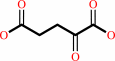 2-oxoglutarate
|
+
|
 O2
O2
|
=
|
trans-4-hydroxy-L-prolyl-[hypoxia-inducible factor alpha subunit]
|
+
|
 succinate
|
+
|
 CO2
CO2
|
|
|
|
|
|
|
|
|
|
Cofactor:
|
|
Fe(2+); L-ascorbate
|
|
|
|
|
|
Fe(2+)
|
L-ascorbate
Bound ligand (Het Group name =
GOL)
matches with 50.00% similarity
|
|
|
|
Enzyme class 2:
|
|
Chain S:
E.C.?
|
|
|
|
|
|
|
|
|
|
Note, where more than one E.C. class is given (as above), each may
correspond to a different protein domain or, in the case of polyprotein
precursors, to a different mature protein.
|
|
|
|
Molecule diagrams generated from .mol files obtained from the
KEGG ftp site
|
|
|
|
|
|
|
|
|
|
|
|
|
|
 |
|
|
|
|
|
|
| |
|
|
| |
|
DOI no:
|
Sci Rep
10:21964
(2020)
|
|
PubMed id:
|
|
|
|
|
|
| |
|
Use of cyclic peptides to induce crystallization: case study with prolyl hydroxylase domain 2.
|
|
R.Chowdhury,
M.I.Abboud,
T.E.McAllister,
B.Banerji,
B.Bhushan,
J.L.Sorensen,
A.Kawamura,
C.J.Schofield.
|
|
|
|
|
| |
ABSTRACT
|
|
|
|
| |
|
|
Crystallization is the bottleneck in macromolecular crystallography; even when a
protein crystallises, crystal packing often influences ligand-binding and
protein-protein interaction interfaces, which are the key points of interest for
functional and drug discovery studies. The human hypoxia-inducible factor prolyl
hydroxylase 2 (PHD2) readily crystallises as a homotrimer, but with a sterically
blocked active site. We explored strategies aimed at altering PHD2 crystal
packing by protein modification and molecules that bind at its active site and
elsewhere. Following the observation that, despite weak inhibition/binding in
solution, succinamic acid derivatives readily enable PHD2 crystallization, we
explored methods to induce crystallization without active site binding. Cyclic
peptides obtained via mRNA display bind PHD2 tightly away from the active site.
They efficiently enable PHD2 crystallization in different forms, both
with/without substrates, apparently by promoting oligomerization involving
binding to the C-terminal region. Although our work involves a specific case
study, together with those of others, the results suggest that mRNA
display-derived cyclic peptides may be useful in challenging protein
crystallization cases.
|
|
|
|
|
|
|
|
|
|
|
|
|
|
|
|
|
|
 |
 |
 |
|
| |


 Links
Links


