 |
PDBsum entry 6yme
 |
|
|
|
|
|
|
Enzyme class:
|
|
E.C.2.1.2.1
- glycine hydroxymethyltransferase.
|
|
|
|
|
|
|
Pathway:
|
|
Folate Coenzymes
|
|
|
|
|
|
Reaction:
|
|
(6R)-5,10-methylene-5,6,7,8-tetrahydrofolate + glycine + H2O = (6S)- 5,6,7,8-tetrahydrofolate + L-serine
|
|
|
|
|
|
(6R)-5,10-methylene-5,6,7,8-tetrahydrofolate
|
+
|
 glycine
|
+
|
H2O
|
=
|
(6S)- 5,6,7,8-tetrahydrofolate
|
+
|
L-serine
Bound ligand (Het Group name = )
matches with 62.50% similarity
|
|
|
|
|
|
|
|
|
|
Cofactor:
|
|
Pyridoxal 5'-phosphate
|
|
|
|
|
|
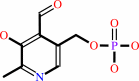 Pyridoxal 5'-phosphate
|
|
|
|
|
|
|
Molecule diagrams generated from .mol files obtained from the
KEGG ftp site
|
|
|
|
|
|
|
|
|
|
|
|
|
|
 |
|
|
|
|
|
|
| |
|
|
| |
|
DOI no:
|
Int J Biol Macromol
159:517-529
(2020)
|
|
PubMed id:
|
|
|
|
|
|
| |
|
Structural and kinetic properties of serine hydroxymethyltransferase from the halophytic cyanobacterium Aphanothece halophytica provide a rationale for salt tolerance.
|
|
I.Nogués,
A.Tramonti,
S.Angelaccio,
M.Ruszkowski,
B.Sekula,
R.Contestabile.
|
|
|
|
|
| |
ABSTRACT
|
|
|
|
| |
|
|
Serine hydroxymethyltransferase (SHMT) is a pyridoxal 5'-phosphate-dependent
enzyme that plays a pivotal role in cellular one‑carbon metabolism. In plants
and cyanobacteria, this enzyme is also involved in photorespiration and confers
salt tolerance, as in the case of SHMT from the halophilic cyanobacterium
Aphanothece halophytica (AhSHMT). We have characterized the catalytic properties
of AhSHMT in different salt and pH conditions. Although the kinetic properties
of AhSHMT correlate with those of the mesophilic orthologue from Escherichia
coli, AhSHMT appears more catalytically efficient, especially in presence of
salt. Our studies also reveal substrate inhibition, previously unobserved in
AhSHMT. Furthermore, addition of the osmoprotectant glycine betaine under salt
conditions has a distinct positive effect on AhSHMT activity. The crystal
structures of AhSHMT in three forms, as internal aldimine, as external aldimine
with the l-serine substrate, and as a covalent complex with malonate, give
structural insights on the possible role of specific amino acid residues
implicated in the halophilic features of AhSHMT. Importantly, we observed that
overexpression of the gene encoding SHMT, independently from its origin,
increases the capability of E. coli to grow in high salt conditions, suggesting
that the catalytic activity of this enzyme in itself plays a fundamental role in
salt tolerance.
|
|
|
|
|
|
|
|
|
|
|
|
|
|
|
|
|
|
 |
 |
 |
|


 Links
Links


