|
PDBsum entry 6t5b

|
|
|
|
|
|

|

|

|

|
|

|
|

|
|

|
|

|
|

|
|
|
 |

|

|
|
|
|
|
|
|
|
|
|
|
|
|
|
|
|
|
|
|
|
|
|
|
|
|
|
|
|
|
|
|
|
|
|
Signaling protein
|
PDB id
|
|
|
|
6t5b
|
|
|
|
|
|
|
|
|
|
|
|
|
|
|

|

|

|
|
|
|
|
|
|
|
|
Enzyme class:
|
|
E.C.3.6.5.2
- small monomeric GTPase.
|
|
|
|
|
|
|
Reaction:
|
|
GTP + H2O = GDP + phosphate + H+
|
|
|
|
|
|
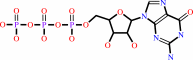 GTP
GTP
|
+
|
H2O
|
=
|
GDP
Bound ligand (Het Group name = )
corresponds exactly
|
+
|
 phosphate
|
+
|
H(+)
|
|
|
|
|
|
|
|
|
|
|
|
|
Molecule diagrams generated from .mol files obtained from the
KEGG ftp site
|
|
|
|
|
|
|
|
|
|
|
|
|
|
 |
|
|
|
|
|
|
| |
|
|
| |
|
DOI no:
|
J Med Chem
63:4468-4483
(2020)
|
|
PubMed id:
|
|
|
|
|
|
| |
|
Structure-Based Design and Pharmacokinetic Optimization of Covalent Allosteric Inhibitors of the Mutant GTPase KRASG12C.
|
|
J.G.Kettle,
S.K.Bagal,
S.Bickerton,
M.S.Bodnarchuk,
J.Breed,
R.J.Carbajo,
D.J.Cassar,
A.Chakraborty,
S.Cosulich,
I.Cumming,
M.Davies,
A.Eatherton,
L.Evans,
L.Feron,
S.Fillery,
E.S.Gleave,
F.W.Goldberg,
S.Harlfinger,
L.Hanson,
M.Howard,
R.Howells,
A.Jackson,
P.Kemmitt,
J.K.Kingston,
S.Lamont,
H.J.Lewis,
S.Li,
L.Liu,
D.Ogg,
C.Phillips,
R.Polanski,
G.Robb,
D.Robinson,
S.Ross,
J.M.Smith,
M.Tonge,
R.Whiteley,
J.Yang,
L.Zhang,
X.Zhao.
|
|
|
|
|
| |
ABSTRACT
|
|
|
|
| |
|
|
Attempts to directly drug the important oncogene KRAS have met with limited
success despite numerous efforts across industry and academia. The
KRASG12C mutant represents an "Achilles heel" and has
recently yielded to covalent targeting with small molecules that bind the mutant
cysteine and create an allosteric pocket on GDP-bound RAS, locking it in an
inactive state. A weak inhibitor at this site was optimized through
conformational locking of a piperazine-quinazoline motif and linker
modification. Subsequent introduction of a key methyl group to the piperazine
resulted in enhancements in potency, permeability, clearance, and reactivity,
leading to identification of a potent KRASG12C inhibitor with high
selectivity and excellent cross-species pharmacokinetic parameters and in vivo
efficacy.
|
|
|
|
|
|
|
|
|
|
|
|
|
|
|
|
|
|
 |
 |
 |
|


 Links
Links