 |
PDBsum entry 6pgo

|
|
|
|
|
|

|

|

|

|
|

|
|

|
|

|
|

|
|

|
|

|
|

|
|
|
 |

|

|
|
|
|
|
|
|
|
|
|
|
|
|
|
|
|
|
|
|
|
|
|
|
|
|
|
|
|
|
|
|
|
|
|
|
|
Signaling protein/inhibitor
|
PDB id
|
|
|
|
6pgo
|
|
|
|
|
|
|
|
|
|
|
|
|
|
|

|

|

|
|
|
|
|
|
|
|
|
|
|
Enzyme class:
|
|
Chains A, B:
E.C.3.6.5.2
- small monomeric GTPase.
|
|
|
|
|
|
|
Reaction:
|
|
GTP + H2O = GDP + phosphate + H+
|
|
|
|
|
|
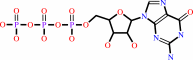 GTP
GTP
|
+
|
H2O
|
=
|
GDP
Bound ligand (Het Group name = )
corresponds exactly
|
+
|
 phosphate
|
+
|
H(+)
|
|
|
|
|
|
|
|
|
|
|
|
|
Molecule diagrams generated from .mol files obtained from the
KEGG ftp site
|
|
|
|
|
|
|
|
|
|
|
|
|
|
 |
|
|
|
|
|
|
| |
|
|
| |
|
DOI no:
|
J Med Chem
63:52-65
(2020)
|
|
PubMed id:
|
|
|
|
|
|
| |
|
Discovery of a Covalent Inhibitor of KRASG12C (AMG 510) for the Treatment of Solid Tumors.
|
|
B.A.Lanman,
J.R.Allen,
J.G.Allen,
A.K.Amegadzie,
K.S.Ashton,
S.K.Booker,
J.J.Chen,
N.Chen,
M.J.Frohn,
G.Goodman,
D.J.Kopecky,
L.Liu,
P.Lopez,
J.D.Low,
V.Ma,
A.E.Minatti,
T.T.Nguyen,
N.Nishimura,
A.J.Pickrell,
A.B.Reed,
Y.Shin,
A.C.Siegmund,
N.A.Tamayo,
C.M.Tegley,
M.C.Walton,
H.L.Wang,
R.P.Wurz,
M.Xue,
K.C.Yang,
P.Achanta,
M.D.Bartberger,
J.Canon,
L.S.Hollis,
J.D.McCarter,
C.Mohr,
K.Rex,
A.Y.Saiki,
T.San Miguel,
L.P.Volak,
K.H.Wang,
D.A.Whittington,
S.G.Zech,
J.R.Lipford,
V.J.Cee.
|
|
|
|
|
| |
ABSTRACT
|
|
|
|
| |
|
|
KRASG12C has emerged as a promising target in the treatment of solid
tumors. Covalent inhibitors targeting the mutant cysteine-12 residue have been
shown to disrupt signaling by this long-"undruggable" target; however
clinically viable inhibitors have yet to be identified. Here, we report efforts
to exploit a cryptic pocket (H95/Y96/Q99) we identified in KRASG12C
to identify inhibitors suitable for clinical development. Structure-based design
efforts leading to the identification of a novel quinazolinone scaffold are
described, along with optimization efforts that overcame a configurational
stability issue arising from restricted rotation about an axially chiral biaryl
bond. Biopharmaceutical optimization of the resulting leads culminated in the
identification of AMG 510, a highly potent, selective, and well-tolerated
KRASG12C inhibitor currently in phase I clinical trials (NCT03600883).
|
|
|
|
|
|
|
|
|
|
|
|
|
|
|
|
|
|
 |
 |
 |
|
|


 Links
Links


