 |
PDBsum entry 6hep

|
|
|
|
|
|

|

|

|

|
|

|
|

|
|

|
|

|
|

|
|
|
 |

|

|
|
|
|
|
|
|
|
|
|
|
|
|
|
|
|
|
|
|
|
|
|
|
|
|
|
|
|
|
|
|
|
|
|
Signaling protein
|
PDB id
|
|
|
|
6hep
|
|
|
|
|
|
|
|
|
|
|
|
|
|
|

|

|

|
|
|
|
|
|
|
PDB id:
|
|
|
|
| Name: |
|
Signaling protein
|
|
|
Title:
|
|
Crystal structure of human 14-3-3 beta in complex with cftr r-domain peptide ps753-ps768
|
|
Structure:
|
|
14-3-3 protein beta/alpha. Chain: a, b, c, d. Synonym: protein 1054,protein kinasE C inhibitor protein 1,kcip-1. Engineered: yes. Cystic fibrosis transmembrane conductance regulator. Chain: e, f. Synonym: cftr,atp-binding cassette sub-family c member 7,channel conductance-controlling atpase,camp-dependent chloride channel. Engineered: yes
|
|
Source:
|
|
Homo sapiens. Human. Organism_taxid: 9606. Gene: ywhab. Expressed in: escherichia coli bl21(de3). Expression_system_taxid: 469008. Synthetic: yes. Organism_taxid: 9606
|
|
Resolution:
|
|
|
1.86Å
|
R-factor:
|
0.204
|
R-free:
|
0.251
|
|
|
Authors:
|
|
L.M.Stevers,C.Ottmann,L.Brunsveld
|
|
Key ref:
|
|
L.M.Stevers
et al.
(2018).
A Thermodynamic Model for Multivalency in 14-3-3 Protein-Protein Interactions.
J Am Chem Soc,
140,
14498-14510.
PubMed id:
DOI:
|
|
|
Date:
|
|
|
20-Aug-18
|
Release date:
|
24-Oct-18
|
|
|
|
|
|
|
PROCHECK
|

|
|
|
|
|
Headers
|
|
|
|
References
|
|
|
|
|
|
|
|
|
|
|
|
Enzyme class:
|
|
Chains E, F:
E.C.5.6.1.6
- channel-conductance-controlling ATPase.
|
|
|
|
|
|
|
Reaction:
|
|
ATP + H2O + closed Cl- channel = ADP + phosphate + open Cl- channel
|
|
|
|
|
|
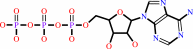 ATP
ATP
|
+
|
H2O
|
+
|
closed Cl(-) channel
|
=
|
 ADP
ADP
|
+
|
 phosphate
|
+
|
open Cl(-) channel
|
|
|
|
|
|
|
|
|
|
|
|
|
Molecule diagrams generated from .mol files obtained from the
KEGG ftp site
|
|
|
|
|
|
|
|
|
|
|
|
|
|
 |
|
|
|
|
|
|
| |
|
|
| |
|
DOI no:
|
J Am Chem Soc
140:14498-14510
(2018)
|
|
PubMed id:
|
|
|
|
|
|
| |
|
A Thermodynamic Model for Multivalency in 14-3-3 Protein-Protein Interactions.
|
|
L.M.Stevers,
P.J.de Vink,
C.Ottmann,
J.Huskens,
L.Brunsveld.
|
|
|
|
|
| |
ABSTRACT
|
|
|
|
| |
|
|
Protein-protein interactions (PPIs) are at the core of molecular control over
cellular function. Multivalency in PPI formation, such as via proteins with
multiple binding sites and different valencies, requires fundamental
understanding to address correlated challenges in pathologies and drug
development. Thermodynamic binding models are needed to provide frameworks for
describing multivalent PPIs. We established a model based on ditopic host-guest
systems featuring the effective molarity, a hallmark property of multivalency,
as a prime parameter governing the intramolecular binding in divalent
interactions. By way of illustration, we study the interaction of the bivalent
14-3-3 protein scaffold with both the nonavalent CFTR and the hexavalent LRRK2
proteins, determining the underlying thermodynamics and providing insights into
the role of individual sites in the context of the multivalent platform. Fitting
of binding data reveals enthalpy-entropy correlation in both systems.
Simulations of speciations for the entire phosphorylated protein domains reveal
that the CFTR protein preferably binds to 14-3-3 by combinations including the
strongest binding site pS768, but that other binding sites take over when this
site is eliminated, leading to only a minor decrease in total affinity for
14-3-3. For LRRK2, two binding sites dominate the complex formation with 14-3-3,
but the distantly located pS1444 site also plays a role in complex formation.
Thermodynamic modeling of these multivalent PPIs allowed analyzing and
predicting the effects of individual sites regarding their modulation via, for
example, (de)phosphorylation or small-molecule targeting. The results
specifically bring forward the potential of PPI stabilization, as an entry for
drug discovery for multivalent PPIs.
|
|
|
|
|
|
|
|
|
|
|
|
|
|
|
|
|
|
 |
 |
 |
|
|


 Links
Links


