 |
PDBsum entry 6f2c
|
|

|
|
PDB id:
|
|
|
|
| Name: |
|
Lyase
|
|
|
Title:
|
|
Methylglyoxal synthase mgsa from bacillus subtilis
|
|
Structure:
|
|
Methylglyoxal synthase. Chain: a, d, b, f, c, e, h, k, g, i, l, j. Fragment: residues 3- 610. Synonym: mgs. Engineered: yes
|
|
Source:
|
|
Bacillus subtilis (strain 168). Organism_taxid: 224308. Gene: mgsa, ypjf, bsu22480. Expressed in: escherichia coli bl21(de3). Expression_system_taxid: 469008.
|
|
Resolution:
|
|
|
2.34Å
|
R-factor:
|
0.173
|
R-free:
|
0.207
|
|
|
Authors:
|
|
A.Dickmanns,P.Neumann,R.Ficner
|
|
Key ref:
|
|
A.Dickmanns
et al.
(2018).
Structural basis for the regulatory interaction of the methylglyoxal synthase MgsA with the carbon flux regulator Crh in
J Biol Chem,
293,
5781-5792.
PubMed id:
|
|
|
Date:
|
|
|
24-Nov-17
|
Release date:
|
07-Mar-18
|
|
|
|
|
|
|
PROCHECK
|

|
|
|
|
|
Headers
|
|
|
|
References
|
|
|
|
|
|

|
|
P42980
(MGSA_BACSU) -
Methylglyoxal synthase from Bacillus subtilis (strain 168)
|
|
|
|
Seq:
Struc:
|
|
|
|
137 a.a.
124 a.a.
|
|

|

|
|
|
|
|
|
|
|
|
|
|
|
Key: |
 |
PfamA domain |
|
|
 |
Secondary structure |
|
|
|
|
|
|
|
|
|
|
|
|
|
Enzyme class:
|
|
E.C.4.2.3.3
- methylglyoxal synthase.
|
|
|
|
|
|
|
Reaction:
|
|
dihydroxyacetone phosphate = methylglyoxal + phosphate
|
|
|
|
|
|
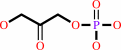 dihydroxyacetone phosphate
|
=
|
methylglyoxal
Bound ligand (Het Group name = )
matches with 83.33% similarity
|
+
|
 phosphate
|
|
|
|
|
|
|
|
|
|
|
|
|
Molecule diagrams generated from .mol files obtained from the
KEGG ftp site
|
|
|
|
|
|
|
|
|
|
|
|
|
|
 |
|
|
|
|
|
|
| |
|
|
| |
|
|
J Biol Chem
293:5781-5792
(2018)
|
|
PubMed id:
|
|
|
|
|
|
| |
|
Structural basis for the regulatory interaction of the methylglyoxal synthase MgsA with the carbon flux regulator Crh in
|
|
A.Dickmanns,
C.P.Zschiedrich,
J.Arens,
I.Parfentev,
J.Gundlach,
R.Hofele,
P.Neumann,
H.Urlaub,
B.Görke,
R.Ficner,
J.Stülke.
|
|
|
|
|
| |
ABSTRACT
|
|
|
|
| |
|
|
Utilization of energy-rich carbon sources such as glucose is fundamental to the
evolutionary success of bacteria. Glucose can be catabolized via glycolysis for
feeding the intermediary metabolism. The methylglyoxal synthase MgsA produces
methylglyoxal from the glycolytic intermediate dihydroxyacetone phosphate.
Methylglyoxal is toxic, requiring stringent regulation of MgsA activity. In the
Gram-positive bacterium Bacillus subtilis, an interaction with the
phosphoprotein Crh controls MgsA activity. In the absence of preferred carbon
sources, Crh is present in the nonphosphorylated state and binds to and thereby
inhibits MgsA. To better understand the mechanism of regulation of MgsA, here we
performed biochemical and structural analyses of B. subtilis MgsA and of
its interaction with Crh. Our results indicated that MgsA forms a hexamer
(i.e. a trimer of dimers) in the crystal structure, whereas it seems to
exist in an equilibrium between a dimer and hexamer in solution. In the hexamer,
two alternative dimers could be distinguished, but only one appeared to prevail
in solution. Further analysis strongly suggested that the hexamer is the
biologically active form. In vitro cross-linking studies revealed that
Crh interacts with the N-terminal helices of MgsA and that the Crh-MgsA binding
inactivates MgsA by distorting and thereby blocking its active site. In summary,
our results indicate that dimeric and hexameric MgsA species exist in an
equilibrium in solution, that the hexameric species is the active form, and that
binding to Crh deforms and blocks the active site in MgsA.
|
|
|
|
|
|
|
|
|
|
|
|
|
|
|
|
|
|
 |
 |
 |
|


 Links
Links


