 |
PDBsum entry 6es6

|
|
|
|
|
|

|

|

|

|
|

|
|

|
|

|
|

|
|
|
 |

|

|
|
|
|
|
|
|
|
|
|
|
|
|
|
|
|
|
|
|
|
|
|
|
|
|
|
|
|
|
|
|
|
|
DNA binding protein
|
PDB id
|
|
|
|
6es6
|
|
|
|
|
|
|
|
|
|
|
|
|
|
|

|

|

|
|
|
|
|
|
|
|
|
|
|
Enzyme class 1:
|
|
Chain B:
E.C.2.3.1.-
- ?????
|
|
|
|
|
|
|
Enzyme class 2:
|
|
Chain B:
E.C.2.3.1.48
- histone acetyltransferase.
|
|
|
|
|
|
|
Reaction:
|
|
L-lysyl-[protein] + acetyl-CoA = N6-acetyl-L-lysyl-[protein] + CoA + H+
|
|
|
|
|
|
L-lysyl-[protein]
|
+
|
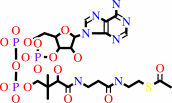 acetyl-CoA
|
=
|
N(6)-acetyl-L-lysyl-[protein]
|
+
|
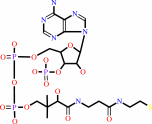 CoA
CoA
|
+
|
H(+)
|
|
|
|
|
|
|
|
|
|
|
|
|
Note, where more than one E.C. class is given (as above), each may
correspond to a different protein domain or, in the case of polyprotein
precursors, to a different mature protein.
|
|
|
|
Molecule diagrams generated from .mol files obtained from the
KEGG ftp site
|
|
|
|
|
|
|
|
|
|
|
|
|
|
 |
|
|
|
|
|
|
| |
|
|
| |
|
|
Sci Adv
4:eaau4130
(2018)
|
|
PubMed id:
|
|
|
|
|
|
| |
|
Structure and dynamics conspire in the evolution of affinity between intrinsically disordered proteins.
|
|
P.Jemth,
E.Karlsson,
B.Vögeli,
B.Guzovsky,
E.Andersson,
G.Hultqvist,
J.Dogan,
P.Güntert,
R.Riek,
C.N.Chi.
|
|
|
|
|
| |
ABSTRACT
|
|
|
|
| |
|
|
In every established species, protein-protein interactions have evolved such
that they are fit for purpose. However, the molecular details of the evolution
of new protein-protein interactions are poorly understood. We have used nuclear
magnetic resonance spectroscopy to investigate the changes in structure and
dynamics during the evolution of a protein-protein interaction involving the
intrinsically disordered CREBBP (CREB-binding protein) interaction domain (CID)
and nuclear coactivator binding domain (NCBD) from the transcriptional
coregulators NCOA (nuclear receptor coactivator) and CREBBP/p300, respectively.
The most ancient low-affinity "Cambrian-like" [540 to 600 million
years (Ma) ago] CID/NCBD complex contained less secondary structure and was more
dynamic than the complexes from an evolutionarily younger
"Ordovician-Silurian" fish ancestor (ca. 440 Ma ago) and extant human.
The most ancient Cambrian-like CID/NCBD complex lacked one helix and several
interdomain interactions, resulting in a larger solvent-accessible surface area.
Furthermore, the most ancient complex had a high degree of
millisecond-to-microsecond dynamics distributed along the entire sequences of
both CID and NCBD. These motions were reduced in the Ordovician-Silurian
CID/NCBD complex and further redistributed in the extant human CID/NCBD complex.
Isothermal calorimetry experiments show that complex formation is enthalpically
favorable and that affinity is modulated by a largely unfavorable entropic
contribution to binding. Our data demonstrate how changes in structure and
motion conspire to shape affinity during the evolution of a protein-protein
complex and provide direct evidence for the role of structural, dynamic, and
frustrational plasticity in the evolution of interactions between intrinsically
disordered proteins.
|
|
|
|
|
|
|
|
|
|
|
|
|
|
|
|
|
|
 |
 |
 |
|
|


 Links
Links


