 |
PDBsum entry 6ege

|
|
|
|
|
|

|

|

|

|
|

|
|

|
|

|
|

|
|

|
|

|
|
|
 |

|

|
|
|
|
|
|
|
|
|
|
|
|
|
|
|
|
|
|
|
|
|
|
|
|
|
|
|
|
|
|
|
|
|
|
|
Transferase/transferase inhibitor
|
PDB id
|
|
|
|
6ege
|
|
|
|
|
|
|
|
|
|
|
|
|
|
|

|

|

|
|
|
|
|
|
|
|
|
|
|
Enzyme class:
|
|
Chains D, A:
E.C.2.7.11.1
- non-specific serine/threonine protein kinase.
|
|
|
|
|
|
|
Reaction:
|
|
|
1.
|
L-seryl-[protein] + ATP = O-phospho-L-seryl-[protein] + ADP + H+
|
|
2.
|
L-threonyl-[protein] + ATP = O-phospho-L-threonyl-[protein] + ADP + H+
|
|
|
|
|
|
|
L-seryl-[protein]
|
+
|
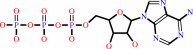 ATP
ATP
|
=
|
O-phospho-L-seryl-[protein]
|
+
|
 ADP
ADP
|
+
|
H(+)
|
|
|
|
|
|
|
L-threonyl-[protein]
|
+
|
ATP
|
=
|
O-phospho-L-threonyl-[protein]
|
+
|
ADP
|
+
|
H(+)
|
|
|
|
|
|
|
|
|
|
|
|
|
Molecule diagrams generated from .mol files obtained from the
KEGG ftp site
|
|
|
|
|
|
|
|
|
|
|
|
|
|
 |
|
|
|
|
|
|
| |
|
|
| |
|
DOI no:
|
J Biol Chem
294:4511-4519
(2019)
|
|
PubMed id:
|
|
|
|
|
|
| |
|
Conformational flexibility and inhibitor binding to unphosphorylated interleukin-1 receptor-associated kinase 4 (IRAK4).
|
|
L.Wang,
R.Ferrao,
Q.Li,
J.M.Hatcher,
H.G.Choi,
S.J.Buhrlage,
N.S.Gray,
H.Wu.
|
|
|
|
|
| |
ABSTRACT
|
|
|
|
| |
|
|
Interleukin-1 receptor-associated kinase 4 (IRAK4) is a key player in innate
immune and inflammatory responses, performing a critical role in signal
transduction downstream of Toll-like receptors and interleukin-1 (IL-1)
receptors. Upon ligand binding and via its N-terminal death domain, IRAK4 is
recruited to an oligomeric receptor that is proximal to the Myddosome signaling
complex, inducing IRAK4 kinase domain dimerization, autophosphorylation, and
activation. To date, all known IRAK4 structures are in the active conformation,
precluding a good understanding of IRAK4's conformational dynamics. To address
this issue, here we first solved three crystal structures of the IRAK4 kinase
domain (at ≤2.6 Å resolution), in its unphosphorylated, inactive state bound
to either the ATP analog AMP-PNP or to one of the two small-molecule inhibitors
JH-I-25 and JH-I-17. The structures disclosed that although the structure in
complex with AMP-PNP is in an "αC-out" inactive conformation, those
in complex with type I inhibitors assume an active "Asp-Phe-Gly
(DFG)-in" and "αC-in" conformation. The ability of
unphosphorylated IRAK4 to take on variable conformations prompted us to screen
for small-molecule inhibitors that bind preferentially to unphosphorylated
IRAK4, leading to the identification of ponatinib and HG-12-6. Solving the
structures of unphosphorylated IRAK4 in complex with these two inhibitors, we
found that they both bind as type II inhibitors with IRAK4 in a
"DFG-out" conformation. Collectively, these structures reveal
conformational flexibility of unphosphorylated IRAK4 and provide unexpected
insights into the potential use of small molecules to modulate IRAK4 activity in
cancer, autoimmunity, and inflammation.
|
|
|
|
|
|
|
|
|
|
|
|
|
|
|
|
|
|
 |
 |
 |
|
|


 Links
Links


