 |
PDBsum entry 6e3v

|
|
|
|
|
|

|

|

|

|
|

|
|

|
|

|
|

|
|

|
|

|
|

|
|
|
 |

|

|
|
|
|
|
|
|
|
|
|
|
|
|
|
|
|
|
|
|
|
|
|
|
|
|
|
|
|
|
|
|
|
|
|
|
|
DNA binding protein/DNA
|
PDB id
|
|
|
|
6e3v
|
|
|
|
|
|
|
|
|
|
|
|
|
|
|

|

|

|
|
|
|
|
|
|
|
|
Enzyme class 1:
|
|
E.C.2.7.7.7
- DNA-directed Dna polymerase.
|
|
|
|
|
|
|
Reaction:
|
|
DNA(n) + a 2'-deoxyribonucleoside 5'-triphosphate = DNA(n+1) + diphosphate
|
|
|
|
|
|
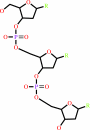 DNA(n)
|
+
|
2'-deoxyribonucleoside 5'-triphosphate
|
=
|
DNA(n+1)
|
+
|
 diphosphate
|
|
|
|
|
|
|
|
|
|
Enzyme class 2:
|
|
E.C.4.2.99.-
- ?????
|
|
|
|
|
|
|
Enzyme class 3:
|
|
E.C.4.2.99.18
- DNA-(apurinic or apyrimidinic site) lyase.
|
|
|
|
|
|
|
Reaction:
|
|
2'-deoxyribonucleotide-(2'-deoxyribose 5'-phosphate)- 2'-deoxyribonucleotide-DNA = a 3'-end 2'-deoxyribonucleotide-(2,3- dehydro-2,3-deoxyribose 5'-phosphate)-DNA + a 5'-end 5'-phospho- 2'-deoxyribonucleoside-DNA + H+
|
|
|
|
|
|
|
|
|
Note, where more than one E.C. class is given (as above), each may
correspond to a different protein domain or, in the case of polyprotein
precursors, to a different mature protein.
|
|
|
|
Molecule diagrams generated from .mol files obtained from the
KEGG ftp site
|
|
|
|
|
|
|
|
|
|
|
|
|
|
 |
|
|
|
|
|
|
| |
|
|
| |
|
DOI no:
|
J Am Chem Soc
141:4584-4596
(2019)
|
|
PubMed id:
|
|
|
|
|
|
| |
|
Mutagenic Replication of the Major Oxidative Adenine Lesion 7,8-Dihydro-8-oxoadenine by Human DNA Polymerases.
|
|
M.C.Koag,
H.Jung,
S.Lee.
|
|
|
|
|
| |
ABSTRACT
|
|
|
|
| |
|
|
Reactive oxygen species attack DNA to produce 7,8-dihyro-8-oxoguanine (oxoG) and
7,8-dihydro-8-oxoadenine (oxoA) as major lesions. The structural basis for the
mutagenicity of oxoG, which induces G to T mutations, is well understood.
However, the structural basis for the mutagenic potential of oxoA, which induces
A to C mutations, remains poorly understood. To gain insight into oxoA-induced
mutagenesis, we conducted kinetic studies of human DNA polymerases β and η
replicating across oxoA and structural studies of polβ incorporating dTTP/dGTP
opposite oxoA. While polη readily bypassed oxoA, it incorporated dGTP opposite
oxoA with a catalytic specificity comparable to that of correct insertion,
underscoring the promutagenic nature of the major oxidative adenine lesion.
Polη and polβ incorporated dGTP opposite oxoA ∼170-fold and ∼100-fold more
efficiently than that opposite dA, respectively, indicating that the 8-oxo
moiety greatly facilitated error-prone replication. Crystal structures of polβ
showed that, when paired with an incoming dTTP, the templating oxoA adopted an
anti conformation and formed Watson-Crick base pair. When paired with dGTP, oxoA
adopted a syn conformation and formed a Hoogsteen base pair with
Watson-Crick-like geometry, highlighting the dual-coding potential of oxoA. The
templating oxoA was stabilized by Lys280-mediated stacking and hydrogen bonds.
Overall, these results provide insight into the mutagenic potential and
dual-coding nature of the major oxidative adenine lesion.
|
|
|
|
|
|
|
|
|
|
|
|
|
|
|
|
|
|
 |
 |
 |
|


 Links
Links


