 |
PDBsum entry 6ccx

|
|
|
|
|
|

|

|

|

|
|

|
|

|
|

|
|

|
|

|
|
|
 |

|

|
|
|
|
|
|
|
|
|
|
|
|
|
|
|
|
|
|
|
|
|
|
|
|
|
|
|
|
|
|
|
|
|
|
Membrane protein/oncoprotein
|
PDB id
|
|
|
|
6ccx
|
|
|
|
|
|
|
|
|
|
|
|
|
|
|

|

|

|
|
|
|
|
|
|
PDB id:
|
|
|
|
| Name: |
|
Membrane protein/oncoprotein
|
|
|
Title:
|
|
Nmr data-driven model of gtpase kras-gmppnp:cmpd2 complex tethered to a nanodisc
|
|
Structure:
|
|
Apolipoprotein a-i. Chain: a, c. Fragment: unp residues 68-265. Synonym: apoa-i,apolipoprotein a1. Engineered: yes. Gtpase kras. Chain: b. Synonym: k-ras 2,ki-ras,c-k-ras,c-ki-ras. Engineered: yes.
|
|
Source:
|
|
Homo sapiens. Human. Organism_taxid: 9606. Gene: apoa1. Expressed in: escherichia coli. Expression_system_taxid: 562. Gene: kras, kras2, rask2. Expression_system_taxid: 562
|
|
NMR struc:
|
|
10 models
|
|
|
Authors:
|
|
Z.Fang,C.B.Marshall,T.Nishikawa,A.D.Gossert,J.M.Jansen,W.Jahnke, M.Ikura
|
|
Key ref:
|
|
Z.Fang
et al.
(2018).
Inhibition of K-RAS4B by a Unique Mechanism of Action: Stabilizing Membrane-Dependent Occlusion of the Effector-Binding Site.
Cell Chem Biol,
25,
1327.
PubMed id:
DOI:
|
|
|
Date:
|
|
|
07-Feb-18
|
Release date:
|
05-Sep-18
|
|
|
|
|
|
|
PROCHECK
|

|
|
|
|
|
Headers
|
|
|
|
References
|
|
|
|
|
|
|
|
|
|
|
|
Enzyme class 2:
|
|
Chains A, C:
E.C.?
|
|
|
|
|
|
|
Enzyme class 3:
|
|
Chain B:
E.C.3.6.5.2
- small monomeric GTPase.
|
|
|
|
|
|
|
Reaction:
|
|
GTP + H2O = GDP + phosphate + H+
|
|
|
|
|
|
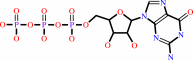 GTP
GTP
|
+
|
H2O
|
=
|
GDP
Bound ligand (Het Group name = )
matches with 81.82% similarity
|
+
|
 phosphate
|
+
|
H(+)
|
|
|
|
|
|
|
|
|
|
|
|
|
Note, where more than one E.C. class is given (as above), each may
correspond to a different protein domain or, in the case of polyprotein
precursors, to a different mature protein.
|
|
|
|
Molecule diagrams generated from .mol files obtained from the
KEGG ftp site
|
|
|
|
|
|
|
|
|
|
|
|
|
|
 |
|
|
|
|
|
|
| |
|
|
| |
|
DOI no:
|
Cell Chem Biol
25:1327
(2018)
|
|
PubMed id:
|
|
|
|
|
|
| |
|
Inhibition of K-RAS4B by a Unique Mechanism of Action: Stabilizing Membrane-Dependent Occlusion of the Effector-Binding Site.
|
|
Z.Fang,
C.B.Marshall,
T.Nishikawa,
A.D.Gossert,
J.M.Jansen,
W.Jahnke,
M.Ikura.
|
|
|
|
|
| |
ABSTRACT
|
|
|
|
| |
|
|
KRAS is frequently mutated in several of the most lethal types of cancer;
however, the KRAS protein has proven a challenging drug target. K-RAS4B must be
localized to the plasma membrane by prenylation to activate oncogenic signaling,
thus we endeavored to target the protein-membrane interface with small-molecule
compounds. While all reported lead compounds have low affinity for KRAS in
solution, the potency of Cmpd2 was strongly enhanced when prenylated K-RAS4B is
associated with a lipid bilayer. We have elucidated a unique mechanism of action
of Cmpd2, which simultaneously engages a shallow pocket on KRAS and associates
with the lipid bilayer, thereby stabilizing KRAS in an orientation in which the
membrane occludes its effector-binding site, reducing RAF binding and impairing
activation of RAF. Furthermore, enrichment of Cmpd2 on the bilayer enhances
potency by promoting interaction with KRAS. This insight reveals a novel
approach to developing inhibitors of membrane-associated proteins.
|
|
|
|
|
|
|
|
|
|
|
|
|
|
|
|
|
|
 |
 |
 |
|
|


 Links
Links


