 |
PDBsum entry 5wpm

|
|
|
|
|
|

|

|

|

|
|

|
|

|
|

|
|

|
|

|
|

|
|
|
 |

|

|
|
|
|
|
|
|
|
|
|
|
|
|
|
|
|
|
|
|
|
|
|
|
|
|
|
|
|
|
|
|
|
|
|
|
Signaling protein
|
PDB id
|
|
|
|
5wpm
|
|
|
|
|
|
|
|
|
|
|
|
|
|
|

|

|

|
|
|
|
|
|
|
PDB id:
|
|
|
|
| Name: |
|
Signaling protein
|
|
|
Title:
|
|
Kras g12v, bound to gppnhp and miniprotein 225-11(a30r)
|
|
Structure:
|
|
Gtpase kras. Chain: a. Fragment: residues 1-166. Synonym: k-ras 2,ki-ras,c-k-ras,c-ki-ras. Engineered: yes. Ras binding peptide. Chain: b, c. Engineered: yes
|
|
Source:
|
|
Homo sapiens. Human. Organism_taxid: 9606. Gene: kras, kras2, rask2. Expressed in: escherichia coli. Expression_system_taxid: 562. Synthetic: yes. Saccharomyces cerevisiae. Baker's yeast.
|
|
Resolution:
|
|
|
1.72Å
|
R-factor:
|
0.237
|
R-free:
|
0.285
|
|
|
Authors:
|
|
S.-J.Lee,S.Y.Shim,J.H.Mcgee,G.L.Verdine
|
|
Key ref:
|
|
J.H.McGee
et al.
(2018).
Exceptionally high-affinity Ras binders that remodel its effector domain.
J Biol Chem,
293,
3265-3280.
PubMed id:
DOI:
|
|
|
Date:
|
|
|
05-Aug-17
|
Release date:
|
03-Jan-18
|
|
|
|
|
|
|
PROCHECK
|

|
|
|
|
|
Headers
|
|
|
|
References
|
|
|
|
|
|

|
|
P01116
(RASK_HUMAN) -
GTPase KRas from Homo sapiens
|
|
|
|
Seq:
Struc:
|
|
|
|
189 a.a.
153 a.a.*
|
|

|

|
|
|
|
|
|
|
|
|
|
|
|
|
|
|
|
|
|
Enzyme class:
|
|
Chain A:
E.C.3.6.5.2
- small monomeric GTPase.
|
|
|
|
|
|
|
Reaction:
|
|
GTP + H2O = GDP + phosphate + H+
|
|
|
|
|
|
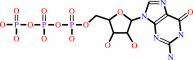 GTP
GTP
|
+
|
H2O
|
=
|
GDP
Bound ligand (Het Group name = )
matches with 81.82% similarity
|
+
|
 phosphate
|
+
|
H(+)
|
|
|
|
|
|
|
|
|
|
|
|
|
Molecule diagrams generated from .mol files obtained from the
KEGG ftp site
|
|
|
|
|
|
|
|
|
|
|
|
|
|
 |
|
|
|
|
|
|
| |
|
|
| |
|
DOI no:
|
J Biol Chem
293:3265-3280
(2018)
|
|
PubMed id:
|
|
|
|
|
|
| |
|
Exceptionally high-affinity Ras binders that remodel its effector domain.
|
|
J.H.McGee,
S.Y.Shim,
S.J.Lee,
P.K.Swanson,
S.Y.Jiang,
M.A.Durney,
G.L.Verdine.
|
|
|
|
|
| |
ABSTRACT
|
|
|
|
| |
|
|
The Ras proteins are aberrantly activated in a wide range of human cancers,
often endowing tumors with aggressive properties and resistance to therapy.
Decades of effort to develop direct Ras inhibitors for clinical use have thus
far failed, largely because of a lack of adequate small-molecule-binding pockets
on the Ras surface. Here, we report the discovery of Ras-binding miniproteins
from a naïve library and their evolution to afford versions with midpicomolar
affinity to Ras. A series of biochemical experiments indicated that these
miniproteins bind to the Ras effector domain as dimers, and high-resolution
crystal structures revealed that these miniprotein dimers bind Ras in an
unprecedented mode in which the Ras effector domain is remodeled to expose an
extended pocket that connects two isolated pockets previously found to engage
small-molecule ligands. We also report a Ras point mutant that stabilizes the
protein in the open conformation trapped by these miniproteins. These findings
provide new tools for studying Ras structure and function and present
opportunities for the development of both miniprotein and small-molecule
inhibitors that directly target the Ras proteins.
|
|
|
|
|
|
|
|
|
|
|
|
|
|
|
|
|
|
 |
 |
 |
|
| |


 Links
Links


