 |
PDBsum entry 5obk
|
|

|
|
PDB id:
|
|
|
|
| Name: |
|
Isomerase
|
|
|
Title:
|
|
The fk1 domain of fkbp51 in complex with (1s,5s,6r)-10-((3,5- dichlorophenyl)sulfonyl)-5-(hydroxymethyl)-3-(pyridin-2-ylmethyl)-3, 10-diazabicyclo[4.3.1]decan-2-one
|
|
Structure:
|
|
Peptidyl-prolyl cis-trans isomerase fkbp5. Chain: a. Fragment: fk1 domain. Synonym: ppiase fkbp5,51 kda fk506-binding protein,fkbp-51,54 kda progesterone receptor-associated immunophilin,androgen-regulated protein 6,ff1 antigen,fk506-binding protein 5,fkbp-5,fkbp54,p54, hsp90-binding immunophilin,rotamase. Engineered: yes. Mutation: yes
|
|
Source:
|
|
Homo sapiens. Human. Organism_taxid: 9606. Gene: fkbp5, aig6, fkbp51. Expressed in: escherichia coli bl21(de3). Expression_system_taxid: 469008. Expression_system_variant: codon+ ril.
|
|
Resolution:
|
|
|
1.00Å
|
R-factor:
|
0.120
|
R-free:
|
0.136
|
|
|
Authors:
|
|
S.Pomplun,C.Sippel,A.Haehle,A.Bracher,F.Hausch
|
|
Key ref:
|
|
S.Pomplun
et al.
(2018).
Chemogenomic Profiling of Human and Microbial FK506-Binding Proteins.
J Med Chem,
61,
3660-3673.
PubMed id:
DOI:
|
|
|
Date:
|
|
|
28-Jun-17
|
Release date:
|
04-Apr-18
|
|
|
|
|
|
|
PROCHECK
|

|
|
|
|
|
Headers
|
|
|
|
References
|
|
|
|
|
|

|
|
Q13451
(FKBP5_HUMAN) -
Peptidyl-prolyl cis-trans isomerase FKBP5 from Homo sapiens
|
|
|
|
Seq:
Struc:
|
|
|
|
457 a.a.
128 a.a.*
|
|

|

|

|
|
|
|
|
|
|
|
|
|
|
Key: |
 |
PfamA domain |
|
|
 |
Secondary structure |
|
|
*
PDB and UniProt seqs differ
at 4 residue positions (black
crosses)
|
|
|
|
|
|
|
|
|
|
|
|
|
Enzyme class:
|
|
E.C.5.2.1.8
- peptidylprolyl isomerase.
|
|
|
|
|
|
|
Reaction:
|
|
[protein]-peptidylproline (omega=180) = [protein]-peptidylproline (omega=0)
|
|
|
|
|
|
 Peptidylproline (omega=180)
|
=
|
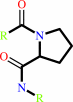 peptidylproline (omega=0)
|
|
|
|
|
|
|
|
|
|
|
|
|
Molecule diagrams generated from .mol files obtained from the
KEGG ftp site
|
|
|
|
|
|
|
|
|
|
|
|
|
|
 |
|
|
|
|
|
|
| |
|
|
| |
|
DOI no:
|
J Med Chem
61:3660-3673
(2018)
|
|
PubMed id:
|
|
|
|
|
|
| |
|
Chemogenomic Profiling of Human and Microbial FK506-Binding Proteins.
|
|
S.Pomplun,
C.Sippel,
A.Hähle,
D.Tay,
K.Shima,
A.Klages,
C.M.Ünal,
B.Rieß,
H.T.Toh,
G.Hansen,
H.S.Yoon,
A.Bracher,
P.Preiser,
J.Rupp,
M.Steinert,
F.Hausch.
|
|
|
|
|
| |
ABSTRACT
|
|
|
|
| |
|
|
FK506-binding proteins (FKBPs) are evolutionarily conserved proteins that
display peptidyl-prolyl isomerase activities and act as coreceptors for
immunosuppressants. Microbial macrophage-infectivity-potentiator (Mip)-type
FKBPs can enhance infectivity. However, developing druglike ligands for FKBPs or
Mips has proven difficult, and many FKBPs and Mips still lack biologically
useful ligands. To explore the scope and potential of C5-substituted
[4.3.1]-aza-bicyclic sulfonamides as a broadly applicable class of FKBP
inhibitors, we developed a new synthesis method for the bicyclic core scaffold
and used it to prepare an FKBP- and Mip-focused library. This allowed us to
perform a systematic structure-activity-relationship analysis across key human
FKBPs and microbial Mips, yielding highly improved inhibitors for all the FKBPs
studied. A cocrystal structure confirmed the molecular-binding mode of the core
structure and explained the affinity gained as a result of the preferred
substituents. The best FKBP and Mip ligands showed promising antimalarial,
antileginonellal, and antichlamydial properties in cellular models of
infectivity, suggesting that substituted [4.3.1]-aza-bicyclic sulfonamides could
be a novel class of anti-infectives.
|
|
|
|
|
|
|
|
|
|
|
|
|
|
|
|
|
|
 |
 |
 |
|


 Links
Links


