 |
PDBsum entry 5mo4
 |
|
|
|
|
|
|
Enzyme class:
|
|
E.C.2.7.10.2
- non-specific protein-tyrosine kinase.
|
|
|
|
|
|
|
Reaction:
|
|
L-tyrosyl-[protein] + ATP = O-phospho-L-tyrosyl-[protein] + ADP + H+
|
|
|
|
|
|
L-tyrosyl-[protein]
|
+
|
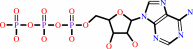 ATP
ATP
|
=
|
O-phospho-L-tyrosyl-[protein]
|
+
|
 ADP
ADP
|
+
|
H(+)
|
|
|
|
|
|
|
|
|
|
|
|
|
Molecule diagrams generated from .mol files obtained from the
KEGG ftp site
|
|
|
|
|
|
|
|
|
|
|
|
|
|
 |
|
|
|
|
|
|
| |
|
|
| |
|
DOI no:
|
Nature
543:733-737
(2017)
|
|
PubMed id:
|
|
|
|
|
|
| |
|
The allosteric inhibitor ABL001 enables dual targeting of BCR-ABL1.
|
|
A.A.Wylie,
J.Schoepfer,
W.Jahnke,
S.W.Cowan-Jacob,
A.Loo,
P.Furet,
A.L.Marzinzik,
X.Pelle,
J.Donovan,
W.Zhu,
S.Buonamici,
A.Q.Hassan,
F.Lombardo,
V.Iyer,
M.Palmer,
G.Berellini,
S.Dodd,
S.Thohan,
H.Bitter,
S.Branford,
D.M.Ross,
T.P.Hughes,
L.Petruzzelli,
K.G.Vanasse,
M.Warmuth,
F.Hofmann,
N.J.Keen,
W.R.Sellers.
|
|
|
|
|
| |
ABSTRACT
|
|
|
|
| |
|
|
Chronic myeloid leukaemia (CML) is driven by the activity of the BCR-ABL1 fusion
oncoprotein. ABL1 kinase inhibitors have improved the clinical outcomes for
patients with CML, with over 80% of patients treated with imatinib surviving for
more than 10 years. Second-generation ABL1 kinase inhibitors induce more potent
molecular responses in both previously untreated and imatinib-resistant patients
with CML. Studies in patients with chronic-phase CML have shown that around 50%
of patients who achieve and maintain undetectable BCR-ABL1 transcript levels for
at least 2 years remain disease-free after the withdrawal of treatment. Here we
characterize ABL001 (asciminib), a potent and selective allosteric ABL1
inhibitor that is undergoing clinical development testing in patients with CML
and Philadelphia chromosome-positive (Ph(+)) acute lymphoblastic leukaemia. In
contrast to catalytic-site ABL1 kinase inhibitors, ABL001 binds to the myristoyl
pocket of ABL1 and induces the formation of an inactive kinase conformation.
ABL001 and second-generation catalytic inhibitors have similar cellular
potencies but distinct patterns of resistance mutations, with genetic barcoding
studies revealing pre-existing clonal populations with no shared resistance
between ABL001 and the catalytic inhibitor nilotinib. Consistent with this
profile, acquired resistance was observed with single-agent therapy in mice;
however, the combination of ABL001 and nilotinib led to complete disease control
and eradicated CML xenograft tumours without recurrence after the cessation of
treatment.
|
|
|
|
|
|
|
|
|
|
|
|
|
|
|
|
|
|
 |
 |
 |
|


 Links
Links


