 |
PDBsum entry 5hjs

|
|
|
|
|
|

|

|

|

|
|

|
|

|
|

|
|

|
|

|
|

|
|
|
 |

|

|
|
|
|
|
|
|
|
|
|
|
|
|
|
|
|
|
|
|
|
|
|
|
|
|
|
|
|
|
|
|
|
|
|
|
Signaling protein
|
PDB id
|
|
|
|
5hjs
|
|
|
|
|
|
|
|
|
|
|
|
|
|
|

|

|

|
|
|
|
|
|
|
PDB id:
|
|
|
|
| Name: |
|
Signaling protein
|
|
|
Title:
|
|
Identification of lxrbeta selective agonists for the treatment of alzheimer's disease
|
|
Structure:
|
|
Oxysterols receptor lxr-alpha. Chain: a, b. Synonym: liver x receptor alpha,nuclear receptor subfamily 1 group h member 3. Engineered: yes. Nuclear receptor coactivator 1. Chain: c, d. Synonym: ncoa-1,class e basic helix-loop-helix protein 74,bhlhe74, protein hin-2,rip160,renal carcinoma antigen ny-ren-52,steroid
|
|
Source:
|
|
Homo sapiens. Human. Organism_taxid: 9606. Gene: nr1h3, lxra. Expressed in: escherichia coli. Expression_system_taxid: 562. Synthetic: yes. Organism_taxid: 9606
|
|
Resolution:
|
|
|
1.72Å
|
R-factor:
|
0.210
|
R-free:
|
0.238
|
|
|
Authors:
|
|
G.Parthasarathy,D.Klein
|
|
Key ref:
|
|
S.J.Stachel
et al.
(2016).
Identification and in Vivo Evaluation of Liver X Receptor β-Selective Agonists for the Potential Treatment of Alzheimer's Disease.
J Med Chem,
59,
3489-3498.
PubMed id:
DOI:
|
|
|
Date:
|
|
|
13-Jan-16
|
Release date:
|
06-Apr-16
|
|
|
|
|
|
|
PROCHECK
|

|
|
|
|
|
Headers
|
|
|
|
References
|
|
|
|
|
|
|
|
|
|
|
|
Enzyme class:
|
|
Chains C, D:
E.C.2.3.1.48
- histone acetyltransferase.
|
|
|
|
|
|
|
Reaction:
|
|
L-lysyl-[protein] + acetyl-CoA = N6-acetyl-L-lysyl-[protein] + CoA + H+
|
|
|
|
|
|
L-lysyl-[protein]
|
+
|
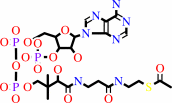 acetyl-CoA
|
=
|
N(6)-acetyl-L-lysyl-[protein]
|
+
|
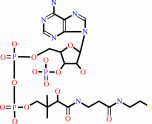 CoA
CoA
|
+
|
H(+)
|
|
|
|
|
|
|
|
|
|
|
|
|
Molecule diagrams generated from .mol files obtained from the
KEGG ftp site
|
|
|
|
|
|
|
|
|
|
|
|
|
|
 |
|
|
|
|
|
|
| |
|
|
| |
|
DOI no:
|
J Med Chem
59:3489-3498
(2016)
|
|
PubMed id:
|
|
|
|
|
|
| |
|
Identification and in Vivo Evaluation of Liver X Receptor β-Selective Agonists for the Potential Treatment of Alzheimer's Disease.
|
|
S.J.Stachel,
C.Zerbinatti,
M.T.Rudd,
M.Cosden,
S.Suon,
K.K.Nanda,
K.Wessner,
J.DiMuzio,
J.Maxwell,
Z.Wu,
J.M.Uslaner,
M.S.Michener,
P.Szczerba,
E.Brnardic,
V.Rada,
Y.Kim,
R.Meissner,
P.Wuelfing,
Y.Yuan,
J.Ballard,
M.Holahan,
D.J.Klein,
J.Lu,
X.Fradera,
G.Parthasarathy,
V.N.Uebele,
Z.Chen,
Y.Li,
J.Li,
A.J.Cooke,
D.J.Bennett,
M.T.Bilodeau,
J.Renger.
|
|
|
|
|
| |
ABSTRACT
|
|
|
|
| |
|
|
Herein, we describe the development of a functionally selective liver X receptor
β (LXRβ) agonist series optimized for Emax selectivity, solubility, and
physical properties to allow efficacy and safety studies in vivo. Compound 9
showed central pharmacodynamic effects in rodent models, evidenced by
statistically significant increases in apolipoprotein E (apoE) and ATP-binding
cassette transporter levels in the brain, along with a greatly improved
peripheral lipid safety profile when compared to those of full dual agonists.
These findings were replicated by subchronic dosing studies in non-human
primates, where cerebrospinal fluid levels of apoE and amyloid-β peptides were
increased concomitantly with an improved peripheral lipid profile relative to
that of nonselective compounds. These results suggest that optimization of LXR
agonists for Emax selectivity may have the potential to circumvent the adverse
lipid-related effects of hepatic LXR activity.
|
|
|
|
|
|
|
|
|
|
|
|
|
|
|
|
|
|
 |
 |
 |
|
|


 Links
Links


