 |
PDBsum entry 4zir

|
|
|
|
|
|

|

|

|

|
|

|
|

|
|

|
|

|
|

|
|
|
 |

|

|
|
|
|
|
|
|
|
|
|
|
|
|
|
|
|
|
|
|
|
|
|
|
|
|
|
|
|
|
|
|
|
|
|
Transport protein, hydrolase/inhibitor
|
PDB id
|
|
|
|
4zir
|
|
|
|
|
|
|
|
|
|
|
|
|
|
|

|

|

|
|
|
|
|
|
|
PDB id:
|
|
|
|
| Name: |
|
Transport protein, hydrolase/inhibitor
|
|
|
Title:
|
|
Crystal structure of ecfaa' heterodimer bound to amppnp
|
|
Structure:
|
|
Energy-coupling factor transporter atp-binding protein ecfa2. Chain: a. Synonym: ecf transporter a component ecfa2, tmecfa. Engineered: yes. Energy-coupling factor transporter atp-binding protein ecfa1. Chain: b. Synonym: ecf transporter a component ecfa1, tmecfa'.
|
|
Source:
|
|
Thermotoga maritima (strain atcc 43589 / msb8 / dsm 3109 / jcm 10099). Organism_taxid: 243274. Strain: atcc 43589 / msb8 / dsm 3109 / jcm 10099. Gene: ecfa2, ecfa, ecfa', tm_0222. Expressed in: escherichia coli bl21(de3). Expression_system_taxid: 469008. Gene: ecfa1, cbio, ecfa', tm_1663.
|
|
Resolution:
|
|
|
3.00Å
|
R-factor:
|
0.198
|
R-free:
|
0.247
|
|
|
Authors:
|
|
N.K.Karpowich,N.Cocco,J.M.Song,D.N.Wang
|
|
Key ref:
|
|
N.K.Karpowich
et al.
(2015).
ATP binding drives substrate capture in an ECF transporter by a release-and-catch mechanism.
Nat Struct Biol,
22,
565-571.
PubMed id:
DOI:
|
|
|
Date:
|
|
|
28-Apr-15
|
Release date:
|
10-Jun-15
|
|
|
|
|
|
|
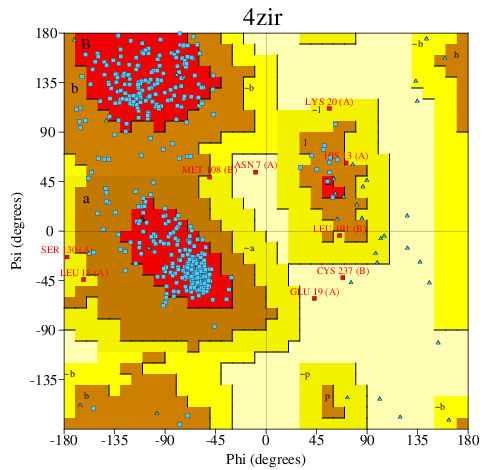
PROCHECK
|
|
|
|
|
|
Headers
|
|
|
|
References
|
|
|
|
|
|
|
|
|
|
|
|
|
|
|
|
 |
|
|
|
|
|
|
| |
|
DOI no:
|
Nat Struct Biol
22:565-571
(2015)
|
|
PubMed id:
|
|
|
|
|
|
| |
|
ATP binding drives substrate capture in an ECF transporter by a release-and-catch mechanism.
|
|
N.K.Karpowich,
J.M.Song,
N.Cocco,
D.N.Wang.
|
|
|
|
|
| |
ABSTRACT
|
|
|
|
| |
|
|
ECF transporters are a family of active transporters for vitamins. They are
composed of four subunits: a membrane-embedded substrate-binding subunit (EcfS),
a transmembrane coupling subunit (EcfT) and two ATP-binding-cassette ATPases
(EcfA and EcfA'). We have investigated the mechanism of the ECF transporter for
riboflavin from the pathogen Listeria monocytogenes, LmECF-RibU. Using
structural and biochemical approaches, we found that ATP binding to the EcfAA'
ATPases drives a conformational change that dissociates the S subunit from the
EcfAA'T ECF module. Upon release from the ECF module, the RibU S subunit then
binds the riboflavin transport substrate. We also find that S subunits for
distinct substrates compete for the ATP-bound state of the ECF module. Our
results explain how ECF transporters capture the transport substrate and
reproduce the in vivo observations on S-subunit competition for which the family
was named.
|
|
|
|
|
|
|
|
|
|
|
|
|
|
|
|
|
|
 |
 |
 |
|
|


 Links
Links


