 |
PDBsum entry 4z80

|
|
|
|
|
|

|

|

|

|
|

|
|

|
|

|
|

|
|

|
|
|
 |

|

|
|
|
|
|
|
|
|
|
|
|
|
|
|
|
|
|
|
|
|
|
|
|
|
|
|
|
|
|
|
|
|
|
|
Membrane protein
|
PDB id
|
|
|
|
4z80
|
|
|
|
|
|
|
|
|
|
|
|
|
|
|

|

|

|
|
|
|
|
|
|
PDB id:
|
|
|
|
| Name: |
|
Membrane protein
|
|
|
Title:
|
|
Crystal structure of toxoplasma gondii ama4 di-dii-egf1 in complex with a 33 aa tgron2l1 peptide
|
|
Structure:
|
|
Egf family domain-containing protein. Chain: a, b. Fragment: residues 58-553. Engineered: yes. Cytoadherence-linked asexual protein. Chain: c, d. Fragment: residues 1292-1324. Engineered: yes
|
|
Source:
|
|
Toxoplasma gondii. Organism_taxid: 5811. Gene: tgveg_294330. Expressed in: trichoplusia ni. Expression_system_taxid: 7111. Gene: tgveg_294400. Expressed in: escherichia coli. Expression_system_taxid: 511693. Expression_system_cell_line: bl21.
|
|
Resolution:
|
|
|
1.53Å
|
R-factor:
|
0.154
|
R-free:
|
0.172
|
|
|
Authors:
|
|
M.L.Parker,M.J.Boulanger
|
|
Key ref:
|
|
M.L.Parker
et al.
(2016).
Dissecting the interface between apicomplexan parasite and host cell: Insights from a divergent AMA-RON2 pair.
Proc Natl Acad Sci U S A,
113,
398-403.
PubMed id:
DOI:
|
|
|
Date:
|
|
|
08-Apr-15
|
Release date:
|
30-Dec-15
|
|
|
|
|
|
|
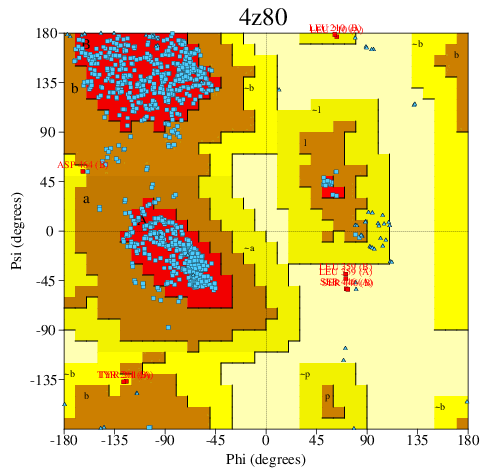
PROCHECK
|
|
|
|
|
|
Headers
|
|
|
|
References
|
|
|
|
|
|

|
|
S7UIL3
(S7UIL3_TOXGG) -
EGF family domain-containing protein from Toxoplasma gondii (strain ATCC 50853 / GT1)
|
|
|
|
Seq:
Struc:
|
|
|
|
1148 a.a.
466 a.a.
|
|

|

|
|
|
|
|
|
|
|
|
|
|
|
|
|
|
|
|
|
|
|
|
|
 |
|
|
|
|
|
|
| |
|
DOI no:
|
Proc Natl Acad Sci U S A
113:398-403
(2016)
|
|
PubMed id:
|
|
|
|
|
|
| |
|
Dissecting the interface between apicomplexan parasite and host cell: Insights from a divergent AMA-RON2 pair.
|
|
M.L.Parker,
D.M.Penarete-Vargas,
P.T.Hamilton,
A.Guérin,
J.P.Dubey,
S.J.Perlman,
F.Spano,
M.Lebrun,
M.J.Boulanger.
|
|
|
|
|
| |
ABSTRACT
|
|
|
|
| |
|
|
Plasmodium falciparum and Toxoplasma gondii are widely studied parasites in
phylum Apicomplexa and the etiological agents of severe human malaria and
toxoplasmosis, respectively. These intracellular pathogens have evolved a
sophisticated invasion strategy that relies on delivery of proteins into the
host cell, where parasite-derived rhoptry neck protein 2 (RON2) family members
localize to the host outer membrane and serve as ligands for apical membrane
antigen (AMA) family surface proteins displayed on the parasite. Recently, we
showed that T. gondii harbors a novel AMA designated as TgAMA4 that shows
extreme sequence divergence from all characterized AMA family members. Here we
show that sporozoite-expressed TgAMA4 clusters in a distinct phylogenetic clade
with Plasmodium merozoite apical erythrocyte-binding ligand (MAEBL) proteins and
forms a high-affinity, functional complex with its coevolved partner, TgRON2L1.
High-resolution crystal structures of TgAMA4 in the apo and TgRON2L1-bound forms
complemented with alanine scanning mutagenesis data reveal an unexpected
architecture and assembly mechanism relative to previously characterized
AMA-RON2 complexes. Principally, TgAMA4 lacks both a deep surface groove and a
key surface loop that have been established to govern RON2 ligand binding
selectivity in other AMAs. Our study reveals a previously underappreciated level
of molecular diversity at the parasite-host-cell interface and offers intriguing
insight into the adaptation strategies underlying sporozoite invasion. Moreover,
our data offer the potential for improved design of neutralizing therapeutics
targeting a broad range of AMA-RON2 pairs and apicomplexan invasive stages.
|
|
|
|
|
|
|
|
|
|
|
|
|
|
|
|
|
|
 |
 |
 |
|
| |


 Links
Links




















