 |
PDBsum entry 4w4z

|
|
|
|
|
|

|

|

|

|
|

|
|

|
|

|
|

|
|

|
|
|
 |

|

|
|
|
|
|
|
|
|
|
|
|
|
|
|
|
|
|
|
|
|
|
|
|
|
|
|
|
|
|
|
|
|
|
|
Transferase/transferase inhibitor
|
PDB id
|
|
|
|
4w4z
|
|
|
|
|
|
|
|
|
|
|
|
|
|
|

|

|

|
|
|
|
|
|
|
PDB id:
|
|
|
|
| Name: |
|
Transferase/transferase inhibitor
|
|
|
Title:
|
|
Structure of the epha4 lbd in complex with peptide
|
|
Structure:
|
|
Ephrin type-a receptor 4. Chain: a, b, c, d. Fragment: unp residues 29-204. Synonym: eph-like kinase 8,hek8,tyrosine-protein kinase tyro1, tyrosine-protein kinase receptor sek. Engineered: yes. Mutation: yes. Apy-bala8.Am peptide. Chain: e, f, g, h.
|
|
Source:
|
|
Homo sapiens. Human. Organism_taxid: 9606. Gene: epha4, hek8, sek, tyro1. Expressed in: escherichia coli. Expression_system_taxid: 562. Synthetic: yes. Synthetic construct. Organism_taxid: 32630
|
|
Resolution:
|
|
|
2.41Å
|
R-factor:
|
0.177
|
R-free:
|
0.241
|
|
|
Authors:
|
|
B.C.Lechtenberg,P.D.Mace,S.J.Riedl
|
|
Key ref:
|
|
I.Lamberto
et al.
(2014).
Development and structural analysis of a nanomolar cyclic peptide antagonist for the EphA4 receptor.
Acs Chem Biol,
9,
2787-2795.
PubMed id:
DOI:
|
|
|
Date:
|
|
|
15-Aug-14
|
Release date:
|
08-Oct-14
|
|
|
|
|
|
|
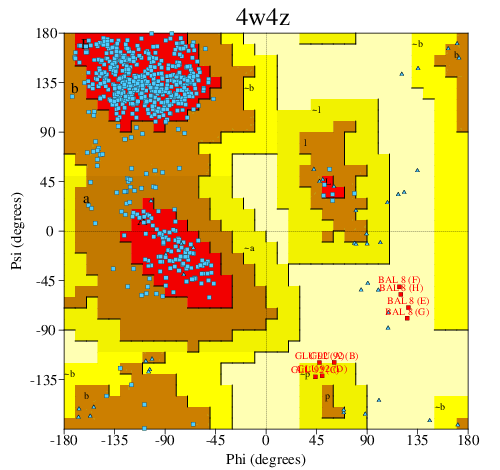
PROCHECK
|
|
|
|
|
|
Headers
|
|
|
|
References
|
|
|
|
|
|
|
|
|
|
|
|
Enzyme class:
|
|
Chains A, B, C, D:
E.C.2.7.10.1
- receptor protein-tyrosine kinase.
|
|
|
|
|
|
|
Reaction:
|
|
L-tyrosyl-[protein] + ATP = O-phospho-L-tyrosyl-[protein] + ADP + H+
|
|
|
|
|
|
L-tyrosyl-[protein]
|
+
|
 ATP
ATP
|
=
|
O-phospho-L-tyrosyl-[protein]
|
+
|
 ADP
ADP
|
+
|
H(+)
|
|
|
|
|
|
|
|
|
|
|
|
|
Molecule diagrams generated from .mol files obtained from the
KEGG ftp site
|
|
|
|
|
|
|
|
|
|
|
|
|
|
 |
|
|
|
|
|
|
| |
|
|
| |
|
DOI no:
|
Acs Chem Biol
9:2787-2795
(2014)
|
|
PubMed id:
|
|
|
|
|
|
| |
|
Development and structural analysis of a nanomolar cyclic peptide antagonist for the EphA4 receptor.
|
|
I.Lamberto,
B.C.Lechtenberg,
E.J.Olson,
P.D.Mace,
P.E.Dawson,
S.J.Riedl,
E.B.Pasquale.
|
|
|
|
|
| |
ABSTRACT
|
|
|
|
| |
|
|
The EphA4 receptor is highly expressed in the nervous system, and recent
findings suggest that its signaling activity hinders neural repair and
exacerbates certain neurodegenerative processes. EphA4 has also been implicated
in cancer progression. Thus, EphA4 inhibitors represent potential therapeutic
leads and useful research tools to elucidate the role of EphA4 in physiology and
disease. Here, we report the structure of a cyclic peptide antagonist, APY, in
complex with the EphA4 ligand-binding domain (LBD), which represents the first
structure of a cyclic peptide bound to a receptor tyrosine kinase. The structure
shows that the dodecameric APY efficiently occupies the ephrin ligand-binding
pocket of EphA4 and promotes a "closed" conformation of the
surrounding loops. Structure-guided relaxation of the strained APY β-turn and
amidation of the C terminus to allow an additional intrapeptide hydrogen bond
yielded APY-βAla8.am, an improved APY derivative that binds to EphA4 with
nanomolar affinity. APY-βAla8.am potently inhibits ephrin-induced EphA4
activation in cells and EphA4-dependent neuronal growth cone collapse, while
retaining high selectivity for EphA4. The two crystal structures of APY and
APY-βAla8.am bound to EphA4, in conjunction with secondary phage display
screens, highlighted peptide residues that are essential for EphA4 binding as
well as residues that can be modified. Thus, the APY scaffold represents an
exciting prototype, particularly since cyclic peptides have potentially
favorable metabolic stability and are emerging as an important class of
molecules for disruption of protein-protein interactions.
|
|
|
|
|
|
|
|
|
|
|
|
|
|
|
|
|
|
 |
 |
 |
|
|


 Links
Links


