 |
PDBsum entry 4ug9

|
|
|
|
|
|

|

|

|

|
|

|
|

|
|

|
|

|
|

|
|

|
|
|
 |

|

|
|
|
|
|
|
|
|
|
|
|
|
|
|
|
|
|
|
|
|
|
|
|
|
|
|
|
|
|
|
|
|
|
|
|
Oxidoreductase
|
PDB id
|
|
|
|
4ug9
|
|
|
|
|
|
|
|
|
|
|
|
|
|
|

|

|

|
|
|
|
|
|
|
|
|
Enzyme class:
|
|
E.C.1.14.14.47
- nitric-oxide synthase (flavodoxin).
|
|
|
|
|
|
|
Reaction:
|
|
3 reduced [flavodoxin] + 2 L-arginine + 4 O2 = 3 oxidized [flavodoxin] + 2 L-citrulline + 2 nitric oxide + 4 H2O + 5 H+
|
|
|
|
|
|
3
×
reduced [flavodoxin]
|
+
|
 2
×
L-arginine
2
×
L-arginine
|
+
|
 4
×
O2
4
×
O2
|
=
|
3
×
oxidized [flavodoxin]
|
+
|
 2
×
L-citrulline
2
×
L-citrulline
|
+
|
 2
×
nitric oxide
2
×
nitric oxide
|
+
|
4
×
H2O
|
+
|
5
×
H(+)
|
|
|
|
|
|
|
|
|
|
Cofactor:
|
|
5,6,7,8-tetrahydrobiopterin; Ferriheme b
|
|
|
|
|
|
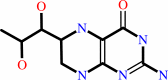 5,6,7,8-tetrahydrobiopterin
|
Ferriheme b
|
|
|
|
|
|
|
Molecule diagrams generated from .mol files obtained from the
KEGG ftp site
|
|
|
|
|
|
|
|
|
|
|
|
|
|
 |
|
|
|
|
|
|
| |
|
|
| |
|
DOI no:
|
Biochemistry
54:4075-4082
(2015)
|
|
PubMed id:
|
|
|
|
|
|
| |
|
Inhibitor Bound Crystal Structures of Bacterial Nitric Oxide Synthase.
|
|
J.K.Holden,
D.Dejam,
M.C.Lewis,
H.Huang,
S.Kang,
Q.Jing,
F.Xue,
R.B.Silverman,
T.L.Poulos.
|
|
|
|
|
| |
ABSTRACT
|
|
|
|
| |
|
|
Nitric oxide generated by bacterial nitric oxide synthase (NOS) increases the
susceptibility of Gram-positive pathogens Staphylococcus aureus and Bacillus
anthracis to oxidative stress, including antibiotic-induced oxidative stress.
Not surprisingly, NOS inhibitors also improve the effectiveness of
antimicrobials. Development of potent and selective bacterial NOS inhibitors is
complicated by the high active site sequence and structural conservation shared
with the mammalian NOS isoforms. To exploit bacterial NOS for the development of
new therapeutics, recognition of alternative NOS surfaces and pharmacophores
suitable for drug binding is required. Here, we report on a wide number of
inhibitor-bound bacterial NOS crystal structures to identify several compounds
that interact with surfaces unique to the bacterial NOS. Although binding
studies indicate that these inhibitors weakly interact with the NOS active site,
many of the inhibitors reported here provide a revised structural framework for
the development of new antimicrobials that target bacterial NOS. In addition,
mutagenesis studies reveal several key residues that unlock access to bacterial
NOS surfaces that could provide the selectivity required to develop potent
bacterial NOS inhibitors.
|
|
|
|
|
|
|
|
|
|
|
|
|
|
|
|
|
|
 |
 |
 |
|


 Links
Links


